
Missions and Resistance
Clip: 6/11/2026 | 6m 5sVideo has Closed Captions
How encroachment of the Spanish brought profound destruction to the First People's lives.
The encroachment of Spanish soldiers and missionaries in 1769 brought profound destruction to the First Peoples of Southern California life. Through archaeological evidence and Indigenous perspectives, this story examines the mission system and the Kumeyaay Nation’s resistance, including the burning of Mission San Diego in 1775.
Problems playing video? | Closed Captioning Feedback
Problems playing video? | Closed Captioning Feedback
Historic Places with Elsa Sevilla: California's History is a local public television program presented by KPBS
Missions and Resistance
Clip: 6/11/2026 | 6m 5sVideo has Closed Captions
The encroachment of Spanish soldiers and missionaries in 1769 brought profound destruction to the First Peoples of Southern California life. Through archaeological evidence and Indigenous perspectives, this story examines the mission system and the Kumeyaay Nation’s resistance, including the burning of Mission San Diego in 1775.
Problems playing video? | Closed Captioning Feedback
Where to Watch Historic Places with Elsa Sevilla: California's History
Historic Places with Elsa Sevilla: California's History is available to stream on pbs.org and the PBS app.
Providing Support for PBS.org
Learn Moreabout PBS online sponsorship- In the West, everything would change when the Spanish invaded Kumeyaay territory, bringing control, violence, and disruption to life, culture and identity.
What followed was not just colonialization, but a fight for survival.
And the Kumeyaay resisted from the start.
(wind gusting) (waves crashing) The Spanish arrived in Kumeyaay territory, what is now San Diego County and Northern Baja, California, in 1542.
But it would take another 227 years for them to return with soldiers and missionaries in 1769, this time, to stay.
They would build the first California mission and presidio in San Diego, marking the beginning of a system that would deeply disrupt life in the region.
- We're standing on a very special place for our people, and there was a village called Cosoy here.
And what it was really about was a fresh water spring, and that was really rare along the coast.
And it provided the Kumeyaay, as well as the Spanish, a fresh water source when they arrived.
- [Elsa] The village of Cosoy was at the foot of Presidio Hill near Old Town.
What followed was a mission system of control that reshaped daily life.
The Kumeyaay and other clans in the region were confined to imposed systems that restricted movement, replaced leadership, and enforced new ways of living.
Archeological evidence from Mission San Diego and The Presidio reveals the toll: malnutrition, forced labor, and lives disrupted under colonial rule.
- These bones showed signs of severe malnutrition.
These people were pushed constantly, with no breaks, you know, similar to a prisoner-of-war camp.
- [Elsa] This was part of a broader global pattern as empires expanded and imposed control over land, people, and resources at the expense of Indigenous Nations in North America.
For the Kumeyaay and neighboring clans, the impact was immediate and devastating.
- In that time, we lost so many of our storytellers and our elders that much of that story was lost.
So we spent so much time from then to now preserving what we have and also trying to reclaim what was once lost.
- [Elsa] But the first peoples, including the Kumeyaay, resisted from the start.
In 1775, the Kumeyaay burned Mission San Diego, an act of resistance against Spanish control.
The Mission was destroyed, but later rebuild.
Spain would continue its expansion, eventually building 21 missions across California.
At the same time, resistance was rising across the continent.
In the East Coast, fighting began in Lexington and Concord in 1775.
Colonists seeking independence and self-rule.
Two struggles in the same year, same land.
One led to independence in the East, the other continued colonization in the West.
- The Spanish wanted to spread the religion and have churches in different areas and convert the Kumeyaay.
- [Elsa] As the American Revolution unfolded from 1775 to 1783, the first peoples of Southern California, including the Kumeyaay, continued fighting for survival, land, and identity.
Their resilience and adaptability continued to carry them forward.
(tribal members singing in foreign language) Ethan Benegas from the Barona Band of Kumeyaay Indians and professor at San Diego State University is with us to talk about San Diego's history.
Ethan, can you tell us about the first encounter between the Kumeyaay people and the Europeans here in San Diego?
Was it peaceful?
- In April of 1769, Pedro Fages has arrives, and it's a small amount of people.
His soldiers had scurvy and they needed a fresh water supply.
Now, scurvy is a lack of vitamin C, so these folks had to quickly find nourishment, and the villagers of Cosoy provided that for them.
Six miles away from Ballast Point to Cosoy, you had the Kumeyaay leaders lead the Spanish to this freshwater spring, and essentially saved their life.
So this is a very similar, again, to kind of what happened on the East Coast with the Wampanoag and the pilgrims.
And we had an event just like that where there was this really a beautiful sign of generosity that saved the Spanish and allowed them to settle here.
- You talked about the mission and the presidio next to the village of Cosoy.
What were things that were discovered there during the excavation?
I believe there was two excavations by San Diego State University.
- These bones showed signs of severe malnutrition.
These people were pushed constantly, with no breaks, you know, similar to a prisoner-of-war camp.
And Sherburne Cook wrote a book in 1976 called "The Conflict Between White Civilization and the California Indian."
And in that book, using Mission records, he uncovered that the San Diego Mission had the least caloric intake out of all the missions, at 1,000 calories a day.
So for the kind of work they were doing at the mission, you would need at least 3,000 calories.
So they were deficient by at least 2,000 calories.
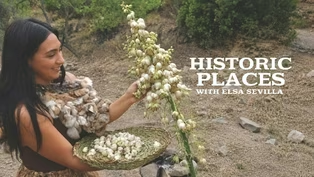
First Peoples of Southern California Preview
Video has Closed Captions
Coming 6/11 learn how the First Peoples of Southern California lived before the American Revolution. (30s)
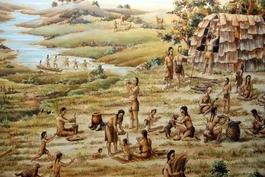
Video has Closed Captions
The First Peoples of Southern California face the beginning of colonization, marking a turning point (6m 32s)

Video has Closed Captions
The First Peoples of Southern California faced destruction of their territory and traditions. (6m 48s)
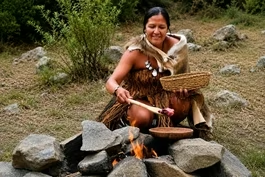
Video has Closed Captions
An intimate look at the First Peoples of Southern California before contact. (6m 35s)
Providing Support for PBS.org
Learn Moreabout PBS online sponsorship











Support for PBS provided by:
Historic Places with Elsa Sevilla: California's History is a local public television program presented by KPBS