
Global Forces Arrive
Clip: 6/11/2026 | 6m 32sVideo has Closed Captions
The First Peoples of Southern California face the beginning of colonization, marking a turning point
As European powers competed for land, wealth, and influence, the First Peoples of Southern California faced the beginning of colonization, marking a turning point that would forever change Indigenous life across California in 1769.
Problems playing video? | Closed Captioning Feedback
Problems playing video? | Closed Captioning Feedback
Historic Places with Elsa Sevilla: California's History is a local public television program presented by KPBS
Global Forces Arrive
Clip: 6/11/2026 | 6m 32sVideo has Closed Captions
As European powers competed for land, wealth, and influence, the First Peoples of Southern California faced the beginning of colonization, marking a turning point that would forever change Indigenous life across California in 1769.
Problems playing video? | Closed Captioning Feedback
Where to Watch Historic Places with Elsa Sevilla: California's History
Historic Places with Elsa Sevilla: California's History is available to stream on pbs.org and the PBS app.
Providing Support for PBS.org
Learn Moreabout PBS online sponsorship- As the Kumeyaay people thrived in balance, European powers were claiming territory across North America and beyond.
Along the East coast, new colonies seize land, setting in motion forces that would reshape entire regions as two worlds move forward on very different paths, - You gotta go higher in the center.
- [Elsa] The first peoples of Southern California lived in harmony with the land pre-contact, but across the Atlantic, powerful forces were building, as European nations fought for power, wealth, and control.
They looked to the West to expand into what they called the New World.
Now North America, where indigenous nations had long been in their territories, stewarding the land for millennia, - Those wars, those conflicts, Protestant versus Catholic, all of those things that were being played out in Europe for hundreds of years are now gonna manifest themselves in what was called the New World.
So each one of these people, each one of these cultures, these countries for nationalism, or for religion, want to get over to the New World and claim it for themselves as soon as possible.
- [Elsa] European powers began encroaching across North America.
Spain invaded what is now Mexico in 1519.
The French encroached on what is now Canada in 1534.
And Spain later occupied what is now Florida in 1565.
The English occupied what is now Jamestown in 1607 and Plymouth in 1620.
- So every European country with a navy, at least, France, England, Spain, Portugal, wanted their piece of the action.
If you were a Catholic nation, the Pope basically issued a bull, a bulletin, saying you have the right to do this.
It is the divine right what's called the right of discovery, so go forth.
- [Elsa] In 1542, Spanish ships arrived in Kumeyaay territory and what is now San Diego County and Northern Baja California.
They came with soldiers and claimed the land for Spain, marking the beginning of outside intrusion on the West coast.
- [Richard] Things got named here on our continent, new England, Nueva Espania.
It's a new Spain, it's a New England, new Bedford.
So in the British and the Spanish mind, this is just an extension of their relatively small countries when you look at the territory they're all about to claim.
- [Elsa] Across both coasts, the impact followed a familiar pattern.
Diseases killed thousands.
Land was taken.
Indigenous nations were forced into new systems.
Spain sought control and assimilation while Britain pushed expansion and displacement to take indigenous territory.
- For us, it was simply slavery and we have... I guess, we were allowed to leave sometimes, but not permanently because if you were baptized, you were then property of the Spanish crown and you could not leave.
So, say an Indian was baptized and try to leave permanently, these soldiers would come get 'em.
- [Elsa] These were not isolated events, but part of a larger pattern unfolding across North America.
European empires were driven by competition, power, and greed, overtaking indigenous nations.
Change was already underway, reshaping their world long before the American Revolution began.
With us is Richard Carrico, author and historian who will talk about Spanish colonialism and the impact on San Diego.
What happens in the very first days, weeks of that expedition arriving in San Diego?
- I always try to stress, you had two different agenda going on, if you will.
You had the military, which represented the crown and represented colonization and taking the land for the crown.
And then you had the Franciscan priest, in this case, father Sarah, and his goal and his motives are completely different.
His goal is to convert the tribes.
- They're religious goals.
- To the religious goal, and there was a lot of schism and a lot of fighting between the church and the crown and the military about funding, about who was in control of the tribes.
- So explain what was happening in Europe that initially started to create these migrations to North America.
- Those wars, those conflicts, Protestant versus Catholic, all of those things that were being played out in Europe for hundreds of years are now gonna manifest themselves in what was called the New World.
So each one of these people, each one of these cultures, these countries for nationalism or for religion, want to get over to the New World and claim it for themselves as soon as possible.
The Protestants that we know more about from most of our American history books at Jamestown, and Rowan Oak, and all of those places, again, they're not terribly interested in missionizing the tribes.
They want to control them and shove them out versus on the West coast and in Florida, the Spanish view, the Catholic view, is to bring the tribes in, to convert them, mix with them.
There was no no Spanish miscegenation law.
In fact, soldiers and others, mercantilists were encouraged to mate with local native women.
That's how you're gonna populate the world.
- What are some of those parallels between the East and West?
- The military out here was trying to build forts.
They built four presidios to keep the Russians, who are moving in from the north, and, potentially, the British away from California.
So it's about nationalism, it's about conquering land, it's about exploiting resources.
In Mexico, it was gold and silver.
On the East coast, it's to build forts and towns, let's say the British, to keep the Dutch out, to keep the French out, to keep the Spanish, who had this long ongoing thing in Florida and the Southeast.
A lot of people don't realize how Spanish the Southeast was at one time, right?
First Peoples of Southern California Preview
Video has Closed Captions
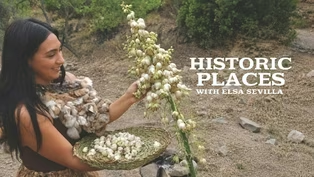
Coming 6/11 learn how the First Peoples of Southern California lived before the American Revolution. (30s)

Video has Closed Captions
The First Peoples of Southern California faced destruction of their territory and traditions. (6m 48s)
Video has Closed Captions
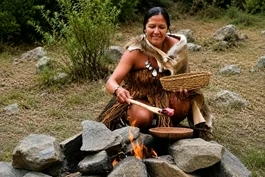
An intimate look at the First Peoples of Southern California before contact. (6m 35s)
Video has Closed Captions
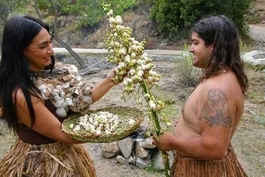
How encroachment of the Spanish brought profound destruction to the First People's lives. (6m 5s)
Providing Support for PBS.org
Learn Moreabout PBS online sponsorship











Support for PBS provided by:
Historic Places with Elsa Sevilla: California's History is a local public television program presented by KPBS