
Washington Week with The Atlantic full episode, 4/17/26
4/17/2026Video has Closed Captions
Washington Week with The Atlantic full episode, 4/17/26
Washington Week with The Atlantic full episode, 4/17/26
Problems playing video? | Closed Captioning Feedback
Problems playing video? | Closed Captioning Feedback
Major funding for “Washington Week with The Atlantic” is provided by Consumer Cellular, Otsuka, Kaiser Permanente, the Yuen Foundation, and the Corporation for Public Broadcasting.
Washington Week with The Atlantic full episode, 4/17/26
4/17/2026Video has Closed Captions
Washington Week with The Atlantic full episode, 4/17/26
Problems playing video? | Closed Captioning Feedback
Where to Watch Washington Week with The Atlantic
Washington Week with The Atlantic is available to stream on pbs.org and the PBS app.
Buy Now
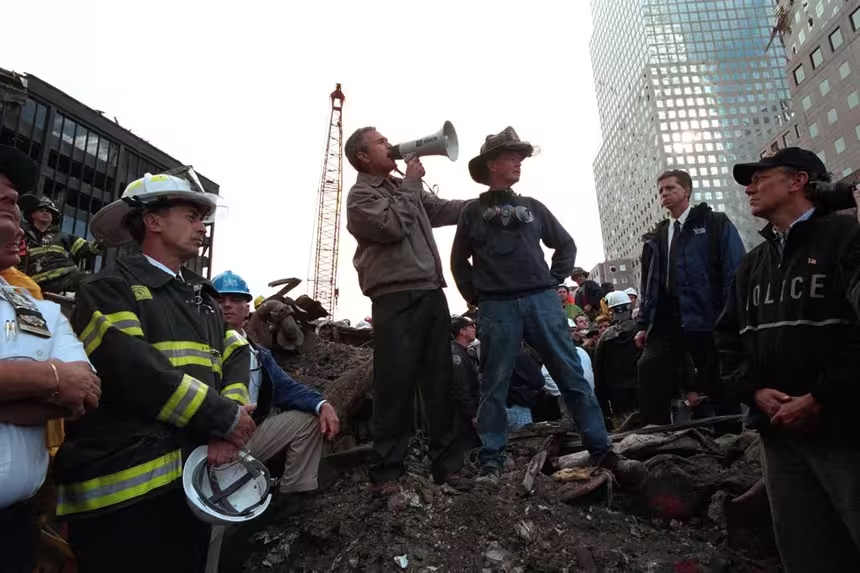
10 big stories Washington Week covered
Washington Week came on the air February 23, 1967. In the 50 years that followed, we covered a lot of history-making events. Read up on 10 of the biggest stories Washington Week covered in its first 50 years.Providing Support for PBS.org
Learn Moreabout PBS online sponsorshipJEFFREY GOLDBERG: You know it's a strange week when the governments of Israel and Lebanon seem to be getting along better than the 47th American president and the first American pope, but here we are.
The Strait of Hormuz is more or less open for the moment but the American blockade on Iranian shipping continues.
And since the only sure thing in the Middle East is sudden and dramatic change, no one knows what next week will bring.
I can safely predict, however, that in the coming days, President Trump will post something inflammatory on social media, next.
Good evening and welcome to Washington Week.
In the year 1076, Pope Gregory III excommunicated King Henry IV, the Holy Roman Emperor, who had challenged the authority of the church to appoint bishops.
Excommunication for Henry meant that his subjects would no longer be required to pledge their loyalty to him.
This put the emperor in a bit of a pickle, and he wound up standing in the snow barefoot for three days at Canossa begging the pope to forgive him.
I tell this story as a reminder that challenging the authority of popes has, on occasion, not worked out so well for temporal political leaders.
This doesn't mean that we're going to see Donald Trump barefoot in the Vatican anytime soon, but I am suggesting that fighting popes comes with special political risks.
Donald Trump has achieved what he's achieved to-date by being more rhetorically reckless, blunter, and more insulting than any president in history.
But are there limits?
I'll discuss this question and other questions with my panel tonight.
Leigh Ann Caldwell is the chief Washington correspondent for Puck.
Stephen Hayes is the editor of the Dispatch.
Jonathan Lemire is a staff writer at The Atlantic and a co-host of Morning Joe on MS NOW.
And Michael Scherer is a staff writer and a White House correspondent at the Atlantic.
Thank you all for joining me.
Before we talk about papal politics and Persian politics, I want to bring up a story that we just published at the Atlantic, FBI politics, I guess you could say.
Jon, you worked on this story with our colleague, Sarah Fitzpatrick, just posted story about Kash Patel's many problems as FBI director.
Can you give us a quick overview of what -- JONATHAN LEMIRE, Staff Writer, The Atlantic: Yes.
Sarah is the byline on this and did a terrific job.
It opens with an anecdote in early April where Kash Patel was locked out of the internal FBI systems and believed he had been fired and panically called allies and friends to say just that.
It turned out that was not the case.
It was a technical error.
But it underscores a couple of things here.
First of all, his job security perhaps not all that strong, but also it highlights to many his sort of erratic behavior in the post where he has people inside and outside of the Bureau have not looked too fondly about his performance, but also his behavior.
And the story gets into well-sourced multiple sources a number of times where he has been seen as drunk and drinking too much in excess, both in Las Vegas, and in Washington, including at a Las Vegas club called the Poodle Room.
In this case, what happened in Vegas did not stay in Vegas, as we have learned about it.
But most tellingly perhaps on multiple occasions and most seriously, his security detail could not reach him.
And once they even requested what is known as broaching equipment, i.e., which a SWAT team would use or a hostage rescue team would use in order to gain access to his room to wake him up.
JEFFREY GOLDBERG: Right.
They were worried about where is he, or is he okay.
Yes.
Well, we can talk about and we probably will be talking about Kash Patel in the coming weeks.
It's obviously tumultuous time generally at the Justice Department.
It's a tumultuous time everywhere.
And we will get papal politics.
I never thought I would say that on this show, but here we are, but I want to turn to the Strait of Hormuz.
Steve, the markets reacted well to the news that the strait seems to be open but the Iranian shipping is still being blocked by the U.S.
Navy.
Give us a state of play and what you expect to see unfold in the coming days.
STEPHEN HAYES, Editor, The Dispatch: Well, I'm not going to make any prediction because as you said in your open, it's pointless to make a prediction.
JEFFREY GOLDBERG: I was laying a track.
Nobody knew actually.
STEPHEN HAYES: Look, I mean, it's really hard.
I think it's a hard time to do what we do for a living right now, particularly reporting on Iran and the Trump administration.
I don't know if there are two other actors who have more of a recent history of saying things that just aren't true again and again and again and again.
And just tonight, before we came on, our main interlocutor in Iran accused Donald Trump of seven lies -- I think you said seven lies in his most recent post about the back and forth with Iran.
We don't know exactly what's going on.
Donald Trump has been very clear that he wants to keep the blockade.
He thinks the blockade is working.
I think there are reasons to surmise that the blockade is having some effect.
It seems to be putting pressure on the Iranians in power right now.
The Iranians have said that they are not opening the strait or they're dialing back and are open to changes if the U.S.
blockade continues.
I expect that we're likely to see this back and forth happen now, for as long as the ceasefire lasts, or maybe we'll end up cutting the ceasefire short.
JEFFREY GOLDBERG: Right.
There is no point in trying to predict.
Something interesting that -- so Israel and Hezbollah have agreed to a ceasefire.
Israeli leaders and Lebanese leaders are actually speaking, which is unusual.
But I think we got an indication that Trump is becoming bored or frustrated by the length and duration of this war.
He tweeted or put on Truth Social just earlier, a bit earlier, said, Israel is, quote, prohibited from striking Hezbollah from now on.
I've never seen an American president say to the Israelis or to an ally you are prohibited using that language from doing something.
It struck me in a week in which Democrats in the Senate showed a kind of remarkable coldness to the Netanyahu government in Israel.
I have to imagine that this Truth Social post for Netanyahu was quite a rude awakening, Michael.
MICHAEL SCHERER, Staff Writer, The Atlantic: Yes.
I mean, Netanyahu needs President Trump to back him later this year because he's going to be facing voters again.
And right now he's not very popular.
And if the war ends with the way it's ending now, I mean, his opposition in the country is going on the attack saying this Iran adventure effectively failed.
I think there's a peril, a political peril in the United States.
Trump is losing leverage.
He has great military leverage in the Gulf right now but he's losing political leverage.
I mean, he's saying to the American people right now, this is over, and it's not over.
He's on a campaign trip in Nevada and Arizona, you know, talking about no tax on tips and how, you know, your affordability issues are going to get better, but it doesn't look like that's the timeline the Iranians are working on.
JEFFREY GOLDBERG: Right.
Leigh Ann, generally speaking though, Donald Trump has had great success over the past ten years of telling people, oh, that problem that you think is a problem is no longer a problem, and then moving on to another subject sometimes by creating another crisis to supplant a crisis.
Is this going to be the same thing over and over again, or is this issue a little bit too big just to kind of distort out of the public eye?
LEIGH ANN CALDWELL, Chief Washington Correspondent, Puck: Yes, well, if past is precedent, then you know it's probably going to happen over and over again.
But with that said, I keep thinking about Greenland.
Remember the deal that was a beautiful framework for a future deal that no one has ever talked about or seen since then?
He's also -- the president is also very good at making it seem like he got a win when, in fact, nothing has changed.
So, that is the question.
But I think it's actually more complicated this time because you have all the regional factors in the Middle East who are very much wanting something specific to happen and very concerned about where this could go.
So, there's more players involved than just the president and the Iranians.
There's a lot of other people that could -- JEFFREY GOLDBERG: They're not going to go with his spin just because he says this has been a great success against Iran.
STEPHEN HAYES: And the American people will not accept that.
You know, there was a great moment in the first term after the House of Representatives passed the repeal and replace of Obamacare.
It was a huge ceremony at the White House.
The Marine Corps Band played.
President Trump called all the Republican leaders up.
They were very nervous about doing this.
And he had a victory celebration.
He said, this is the end of Obamacare.
The end of Obamacare is here.
He had a couple remarks from Paul Ryan and others.
It was a victory celebration.
And then Obamacare didn't go away and it didn't pass the Senate and it was a total disaster.
But he does this to distract.
I don't think he's going to be able to do this this time because gas prices aren't going to change.
If he tries to shape reality, you know, I think he thinks if he can create the perception, he can create the reality.
It won't work if you're still -- JEFFREY GOLDBERG: Two things people know, grocery prices, gasoline prices.
You can't fool people about those.
JONATHAN LEMIRE: You see them every day.
The gas prices are literally advertised on billboards on the side of most major American roads.
Ron Klain, Joe Biden's, first chief of staff would, has told me that when he would wake up each and every morning, the first thing he would do, even before seeing the president called, he would check the price of gas.
Do you know how important that is for the American psyche, how they feel about the economy?
And Trump -- look, Trump is really good about asserting his own reality.
He clearly was trying to do with that barrage of Truth Social posts today saying the Strait of Hormuz is open, and more or less saying the war is won, but Americans aren't going to buy it if things don't change and change soon.
And even if they do improve, the higher prices are going to remain for a while.
JEFFREY GOLDBERG: Right MICHAEL SCHERER: And it's not just that they have to change to something before the Iran war.
Before the Iran war, it was unacceptable to the American people.
So, he's been losing this argument for more than a year.
They said after the off-year elections last year that they were going to pivot to affordability, and they still haven't been able to do it.
JEFFREY GOLDBERG: I want to turn to ecclesiastical politics for a while.
And I want to be fair, I want to talk about something that J.D.
Vance said, which I thought was very interesting.
And I want fair here.
We live in the age of the enlightenment in which it is permissible and even encouraged to question religious authority and question religious doctrine.
And the world's Catholics obviously differ on many theological issues, but there is still something odd about the statement that J.D.
Vance made the other day.
Watch part of it.
J.D.
VANCE, U.S.
Vice President: When the pope says that God is never on the side of those who will the sword, there is a thousand-year -- more than a thousand-year tradition of just war theory, okay?
Now, we can, of course, have disagreements about whether this or that conflict is just, but I think that it's important in the same way that it's important for the vice president of the United States to be careful when I talk about matters of public policy, I think it's very, very important for the pope to be careful when he talks about matters of theology.
JEFFREY GOLDBERG: So, he's right, obviously.
There's Augustinian just war theory, thousand years of tradition and obviously doctrinal difference, and that's all true and actually intellectually interesting.
I was a little confused by the tone at the end, by telling the pope to be careful about how he discusses theology.
There was a temerity to it that I thought was misplaced to talk about this a little.
STEPHEN HAYES: Yes, temerity to it that I think we're accustomed to from J.D.
Vance.
I think it's fair and generous of you to suggest that he was making that more profound point about just war theory.
I mean, one of the four main points of just war theory is that you have to be fighting on behalf of a righteous cause.
J.D.
Vance opposed the war to Donald Trump, and he's out in public arguing in favor of it.
So, I think he's on shaky ground there.
The other thing he said in the very next sentence was that he advised the pope that when he talks about theology, he said, you've got to make sure it's anchored in the truth.
You just have to -- from JD Vance, who's the vice president to Donald Trump, this is the guy who said that, you know, they were eating pets in Ohio.
And when he was asked about that, said, if I have to create stories to get the American media to follow these things, that's what I'm going to do, this is the guy who's lecturing the pope on truth?
Temerity is a pretty good word for it.
JEFFREY GOLDBERG: Michael, take us a little bit through this.
How did this fight begin between the pope and the president?
MICHAEL SCHERER: Well, so Pope Leo for weeks has been steadily increasing his rhetoric of concern about what's happening in Iran.
You know, March 31st, he says he hopes that Trump is looking for an off-ramp.
Weeks later, he says the threat to the American -- or days later, the threat to the American people is unacceptable.
Then he comes out and says, God does not bless any conflict, which prompts, you know, that response.
That was actually in a tweet, which I think then prompts the president, because he can read a tweet, to release last Sunday a very long sort of blistering Truth Social post that essentially says -- you know, talks about the pope as if he's just another politician.
He's weak on crime, he's terrible on foreign policy.
I like his brother better.
I mean, that was basically the tone of it.
And, interestingly, the pope, rather than step back from that, has stepped up and has talked in even more aggressive terms.
He's on a trip to Africa right now about how, you know, the military leaders should not use religion to justify their actions, you know, sort of veiled reference what Pete Hegseth has been doing over at the Pentagon.
Catholic voters are a real swing group in this country.
There're not a lot of swing groups left in this country.
But, you know, Joe Biden won Catholics by like one point.
It was a 50-50 race in 2020.
Trump won Catholics by 12 points over Kamala Harris.
The world has sort of cited against Trump on this.
You had Meloni, the prime minister of Italy, coming out and saying, I really don't like what he's saying.
She's an ally of President Trump.
And then you had separately this week, this whole other scandal of the president throwing up an A.I.-generated image of himself as Jesus, which upset all his Evangelical followers.
So, Trump is not really operating -- he hasn't backed down.
He says he won't apologize, but he's not really operating from a position of strength.
JEFFREY GOLDBERG: Just to hear the pope directly, this is, I think, a quote that captures what he's trying to say over the last couple of weeks.
Let's listen to the pope.
POPE LEO XIV: The things that I say are certainly not meant as attacks to anyone.
And the vestige of the gospel is very clear, blessed are the peacemakers.
I will not shy away from announcing the message of the gospel for the ways to enjoy for anytime it's possible.
JEFFREY GOLDBERG: Leigh Ann, let's talk about this politically, alas.
It's one thing to attack senators, congressmen, governors.
It's another thing to pick a political fight with the pope.
On the Hill, what are people, Catholic and non-Catholic, what are they saying about this in terms of the political price that could be paid for having a fight with somebody you really can't beat in a kind of way?
LEIGH ANN CALDWELL: Well, Republicans are mostly defending the president here.
JEFFREY GOLDBERG: Including Catholic Republicans?
LEIGH ANN CALDWELL: Yes.
Speaker Mike Johnson is not Catholic, but he is extremely religious.
He says that the pope should not get involved in political discussions and political fights.
And, you know, Democrats obviously think that this is ridiculous and that the president is not a fight that he should be fighting.
But, politically, Republicans see the entire coalition, the Republican coalition, falling apart and they're extremely nervous about it.
He's upsetting Catholics.
He is upsetting -- the president is upsetting young voters who are moving away from the president.
Independents, absolutely in polling, are very unsatisfied with this president.
Women are not happy with the president and in some recent polling, even some men are -- he's underwater on men, or close to it.
So, this is really bad news for Republicans heading into the midterm elections when they're trying desperately to get the president focused on the economy.
I mean, we said that, you know, earlier that he was in Nevada and Arizona talking about no taxes on tips while this war was happening.
That's actually what the Republicans want him to be talking about.
Two days was a huge success in the eyes of Republicans that they were able to get him to focus on it, but they want a lot more of it, and they still think, despite all of this, that he is their best messenger.
JEFFREY GOLDBERG: Jon, how does he get out of this fight with the pope?
JONATHAN LEMIRE: His usual tactics don't work.
He only knows he only has one speed, and that's just to accelerate, to expand the fight.
He did get blowback from Republicans over the A.I.
image.
I think that is something that even -- JEFFREY GOLDBERG: The Jesus image.
JONATHAN LEMIRE: The Jesus image, yes.
Even Speaker Johnson felt that was inappropriate and it is so rare when he dares cross President Trump.
I mean, you know, for Trump, it would mean backing down.
He's sort of refused to do that.
But I think it also -- it comes in a week where he's just taking loss after loss after loss after loss.
Now, perhaps the Iran situation will turn around, as we all say, it's too soon to say and impossible to predict, but this is also a week where his best buddy in Europe, Viktor Orban, lost and lost big after Trump had endorsed him, after the vice president went to Budapest, the secretary of state was there earlier this year, Trump, on the eve of the election, said the U.S.
will invest in Hungary if Orban wins another term.
And the Hungarian voters not only said no, they said no resoundingly.
So, Trump's usual plays, as I wrote this week for The Atlantic, is not working right now.
JEFFREY GOLDBERG: Yes.
I mean, here's the example of what we're talking about.
This is the image that he posted.
And then Trump had a kind of incredible denial which we should listen to.
DONALD TRUMP, U.S.
President: It was me.
I did post it and I thought it was me as a doctor, and had to do with Red Cross, as a Red Cross worker there, which we support.
And only the fake news could come up with that one.
So -- JEFFREY GOLDBERG: A deeper question, what percentage of the country believes him when he says that he thought he was a doctor?
MICHAEL SCHERER: Oh, I don't think even his supporters believe that.
I mean, I don't think anybody's had a doctor with glowing ointment, you know, put on their heads.
But I think his supporters are willing to go along with it, which is a different point.
JEFFREY GOLDBERG: You've made Steve laugh.
STEPHEN HAYES: The robe, the white robe and the (INAUDIBLE).
JONATHAN LEMIRE: I think about who our health secretary is.
So, maybe, yes.
MICHAEL SCHERER: No.
But, honestly, like his supporters, like when he says things like that at this point, there's sort of like a meta narrative going on.
Everyone knows he's making that up.
And I think, you know, the question is whether you're happy he's sticking it again to the liberal media and calling them liars and are willing to go along with this trade, or whether you're actually, you know, upset about the truth.
That's what's he worried about.
STEPHEN HAYES: It wasn't anchored in truth, as J.D.
Vance might say.
JEFFREY GOLDBERG: I want to read you something that our Washington Week colleague Peter Baker wrote this week.
A series of disjointed, hard to follow and sometimes profane statements kept by his, a whole civilization will die tonight threat to wipe Iran off the map last week, and his head-spinning attack on the weak on crime and terrible for foreign policy pope on Sunday night, have left many with the impression of a deranged autocrat mad with power.
Now, we have all spent years in the media kind of dancing around subjects of mental stability, intellectual capability and so on.
I feel like this conversation is becoming a little bit more -- and Peter is not the most incautious journalist.
The New York Times is not the most incautious journalism institution in America.
Are we entering a new phase?
Was all this Jesus talk and fighting with the pope this week a sign that maybe we're entering a new phase in a discussion about Trump's capabilities?
JONATHAN LEMIRE: I think it's possible.
And when we got there with his predecessor, President Biden, whether his age, whether he was still up for the job, it became one of the defining storylines, of course, in 2024 with that debate, people have been dancing around it for a while now.
And, of course, the White House denies it.
They say he is up for the job.
They say, President Trump's always been like this, and in some ways he's always been like this.
But I do think it's -- what we've seen the last ten days, particularly the threat to wipe out a civilization, I think is raising questions for more and more Americans about his stability.
MICHAEL SCHERER: I think we're -- LEIGH ANN CALDWELL: I think that -- MICHAEL SCHERER: Go ahead.
LEIGH ANN CALDWELL: I was just going to say, I think that more than, you know, his mental capability right now, it's more the kind of drunk on power situation.
If Iran would have been successful, it's highly likely, I'm told by people close to him, that he already would've been in Cuba.
So, the successes that he feels like he has had over and over again is perpetuating this image of -- this God-like image, really, and I think that that is probably perhaps more than his mental capacity where the discussion is.
JEFFREY GOLDBERG: You raised it.
Do you think there's still a chance he will go into Cuba?
LEIGH ANN CALDWELL: I do.
I don't think that there's not a chance.
What's to say when he gets bored or when he moves on from Iran.
He has Marco Rubio, who -- this is something that he wants as well.
He has allies in the administration who want it.
So, we'll see.
JEFFREY GOLDBERG: Yes.
MICHAEL SCHERER: I think we're returning to the sort of erratic behavior of the first term.
The defining fact of this last year was there was this sort of missionary zeal across government and an amazing ability to get stuff done.
He was able to sort of remake a lot of the federal government.
He got big legislation through.
He had all these foreign conflicts.
We're now entering a stage where his ability to do any of that is severely diminished.
Like Congress is going to be basically locked, he's going to lose power.
He's going to have to fight for these midterm elections.
The polling is not good.
It's probably not going to get much better.
And his foreign ability to project power is basically been shown to have limits in a way it hadn't up to this point.
And so when that happens, he begins to act out.
And I think that's what we're entering again.
JEFFREY GOLDBERG: I'm still betting - - maybe you guys disagree with me, but I'm still betting that he comes back to the Greenland subject as well, because it always -- everything spins back around, yes.
But, Steve, let me we'll end with you on this.
I guess there's two questions.
One, is he diminishing in capabilities or in self-restrained?
And the second question is, are we in the media, in the political class, generally, if not on the MAGA side, going to be more -- do you anticipate people being more frank about what we're seeing?
This Jesus moment and the fight with the pope really struck me as well.
This is a new level.
STEPHEN HAYES: I don't think it's a different Donald Trump.
I think this is who Donald Trump has always been.
We've seen moments of intensity, like we're seeing right now, and we've seen moments when it wanes.
JEFFREY GOLDBERG: Well, we'll be talking about this again.
I don't know how much we're going to be talking about papal politics in the future, but we very well might be.
We very well might be.
LEIGH ANN CALDWELL: They should debate.
Donald Trump and Pope Leo should debate.
JEFFREY GOLDBERG: Well, thank you for watching Vatican Week.
We're going to have to leave it there.
And I want to thank our guests for joining me, and I want to thank you at home for watching us.
To read our latest investigation into why Kash Patel's behavior is raising red flags of the FBI, please visit theatlantic.com.
I'm Jeffrey Goldberg.
Goodnight from Washington.
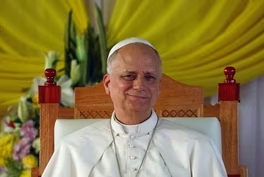
How will Trump get out of his fight with Pope Leo?
Video has Closed Captions
How will Trump get out of his fight with Pope Leo? (13m 49s)
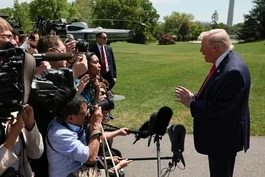
Iran war reality undercuts Trump's messaging
Video has Closed Captions
Iran war reality undercuts Trump's messaging (9m 19s)
Providing Support for PBS.org
Learn Moreabout PBS online sponsorship New Episode
- News and Public Affairs

Top journalists deliver compelling original analysis of the hour's headlines.

- News and Public Affairs

FRONTLINE is investigative journalism that questions, explains and changes our world.

 New Episode
 New Episode
 New Episode
 New Episode
 New Episode
 New Episode


Support for PBS provided by:
Major funding for “Washington Week with The Atlantic” is provided by Consumer Cellular, Otsuka, Kaiser Permanente, the Yuen Foundation, and the Corporation for Public Broadcasting.