
November 9, 2023 - PBS NewsHour full episode
11/9/2023 | 57m 46sVideo has Closed Captions
November 9, 2023 - PBS NewsHour full episode
Thursday on the NewsHour, Israel's military pushes deeper into Gaza as negotiations for humanitarian pauses and hostage releases become increasingly urgent. Then, Republican presidential hopefuls make their case to voters in the latest debate, but remain far behind the absent frontrunner, Donald Trump. Plus, Senate Democrats seek to expand their probe into ethics concerns on the Supreme Court.
Problems playing video? | Closed Captioning Feedback
Problems playing video? | Closed Captioning Feedback
Major corporate funding for the PBS News Hour is provided by BDO, BNSF, Consumer Cellular, American Cruise Lines, and Raymond James. Funding for the PBS NewsHour Weekend is provided by...
Support provided by:

November 9, 2023 - PBS NewsHour full episode
11/9/2023 | 57m 46sVideo has Closed Captions
Thursday on the NewsHour, Israel's military pushes deeper into Gaza as negotiations for humanitarian pauses and hostage releases become increasingly urgent. Then, Republican presidential hopefuls make their case to voters in the latest debate, but remain far behind the absent frontrunner, Donald Trump. Plus, Senate Democrats seek to expand their probe into ethics concerns on the Supreme Court.
Problems playing video? | Closed Captioning Feedback
How to Watch PBS News Hour
PBS News Hour is available to stream on pbs.org and the free PBS App, available on iPhone, Apple TV, Android TV, Android smartphones, Amazon Fire TV, Amazon Fire Tablet, Roku, Samsung Smart TV, and Vizio.
Providing Support for PBS.org
Learn Moreabout PBS online sponsorshipAMNA NAWAZ: Good evening.
I'm Amna Nawaz.
GEOFF BENNETT: And I'm Geoff Bennett.
On the "NewsHour" tonight: Israel's military pushes deeper into Gaza as negotiations for humanitarian pauses and hostage releases become increasingly urgent.
AMNA NAWAZ: Republican presidential hopefuls make their case to voters in the latest debate, but remain far behind the absent front-runner, Donald Trump.
GEOFF BENNETT: And Senate Democrats seek to expand their probe into Supreme Court ethics concerns after reports that some justices received undisclosed gifts.
SEN. SHELDON WHITEHOUSE (D-RI): If it happened in any other court in the United States, it would have been investigated, there would have been fact-finding, and there would have been a result and consequences.
It's only the Supreme Court that is living outside the bounds of the rules.
(BREAK) GEOFF BENNETT: Welcome to the "NewsHour."
With tens of thousands of civilians still fleeing the heavy fighting in Northern Gaza, Israel agreed today to open a second route south and pause fighting for a few hours each day.
AMNA NAWAZ: Late today, President Biden says Israel has a -- quote -- "obligation" to distinguish between terrorists and civilians and follow international law.
Leila Molana-Allen reports.
LEILA MOLANA-ALLEN: As Israeli ground forces push deeper into Gaza, a rare look inside the northern strip showed abandoned neighborhoods scarred by battle.
It also gave clues about how Hamas operates.
The IDF claims they found these weapons in a workshop under an apartment building.
MAN (through translator): You can see a pink dresser and a little girl's bed in a residential home.
LEILA MOLANA-ALLEN: A few floors above, this bedroom appears to have belonged to young girls.
Israel says it's evidence that Hamas hides within and behind the civilian population.
YOAV GALLANT, Israeli Defense Minister (through translator): This entire city is one big terror base.
There are miles of tunnels underground.
They connect to hospitals, to schools.
LEILA MOLANA-ALLEN: Now the IDF is closing in on Gaza City's Al Shifa Hospital.
It claims Hamas' main command center is located underneath, which Hamas and hospital staff deny.
DR. MUHAMMAD ZAQOUT, Director General, Gaza Hospitals: See, we have many patients placed here.
LEILA MOLANA-ALLEN: Inside Al Shifa are Gaza's most vulnerable.
The director general of Gaza's hospitals, Dr. Mohammed Zaqout, sent the "NewsHour" this video earlier this week.
DR. MUHAMMAD ZAQOUT: It's overwhelmed with the huge number of patients here.
LEILA MOLANA-ALLEN: It's overflowing with people injured by Israeli airstrikes, and thousands of civilians taking shelter in what they hope is a safe zone.
Tens of thousands of Palestinians have already fled the northern part of strip via a humanitarian corridor along Gaza's main highway.
The White House announced today that Israel agreed to another corridor along Gaza's coast, where there will be daily four-hour humanitarian pauses in the bombing.
Also today, it's been reported that mediators are trying to negotiate a three-day pause in fighting in exchange for a dozen hostages held by Hamas.
President Biden confirmed this morning that he asked Israeli Prime Minister Benjamin Netanyahu for the swap, but gave no details.
QUESTION: Did you ask him to pause for three days to get the hostages out?
JOE BIDEN, President of the United States: Yes.
I have asked for even a longer pause for some of them.
LEILA MOLANA-ALLEN: And Hamas announced today it's ready to release an elderly woman and a young boy for humanitarian reasons, but said no deal had been made yet with Israel.
In France, world leaders gathered today for a Gaza aid conference.
EMMANUEL MACRON, French President (through translator): And we worry about the humanitarian situation in Gaza.
LEILA MOLANA-ALLEN: The host, French President Emmanuel Macron, appealed to Israel to protect the innocent.
EMMANUEL MACRON (through translator): Civilians must be protected.
And this is absolutely vital.
It's not negotiable.
Its also a condition for the effectiveness of our fight against violence.
LEILA MOLANA-ALLEN: Others were more direct, like Prime Minister of the Palestinian Authority Mohammad Shtayyeh.
MOHAMMAD SHTAYYEH, Palestinian Prime Minister (through translator): How many Palestinians must be killed for the war to stop?
What Israel is doing is not waging war against Hamas, but against the whole Palestinian people.
LEILA MOLANA-ALLEN: The people of Gaza need help more than ever.
On top of Israel's constant aerial bombardment, the World Health Organization warns, disease is spreading rapidly.
Some, like the Kullab family, have chosen to move back to their bombed homes after staying in shelters.
JIHAN KULLAB, Gaza Strip Resident (through translator): My home is completely destroyed.
Look at the damage we live in.
I couldn't stand living surrounded by people, diseases, in hospitals, on the streets, so I came back to my home here.
LEILA MOLANA-ALLEN: Like most other families in Gaza now, they live without electricity or running water and with barely any food.
While some aid is entering the strip each day, the U.N. says it's just a drop in the ocean of need.
For the "PBS NewsHour," I'm Leila Molana-Allen in Tel Aviv.
GEOFF BENNETT: In the day's other headlines: Former President Trump's legal team asked a judge in New York to end his civil fraud trial immediately.
Defense lawyers argued that prosecutors failed to prove that Mr. Trump, family members, and his company deceived banks and insurers with inflated financial statements.
The judge did not immediately rule, but he indicated the defense will start its case on Monday.
The man accused of attacking former House Speaker Nancy Pelosi's husband went on trial today, with opening statements in San Francisco.
David DePape faces federal charges of assaulting Paul Pelosi with a hammer after breaking into the family's house last year.
He also allegedly tried to kidnap the speaker, but she wasn't home at the time.
Close calls at the nation's airports were front and center at a Senate hearing today.
One animation showed a cargo plane coming in for a landing just 100 feet over a passenger plane that was taking off last February in Austin, Texas.
The nation's top safety investigator called it a clear warning sign that increased air traffic and staffing shortages are taking a toll.
JENNIFER HOMENDY, Chair, National Transportation Safety Board: Air traffic controllers are being required to do mandatory overtime, and what happens with mandatory overtime?
You -- it ends up leading up to fatigue and distraction, which is exactly what we're seeing as part of these incident investigations.
GEOFF BENNETT: The FAA plans meetings at 16 airports before the end of the year to focus on improving safety.
More than two dozen labor unions are calling for an industry-wide investigation of driverless cars.
They wrote to the Transportation Department and the National Highway Traffic Safety Administration today.
The letter said driverless vehicles are -- quote - - "unsafe and untenable in their current form.
This industry is in dire need of federal regulation."
Just yesterday, GM's Cruise unit recalled 950 driverless cars after a crash in California.
FBI Director Christopher Wray says there's a potential conflict of interest in selecting a location for the bureau's new headquarters.
That's after the general services administration chose Greenbelt, Maryland.
The Associated Press reports Wray sent an e-mail today saying a GSA executive picked land owned by a former employer.
The GSA insisted the process was strictly aboveboard.
In Pakistan, schools, stores and parks in Lahore have started a four-day closure as toxic smog stifles the city.
Authorities say the heavy gray haze has made tens of thousands of people sick.
The smog is largely due to farmers burning crop waste at the start of the winter wheat planting season.
On Wall Street, stocks retreated as interest rates advanced on the bond market.
The Dow Jones industrial average lost 220 points to close below 33892.
The Nasdaq fell 129 points.
The S&P 500 gave up 35.
And Tracy Chapman's folk anthem "Fast Car" is a winner again 35 years after its release.
It took song of the year last night at the Country Music Association Awards.
The tune gained new popularity thanks to a chart-topping cover by Luke Combs.
He called it one of the greatest songs of all time.
Chapman is the first Black woman ever to win a CMA Award.
Still to come on the "NewsHour": the Screen Actors Guild agrees to a deal to end a strike that has crippled Hollywood; the top Hamas representative in Tehran discusses relations with Iran and the attack on Israel; and how the risks from climate change are disproportionately affecting people with disabilities.
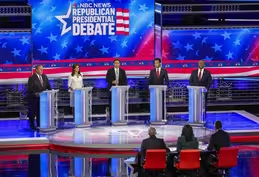
AMNA NAWAZ: Five Republican presidential candidates took the stage in Miami last night for the third debate of the primary.
Missing from the stage once again was former President Donald Trump.
Political correspondent Lisa Desjardins takes a deeper look at the divides in the party over policies abroad and at home.
LISA DESJARDINS: Perhaps it was the moderators.
LESTER HOLT, NBC Anchor: Good evening.
everyone.
Welcome to the Republican presidential debate.
LISA DESJARDINS: Or perhaps the smaller number of candidates, five, who made the stage.
LESTER HOLT: And, to our audience, please, please hold your applause.
LISA DESJARDINS: But, in Miami, Republican presidential candidates cut down the interruptions and raised the substance level, especially on foreign policy.
GOV.
RON DESANTIS (R-FL): We will stand with Israel in word and in deed, in public and in private.
LISA DESJARDINS: Candidates echoed support for Israel and calls to wipe out Hamas.
NIKKI HALEY (R), Presidential Candidate: As I said, finish them.
Finish them.
SEN. TIM SCOTT (R-SC), Presidential Candidate: As president of the United States, my foreign policy is simple.
You cannot negotiate with evil.
You have to destroy it.
LISA DESJARDINS: Early on, businessman Vivek Ramaswamy aimed to cast Florida Governor Ron DeSantis and former U.N.
Ambassador Nikki Haley as out-of-touch warmongers.
VIVEK RAMASWAMY (R), Presidential Candidate: Do you want a leader from a different generation who's going to put this country first?
Or do you want Dick Cheney in three-inch heels, in which case we've got two of them on stage tonight?
LESTER HOLT: All right, Mr. Ramaswamy... LISA DESJARDINS: Haley was ready.
NIKKI HALEY: Yes, I'd first like to say they're five-inch heels, and I don't wear them unless you can run in them.
(CHEERING AND APPLAUSE) LISA DESJARDINS: The two quickly moved into a deeper debate over the Ukraine war.
Ramaswamy echoed a Russian argument about separatist areas.
VIVEK RAMASWAMY: These are Russian-speaking regions that have not even been part of Ukraine since 2014, and other people probably couldn't name those provinces for you.
Those are the hard facts.
And so, to frame this as some kind of battle between good versus evil, don't buy it.
LISA DESJARDINS: But many who speak Russian in those regions still identify as Ukrainian.
Haley fired back.
NIKKI HALEY: I am telling you, Putin and President Xi are salivating at the thought that someone like that could become president.
We all know that half-a-million people have died because of Putin, and here is a freedom-loving, pro-American country that is fighting for its survival and its democracy.
LISA DESJARDINS: Former Governor Chris Christie added another theme, Iran.
FMR.
GOV.
CHRIS CHRISTIE (R-NJ), Presidential Candidate: Iran is in the middle of this as well, and so is North Korea, and they are all working to support Russia right now.
And the reason they're doing it is because dictators work together.
People who believe in democracy work together.
LISA DESJARDINS: South Carolina Senator Tim Scott went further.
SEN. TIM SCOTT: If you want to stop the 40-plus attacks on military personnel in the Middle East, you have to strike in Iran.
LISA DESJARDINS: China and Chinese technology also arose, as Ramaswamy attacked Haley for her adult daughter's use of TikTok.
VIVEK RAMASWAMY: She made fun of me for actually joining TikTok, while her own daughter was actually using the app for a long time.
So, you might want to take care of your family first before preaching to anybody else.
NIKKI HALEY: Leave my daughter out of your voice.
LISA DESJARDINS: There were a host of issues.
The border.
SEN. TIM SCOTT: We should go to our Southern border and close our Southern border with the resources necessary.
LISA DESJARDINS: Fentanyl and addiction.
FMR.
GOV.
CHRIS CHRISTIE: We're going to call this what it is.
It is a disease, like heart disease, diabetes, or any other disease, like cancer, that can be treated, should be treated.
LISA DESJARDINS: And Social Security.
While Haley is open to raising retirement ages, Scott and DeSantis were not.
GOV.
RON DESANTIS: When life expectancy is declining, I don't see how you could raise it the other direction.
LISA DESJARDINS: Missing from the stage was the front-runner of the field, former President Donald Trump.
AUDIENCE: We want Trump!
We want Trump!
We want Trump!
LISA DESJARDINS: He held his own show, a rally nearby, where he bragged about the 91 felony charges he faces.
DONALD TRUMP, Former President of the United States (R) and Current U.S. Presidential Candidate: But every time I'm indicted, I consider it a great badge of honor, because I'm being indicted for you.
Thanks a lot, everybody.
I appreciate it.
(CHEERING AND APPLAUSE) LISA DESJARDINS: At the debate, Christie raised the counts as disqualifying for Trump.
FMR.
GOV.
CHRIS CHRISTIE: Anybody who's going to be spending the next year-and-a-half of their life focusing on keeping themselves out of jail and courtrooms cannot lead this party or this country.
LISA DESJARDINS: Others tiptoed into Trump criticism.
NIKKI HALEY: I think he was the right president at the right time.
I don't think he's the right president now.
GOV.
RON DESANTIS: And Donald Trump's a lot different guy than he was in 2016.
He owes it to you to be on this stage and explain why he should get another chance.
LISA DESJARDINS: Woven in, the fight over Republican identity and this week's election losses.
VIVEK RAMASWAMY: We have become a party of losers, at the end of the day.
There's a cancer to the Republican establishment.
LISA DESJARDINS: The Republican establishment has decisions to make.
The best chance any of these candidates has to beat Trump is for the others to drop out, fast.
For the "PBS NewsHour," I'm Lisa Desjardins.
AMNA NAWAZ: While Republicans are focusing on a crowded presidential field, Democrats are facing a new challenge to their majority in the Senate.
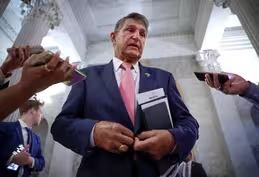
Democratic Senator from West Virginia Joe Manchin announced today that he will not be seeking reelection next year, raising the stakes in the Democrats' battle to maintaining power in the Upper Chamber.
Lisa Desjardins is here with me in the studio for more.
Lisa, good to see you.
LISA DESJARDINS: Hi.
AMNA NAWAZ: So what do we know?
Why is Manchin leaving the Senate now?
LISA DESJARDINS: Well, Manchin sent out a video statement today.
And in that, he said this was one of his hardest decisions of his life, but that, in his heart of hearts, in his quotes, he feels that he has done what he came to do for West Virginia, and it essentially is time for him to leave.
Now, as you say, this is an issue for Democrats potentially.
He's 76 years old, and he is the last statewide elected Democrat in the state of Virginia, a Kennedy Democrat.
That's sort of been part of his political identity is the kind of Kennedy era.
And now they have to figure out, can anyone, any other Democrat win that seat?
Joe Manchin himself, of course, didn't -- almost didn't win last time.
He just won by three points.
AMNA NAWAZ: Well, his announcement, for those who listen to it, didn't exactly sound like a goodbye.
He's been asked previously, too, if he would run for president.
He didn't rule it out.
Do we know?
Is he running?
LISA DESJARDINS: Right.
I think that part of the calculus here is he would have a challenging time trying to become a senator.
My sources close to Senator Manchin tell me that he's opening the door, let's say, to a presidential run.
He plans on traveling around the country.
And here's what he said in his video today.
SEN. JOE MANCHIN (D-WV): I will not be running for reelection to United States Senate, but what I will be doing is traveling the country and speaking out to see if there is an interest in creating a movement to mobilize the middle and bring Americans together.
LISA DESJARDINS: A movement to mobilize the middle or potentially nominate Joe Manchin as an independent candidate for president.
This is not yet a presidential run, but it is some sort of exploration.
There is also a real question here, I think, for Joe Manchin.
Are there centrists in this country anymore?
Is there a viable political momentum that can be galvanized for moderates, for centrists?
He's not the only centrist trying to do this.
He's a Democrat.
And we're going to see his schedule coming up.
We will see exactly where he thinks the middle of the country lives.
AMNA NAWAZ: One to watch, for sure.
The meantime, what does it mean for the balance of power in the Senate and for the fight ahead in 2024?
LISA DESJARDINS: Lots of discussion about this today around Washington and around the entire country.
So let's just start by explaining -- reminding viewers that, right now, our U.S. Senate has 51 Democrats and 49 Republicans.
So let's say Manchin's seat, as it is expected now, goes Republican, 50/50.
So let's look at the rest of the map for next year's Senate elections.
We have got 34 seats up for grabs.
And if you look at this map, you can see there aren't a lot of -- there are several Democratic seats that are going to be tough.
Montana, light blue, that's Jon Tester.
That might be tough to hold.
Look at that yellow seat.
That's Kyrsten Sinema in Arizona and also yellow in Ohio.
That's Sherrod Brown.
Those are three seats.
Democrats have to run the table basically to keep all three of those seats.
And a reminder, Kyrsten Sinema is no longer a Democrat.
She's an independent.
There's another Democrat trying to run for that seat.
All of this is to say it is even more uphill now for Democrats to keep control of the Senate.
Not impossible, but this makes it harder.
AMNA NAWAZ: Lisa Desjardins covering it all, thank you so much.
LISA DESJARDINS: You're welcome.
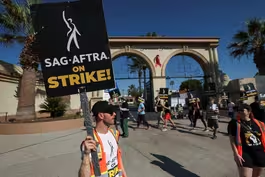
GEOFF BENNETT: The actors union SAG-AFTRA has reached a tentative deal with the Hollywood studios, ending the longest strike for TV and film actors in history.
The deal, worth more than $1 billion, includes new levels of minimum compensation, bonuses tied to streaming and the first protections against artificial intelligence.
SAG-AFTRA president Fran Drescher joins us now.
Welcome back to the "NewsHour."
FRAN DRESCHER, President, SAG-AFTRA: Thank you.
I'm happy to be here.
GEOFF BENNETT: You have described this as an historic agreement.
In what ways?
FRAN DRESCHER: Well, we -- first of all, we broke through the billion-dollar mark, so that's a crowning achievement.
And we developed protections and language and consent and compensation in the area of artificial intelligence that never existed before.
We broke a brand-new stream of revenue for people on the streaming platforms that never existed before.
So that's additional money.
We broke pattern with the other two unions, the WGA and the DGA.
So we got more minimum wage growth than they did, which is unusual and unprecedented.
And we got an amazing deal for our lowest-earning members, who are our background performers.
We got all kinds of new things that have never been in the contract before, because of the way we -- the digital age has impacted our industry.
So, even when it comes to auditions and interviews on home self-tapes, that has to be redefined.
And we're still working on that, but at least we got some improvements there for those people, because everything needed to have regulations put into it.
People don't do the right thing unless they're forced to.
And as Frederick Douglass said, power concedes nothing without demands.
So, we -- that's what this was all about.
We knew it was a historic time because of the digitization of our industry, and we knew that we needed a seminal deal.
And I feel very proud to say we got one.
GEOFF BENNETT: A question about streaming, because, as I understand it, the union had to compromise fairly significantly on streaming.
The union wanted 1 or 2 percent of revenue of streaming shows and ultimately settled for less.
Tell us more about that compromise.
FRAN DRESCHER: Well, we settled for different, more than for less, because that was -- first, we identified that there was a very real problem between this new model of exhibition and how it could never be properly compensated for with the old contract.
GEOFF BENNETT: If I can ask, what's a model of exhibition?
FRAN DRESCHER: Oh, well, like the streaming platforms, the shows that show on streaming.
That means that, if your show is made for a streaming platform, you're never going to get the kind of residuals that you would if you were on, let's say, network television.
GEOFF BENNETT: Right.
FRAN DRESCHER: Because there's not a -- you don't get paid in the same way with reruns.
You don't have syndication money.
And so our members were feeling that, as more and more shows were getting produced on streaming platforms.
So the actual structure of the contract had to change.
And they were reticent to do it.
And I said to their faces, I want you to understand why this is important, because maybe you don't.
And then, after I tell you this, I want you to understand that this is a deal-breaker.
And so I think that they really understood that.
They -- I was being very honest with them.
GEOFF BENNETT: As this deal reached the finish line, artificial intelligence remained one of the most complicated issues to resolve.
How do these new protections benefit actors?
FRAN DRESCHER: Well, when you start out in an environment where they don't have to ask your permission, and now they have to, that's a huge difference.
That speaks volumes.
That means that you're in control of your likeness.
You're in control of if you want to be duplicated, if you want some kind of a synthetic version of you on screen.
And that puts a lot of control back into the performer's hands, because the performer's likeness, the performer's performance, everything that makes them, them, I think that there was quite a bit of back-channeling to get the messaging across that, without this, we're going to protract the strike.
It's as simple as that, because, in A.I., three months is equivalent to a year.
So, without the protections that we absolutely felt we needed, there was no way that we were going to sign a three-year contract, because, three years from now, the whole idea of it is going to be a completely different animal.
And if we don't put a saddle on that wild pony now and pull in the reins, we're never going to be able to catch it.
GEOFF BENNETT: This deal comes 118 days, nearly four months after the strike started.
I was going to ask you, was it worth the wait?
It seems like the answer to that, from your point of view, is yes.
But I will rephrase the question differently.
Could you have arrived at this deal any earlier, or did it just take time for people to test the leverage points that they thought they had?
FRAN DRESCHER: Well, I think that there was a lot of that.
First of all, when you -- from the beginning, I think that they needed to adjust to the fact that we are a union that was at a point where we had the largest strike authorization in our history.
And the leadership, meaning myself and Duncan Crabtree-Ireland, were new to them in our roles, and we were no pushovers, and we were not going to be intimidated.
So, once they had that rude awakening, then there had to be adjustments.
They walked away from the table at one point, but that intimidation tactic did not work for us.
And then they would take a week, at least, before they'd come back with even a supposal, let alone a counter, once they did come back.
And then, on my side, patience -- patience and time is the secret sauce.
And we never felt a need to rush in order to come to a conclusion of what needed to happen.
And, as a result of that, we remained in unity.
And, as a result of that, when we finally got that last piece of A.I.
in place and the last piece needed for the streaming platform new revenue source, then we were ready to make a motion and pass without objection.
And that is what happened.
And that, in itself, is historic.
GEOFF BENNETT: Fran Drescher is the president of the actors union SAG-AFTRA.
Thanks so much for your time.
FRAN DRESCHER: Thank you.
I appreciate it.
AMNA NAWAZ: One of the largest financial backers and supporters of Hamas is Iran.
And although the Biden administration has said no intelligence shows that Iran approved or green-lit the October 7 Hamas attacks on Israel, the relationship between Iran and Hamas is strong and lasting.
Our special correspondent in Tehran Reza Sayah sat down with the top Hamas representative to Iran for a rare interview.
REZA SAYAH: At the annual government-organized rally in Tehran this week to mark the anniversary of the 1979 seizing of the U.S. Embassy, the chant that has long echoed in the Islamic Republic, "Death to America."
And among the featured speakers leading those chants in fluent Farsi was a man who is neither Iranian nor a follower of Shia Islam, Iran's state religion.
Where did you learn how to speak Farsi?
KHALED AL-QADDUMI, Hamas Representative in Iran: I have been in Iran for 10 or 12 years.
REZA SAYAH: For much of those 12 years, Kuwaiti-born Palestinian Khaled Al-Qaddumi has served as the permanent representative of Hamas in Tehran, a post that underscores the Islamic Republic's close ties with the Sunni Islamist and militant movement designated by the U.S., the European Union and others as a terrorist organization.
Many people don't know that Hamas has an office here.
What does your day look like?
What do you do?
KHALED AL-QADDUMI: Yes.
Well, I mean, we have a representation office over here.
We deal with all decision-makers, organizations over here.
We talk to the people.
We work with them in cultural activities, political activities.
Iran is a big brother to us.
They have supported the Palestinian issue even much before creation of Hamas.
They extended their support to the whole Palestinian from the beginning, since the beginning.
REZA SAYAH: Relations between Iran and Hamas frayed during the Syrian war, when Hamas backed its fellow Sunni Syrian rebels and stood against Tehran's Shia militias and Syrian President Bashar al-Assad.
In 2017, the two reconciled under the shared view that Israel is not a legitimate state.
Today, Hamas officials openly praise Iran's military and financial support that, according to the U.S. State Department, has reached $100 million a year.
Soon after the October 7 attacks, there was speculation in Washington and beyond that Tehran helped plot the assault that Hamas calls the Al-Aqsa Flood.
Tehran and Hamas deny the Islamic Republic was involved.
Many believe that Hamas would not launch this attack without support, without a green light.
Who gave Hamas the green light?
KHALED AL-QADDUMI: That's a very strange question.
Hamas is a deep-rooted organization in the Palestinian arena.
We have gained the trust of our people in the field.
Of course, we defended our people a long time ago in the First Intifada, Second Intifada.
The Al-Aqsa Flood was a pure, transparent, signed Palestinian operation.
REZA SAYAH: Did you know what was going to happen?
KHALED AL-QADDUMI: No.
Many of my seniors, they didn't.
In general lines, we are in coordination with Iran and Hezbollah, with the components of the resistance axis.
REZA SAYAH: Increasingly, Russia is emerging as another key supporter of Hamas.
Late last month, Moscow hosted delegates from Hamas and the Islamic Republic.
Moscow says the meeting was to discuss the release of Russian hostages.
But some speculate that Russia has other motivations.
There's a number of geopolitical conflicts.
One of them is the Russian-Ukrainian conflict.
Russia is one of your supporters.
Some are starting to say, perhaps Russia wouldn't mind delivering a blow to the United States, to Washington.
KHALED AL-QADDUMI: I mean, I need to remind you over here and your audience that, as Israel have friends, we have also friends.
I mean, I feel that it's the duty of our friends, allies and the freedom, rational voices in the world to support our struggle against colonial powers of Israeli.
So, if we say that Russia and President Putin is supporting us, that is very much rational and logic.
REZA SAYAH: So did Russia have any role?
(CROSSTALK) KHALED AL-QADDUMI: No, no, no.
But we were a couple of days ago over there in Moscow, and we received good reception from them with the authorities over there, and we chatted over many, many things.
I mean, they were very warm.
And they are friends.
REZA SAYAH: These days, Qaddumi gets plenty of warm receptions at government-organized events in Tehran, where he criticizes the Israeli government's bombing campaign of Gaza, its occupation of Palestinian land, and defends the October 7 terror attacks that killed more than 1,000 civilians in Israeli towns bordering Gaza.
You say the occupation and the illegal settlements are the root cause of this conflict.
You say Israel is to blame, but I have to ask you, how did the attacks of October 7 help resolve these issues?
KHALED AL-QADDUMI: See, the attack of 7 of October is a very reaction to the big action of occupation.
Sometimes, you do it with a stone, and, sometimes, you do it with effective rockets that's shaken the Israeli army.
And now you have awakened the international community that Palestine is not to be wasted.
And then, for us, when the so-called peaceful solution is exhausted and the peace process did -- failed, and we are in a cul-de-sac, then the -- it is a legitimate, integral right to the people who are living under occupation to defend themselves with all possible means.
Hence, nobody should ask us why we have started this thing.
REZA SAYAH: You believe the media oftentimes dehumanizes Hamas, sometimes dehumanizes the Palestinian people.
And here you have the October 7 attacks, where innocent civilians were attacked.
How do you reconcile that?
KHALED AL-QADDUMI: Well, see, when you talk to me, it doesn't mean that you agree to what I am saying.
So, this is what I am simply asking.
REZA SAYAH: What are you asking?
You want to be heard.
KHALED AL-QADDUMI: Yes.
REZA SAYAH: So I'm listening to you.
I'm here.
You're talking to an American audience, who've seen some horrific images.
Tell the American people what Hamas plans to do to end the fighting, to end the bloodshed.
KHALED AL-QADDUMI: Hamas is looking for the justice, and they are adapting a right... REZA SAYAH: Be specific.
What can you do right now?
KHALED AL-QADDUMI: And I'm telling you, I'm telling you, we are adapting the right which has been granted for the masses, for the nations.
REZA SAYAH: The right to fight back.
KHALED AL-QADDUMI: The right to fight back, the right to defend ourselves.
REZA SAYAH: So you're suggesting the conflict is going to continue?
KHALED AL-QADDUMI: Unless and until we are getting our own rights.
REZA SAYAH: Be specific.
KHALED AL-QADDUMI: Yes.
REZA SAYAH: What do you want to happen immediately?
KHALED AL-QADDUMI: Lifting the siege, releasing 7,000-plus prisoners.
They are our heroes.
They are not criminals.
Many of them, they are within -- without any fair trial.
Finishing the occupation and many things.
We can draft it.
But I'm telling you, I mean, you are asking something which is not fair, because it's always me as... (CROSSTALK) REZA SAYAH: No, no, no, it's not.
I have you now.
I have you now.
So, I'm just... KHALED AL-QADDUMI: I am the victim.
The bottom line, that Palestinians are living under occupation.
We have two ways, only two ways.
Either international community make Israel pay the tax of independence of the Palestinians, or we will do it our own self.
REZA SAYAH: What Hamas decides to do from here is a daunting open question.
What is clear is that Hamas is committed to an unprecedented level of violence in its war with Israel, and standing firmly behind them is the Islamic Republic of Iran.
For the "PBS NewsHour," I'm Reza Sayah in Tehran.
GEOFF BENNETT: A series of reports this year about several conservative Supreme Court justices accepting free trips and failing to disclose them has prompted renewed efforts by Senate Democrats to implement a code of ethics for the High Court.
Democrats on the Senate Judiciary Committee intend to subpoena Republican megadonor Harlan Crow and conservative legal activist Leonard Leo as part of their investigation.
A planned vote on those subpoenas was postponed today.
Democratic Senator Sheldon Whitehouse of Rhode Island chairs the Subcommittee on Federal Courts, and he joins us now.
Welcome to the "NewsHour."
SEN. SHELDON WHITEHOUSE (D-RI): Good to be with you.
Thanks for having me on.
GEOFF BENNETT: So, as we mentioned, the committee was expected to vote on those two subpoenas today, but hit a roadblock.
What happened?
SEN. SHELDON WHITEHOUSE: The Republicans are desperate not to have to vote on this.
And so, last night, they filed nearly 90 amendments, and that meant that all of our members had to review overnight 90 separate amendments, all of them intended to be poisonous, and try to figure out, like, what our joint response was going to be.
In effect, they jammed the gears of the committee with an avalanche of bad faith amendments.
And so that stopped things today.
But the resolve of the committee to vote out the subpoenas is fixed and firm, and it's just a matter of rescheduling.
And now that we know that that's the strategy, we can prepare for it.
GEOFF BENNETT: Well, what information are you seeking with these subpoenas to Mr. Crow and Mr. Leo?
Does the investigation extend beyond what you see as a need to implement a code of ethics?
And the reason I ask the question is because I have watched your Senate floor speeches... SEN. SHELDON WHITEHOUSE: Yes.
GEOFF BENNETT: ... the series called The Scheme.
SEN. SHELDON WHITEHOUSE: Yes.
GEOFF BENNETT: And you seem to allude to underlying tax crimes.
What's your theory of the case?
SEN. SHELDON WHITEHOUSE: First of all, we need to know what all these conservative justices have been receiving.
ProPublica and other news reports have done a very good job of bringing out some things, but it's not clear that we know all of it.
We also need to develop information about how systemic this was.
This isn't just random gift here and a random gift there.
It's always the same individuals, the same front groups.
It's -- there's a network effect here that we need to understand.
And then the Finance Committee, separately, is looking at the tax side for several reasons.
First of all, were these gifts declared as income, if they should have been?
And if the donor declared them as a business expense, how do you get away with claiming that it's personal hospitality?
And if it's a gift, there are also gift tax considerations once you get over $17,000.
So it looks like the reporting failures aren't just violations of the disclosure laws.
They may also be violations of the tax laws.
GEOFF BENNETT: On this matter of Justice Thomas accepting gifts and luxury trips, what do you say to those who might make the argument Harlan Crow can spend his money however he sees fit?
And if Justice Thomas is eating canapes off the back of Harlan Crow's mega-yacht, whether he does that or not, it's not going to change the fact that he is a conservative vote and voice on the Supreme Court.
SEN. SHELDON WHITEHOUSE: The issue is probably not Harlan Crow.
I don't see that Harlan Crow is in trouble for any of this, unless false statements were filed of some kind.
But we have no indication of that.
The problem is on the court side.
Supreme Court justices, like other judges, have an obligation to file disclosures that show what gifts and emoluments and so forth they have received.
And that legal obligation, a law passed by Congress, is implemented by the Judicial Conference, a body created by Congress for that purpose, among others.
So we need to look into whether those laws are being properly implemented by the Judicial Conference should these big gifts have been disclosed, and how do the arguments that they didn't need to be disclosed fare when shone to the light of day?
And my contention is, the arguments fare terribly when shone to the light of day.
The gifts should have been disclosed.
And, potentially, because of the systematic nature of these gifts and the repeated nature of these gifts, there may be a good deal more to this than just come on my yacht and have a nice afternoon.
GEOFF BENNETT: So you're saying that Congress does have a role here, because Justice Alito, as I'm sure you know, says that Congress does not have the authority to implement a code of ethics on the Supreme Court, says there's nothing in the Constitution that calls for it.
SEN. SHELDON WHITEHOUSE: Yes, that was weird.
GEOFF BENNETT: In what ways?
SEN. SHELDON WHITEHOUSE: Well, it was weird in several ways.
First, it was weird in that he's wrong.
Second, it was weird in that he offered it as an opinion in The Wall Street Journal editorial page, as opposed to in a Supreme Court opinion.
And we're told every time they come before us, oh, we couldn't possibly comment on that, Senator, because we're not allowed to offer opinions on matters that might come before the court.
Here's a matter headed for the court, and he offered an opinion on it.
And the sort of final salvo here is that, when there have been previous episodes of potential improper gifts, those issues have been referred to the Judicial Conference under the disclosure laws.
And the Supreme Court has never objected to it.
When Harlan Crow gave his first round of yacht and jet travel gifts to Justice Thomas, that question was referred to the Judicial Conference and addressed under these disclosure laws.
So to say that we have no role here is in flat conflict with the facts and the history of what has already taken place in similar matters.
With the Supreme Court's full consent.
GEOFF BENNETT: You and Senator Durbin, who now chairs the Judiciary Committee, have been calling for an enforceable code of conduct for more than 10 years.
SEN. SHELDON WHITEHOUSE: Yes.
GEOFF BENNETT: There was a letter that was issued 11 years ago.
And we know, just based on public reporting and public comments, that Justices Kagan, Kavanaugh, and Coney Barrett have publicly vote -- voiced support.
SEN. SHELDON WHITEHOUSE: And Roberts himself, yes.
GEOFF BENNETT: So what's the holdup?
SEN. SHELDON WHITEHOUSE: I think the holdup is probably Thomas and Alito, who seem to be the ones with their hands furthest in the cookie jar, who probably don't want any further inquiry into that, and who seem to be liking billionaire-funded lifestyles of the rich and famous.
GEOFF BENNETT: There are Republicans who say this entire effort, this entire enterprise is aimed at defanging the Supreme Court's conservative supermajority as it moves jurisprudence to the right.
What do you say to that?
SEN. SHELDON WHITEHOUSE: Well, I think they're wrong.
First of all, you mentioned the letter that began 11 years ago, before this had taken place.
So the timing doesn't work.
Second, set all the drama aside and all the noise.
What you have is billionaires with a demonstrated pattern of trying to influence the Supreme Court through a whole variety of groups by giving donations and participating, who are at the same time also giving enormous, massive, secret gifts to justices.
Just on its face, that merits investigation.
And if it happened in any other court in the United States, it would have been investigated.
There would have been fact-finding, and there would have been a result and consequences.
It's only the Supreme Court that is living outside the bounds of the rules.
And if they were not living outside of the bounds of the rules, then we'd have probably a separate fight over the merits of the decisions that they're making.
But that doesn't change the fact that they're operating right now, some of them, outside of the rules.
GEOFF BENNETT: In the time that remains, I want to get your reaction to West Virginia Democratic Senator Joe Manchin announcing today that he's not running for reelection in 2024.
At a minimum, it's going to be difficult, if not impossible, for Democrats to hold onto that seat in deep red West Virginia.
SEN. SHELDON WHITEHOUSE: Yes, I think that probably puts an extra seat on the table for Mitch McConnell, and that means we have to fight particularly hard to win in Texas and defeat Ted Cruz... GEOFF BENNETT: Is that possible?
SEN. SHELDON WHITEHOUSE: ... and to -- it seems so.
We were very close last time.
And I think we have got a very, very good candidate in Colin Allred, a good Texan football star, local hero, very talented member of Congress.
So I think that's good.
And we also just -- it puts extra pressure on us to make sure we hold the other Democratic seats.
GEOFF BENNETT: Senator Sheldon Whitehouse of Rhode Island.
SEN. SHELDON WHITEHOUSE: Good to be with you.
GEOFF BENNETT: Thanks so much for coming in.
AMNA NAWAZ: As the planet warms, scientists say natural disasters are becoming more destructive and more frequent.
And data shows certain communities are hit harder than others.
Judy Woodruff reports from Florida on the disproportionate impact on people with disabilities.
It's part of our series Disability Reframed.
JUDY WOODRUFF: By the time Hurricane Ian left a trail of destruction in Fort Myers, Florida, last September, 61-year-old Lynne Bitzinger had already been without permanent housing for five years.
LYNNE BITZINGER, Hurricane Survivor: 2017, Hurricane Irma, it wiped us out.
A tree was put through my roof on my mobile home.
I ended up with mold, water running down my walls.
Up to that point, the storms were just an event.
At that point, the storms became cruel.
Everything in my home was gone.
JUDY WOODRUFF: Bitzinger, who's been in several car accidents and suffers from spinal damage, uses a scooter and a Walker to get around.
She also cares for her friend Dennis Vaughn, a 73-year-old Vietnam veteran with critical illnesses and post-traumatic stress disorder.
As Ian approached, the two huddled in a Fort Myers motel.
LYNNE BITZINGER: I was on the first floor in an ADA room, and when the water started surging, we had to escape to safety.
I have never seen water like I saw.
Everything was underwater.
Our cars were underwater.
And I looked up and I said: "God, I'm in trouble here.
I need an Ark."
JUDY WOODRUFF: They eventually made it to a higher floor.
But it would be months before they had a permanent place to live.
Bitzinger's new mobile home was delayed, in part, because it needed a ramp and other modifications for her disability.
She has lived through hurricanes in Florida for decades.
She navigated unaccommodating shelters and complicated disaster recovery.
She says those tasked with helping residents in these storms don't pay enough attention to the needs of people like her and Dennis.
LYNNE BITZINGER: I would like people to stop ignoring the need.
JUDY WOODRUFF: The challenges can be particularly acute in Florida, a state with more natural disasters than almost anywhere in the country and where more than 4.5 million people -- that is more than a quarter of the adult population - - have a disability.
Travis Taylor is with the Center for Independent Living, Gulf Coast.
He helped Bitzinger get a new scooter after hers was damaged during Ian.
Taylor distributed food and supplies to residents after the storm.
He also went into shelters to make sure they complied with the Americans With Disabilities Act.
He found cluttered aisles, residents unable to reach staff, and a shortage of accessible restrooms.
TRAVIS TAYLOR, Center for Independent Living Gulf Coast: Just listening to the stories of individuals that had gone through the hurricane, nothing is ever going to be the same here in Lee County.
All we can do is learn and be prepared for before, during, and after the hurricanes, because it's not if it is going to happen again; it's when.
JUDY WOODRUFF: As climate change worsens, with extreme weather events becoming more severe and frequent nationwide, the disability community is sounding the alarm.
Research shows people with disabilities are up to four times more likely to die in disasters than the general population.
And, according to U.S. census data released in January, most people with disabilities never return to their homes after a disaster.
About 70 percent of deaf evacuees lived in unsanitary conditions for a month post-disaster, compared to just 7 percent of those with hearing.
And three-quarters of people who couldn't walk experienced a lack of food, compared to just 9 percent of those who could walk.
JUSTICE SHORTER, Disability Advocate: For me, that data was simply affirmation.
JUDY WOODRUFF: Justice Shorter is a Washington, D.C.-based blind disability activist who also advocates for racial and environmental justice.
An expert on emergency management, she's heard countless stories about what people face before, during, and after natural disasters.
JUSTICE SHORTER: First, getting even access to information is a hurdle.
Let's say your local officials tell you, go on our Web site to find more information to be able to track the storm, track what's going on.
We will send out information via our Web site.
When you go on that Web site, it's completely inaccessible.
In terms of sheltering, right, so many shelters have been deemed accessible, when they simply are not.
How soon the debris is moved from the side of the road, because other people might have been coming back, but they're also gutting their homes and doing that on or near the sidewalk.
That might not be a huge inconvenience, unless you need to use the sidewalk to safely navigate.
JUDY WOODRUFF: Overlaying so much of this, Justice, is this is this message that people with disabilities may be hearing that, well, we're doing everything we can, but we can't take care of everybody.
The question is, where does that leave individuals with disabilities?
JUSTICE SHORTER: When we say we can't save everybody, when we say that every disaster is going to bring about a number of acceptable losses, when we use phrases like that, what we are truly saying is, individuals with disabilities will die, and we just have to deal with it.
JUDY WOODRUFF: In 2005, Hurricane Katrina killed more than 1,800 people.
In hard-hit New Orleans, over 70 percent of the deaths were among people age 60 and older, and most of them had medical conditions or disabilities that increased their vulnerability.
In Katrina's aftermath, Congress mandated the Federal Emergency Management Agency, or FEMA, appoint a coordinator to help people with disabilities through disasters.
Sherman Gillums Jr., a former Marine, took over that job in August 2022.
He's worked to get FEMA's disability experts to disasters faster, and has visited multiple hurricane and tornado sites himself.
SHERMAN GILLUMS JR., Disability Coordinator, Federal Emergency Management Agency: We went from a response model to a proactive, we do the planning.
We don't wait until the disaster matures to a point there are a lot of problems we have to fix.
So, if We're averting problems, there's no need to be there as long or have as many people because we are laying down better plans.
JUDY WOODRUFF: But criticism of FEMA persists.
Lynne Bitzinger said she jumped through many hoops with the agency, only to be denied housing assistance.
She also complained about a lack of communication and underqualified staff.
SHERMAN GILLUMS JR.: I accept that criticism because we want to make sure that nobody comes out of a disaster feeling that way.
I don't listen for good news.
I'm listening for the areas where we may not get a do-over, but we can a do-better.
JUDY WOODRUFF: And Gillums agrees with activist Justice Shorter that improving conditions for those with disabilities requires their input and that authorities take them seriously.
JUSTICE SHORTER: People with disabilities are still not meaningfully included in every phase of disaster management and planning.
We are pushed to the side as a kind consideration.
So, we are doing you a favor by listening to you, disability community, and we need you to spend extensive amount of time, labor telling us all of the things that we need to do, and then we will go back and decide whether or not and how we go about doing that.
And I'm saying there has to be a fundamental shift in how that process works.
JUDY WOODRUFF: Part of that shift, advocates say, must come in the long-term planning for climate change.
Last year, a report from McGill University and the International Disability Alliance found governments worldwide largely ignored people with disabilities in their climate mitigation and adaptation work.
It said less than a third of countries who signed the landmark 2015 Paris climate agreement even mentioned people with disabilities in their long-term plans.
LYNNE BITZINGER: It would be really awesome if people would start to see a little bit of the struggle.
JUDY WOODRUFF: For her part, Lynne Bitzinger has considered leaving Florida and its devastating storms behind.
LYNNE BITZINGER: I have thought of moving, but where am I going to move to?
JUDY WOODRUFF: She says she can't help but wonder, is there anywhere she'd be truly safe from the effects of climate change?
For the "PBS NewsHour," I'm Judy Woodruff in Fort Myers, Florida.
GEOFF BENNETT: And there is more coverage online, including a story about the struggles to keep childcare facilities open now that pandemic funding is dwindling.
That's at PBS.org/NewsHour.
AMNA NAWAZ: And join us again here tomorrow night, where we will have a look at the little-known story of the nation's first two Black generals.
That's the "NewsHour" for tonight.
I'm Amna Nawaz.
GEOFF BENNETT: And I'm Geoff Bennett.
Thanks for spending part of your evening with us.

How climate change impacts people with disabilities
Video has Closed Captions
How climate change risks impact people with disabilities (9m)

Israel pushes deeper into Gaza amid negotiations for aid
Video has Closed Captions
Israel's military pushes deeper into Gaza amid negotiations for humanitarian pauses (4m 37s)
Manchin won't seek reelection, creating new hurdle for Dems
Video has Closed Captions
Manchin won't seek reelection, creating a new challenge for Democrats' Senate majority (3m 30s)

News Wrap: Trump's legal team asks judge to end civil trial
Video has Closed Captions
News Wrap: Trump's legal team asks judge to end New York civil trial (3m 50s)
Republican presidential hopefuls make their case to voters
Video has Closed Captions
Republican presidential hopefuls make their case to voters but remain far behind Trump (4m 45s)
Screen Actors Guild agrees to a deal to end strike
Video has Closed Captions
Why the Screen Actors Guild agreed to end a strike that crippled Hollywood (8m 24s)
Senate Democrats try to expand probe on Supreme Court ethics
Video has Closed Captions
Senate Democrats expand their probe over ethics concerns on the Supreme Court (8m 27s)

Top Hamas official discusses Israel attack, Iran relations
Video has Closed Captions
Top Hamas official in Tehran discusses relations with Iran and the attack in Israel (8m 39s)
Providing Support for PBS.org
Learn Moreabout PBS online sponsorship
- News and Public Affairs

FRONTLINE is investigative journalism that questions, explains and changes our world.

- News and Public Affairs

Amanpour and Company features conversations with leaders and decision makers.












Support for PBS provided by:
Major corporate funding for the PBS News Hour is provided by BDO, BNSF, Consumer Cellular, American Cruise Lines, and Raymond James. Funding for the PBS NewsHour Weekend is provided by...