
Flint water crisis 10 years later, Small Business Workshop
Season 52 Episode 19 | 26m 46sVideo has Closed Captions
A decade after the Flint water crisis and a preview of the 2024 Small Business Workshop.
Host Stephen Henderson talks with current Flint Mayor Sheldon Neeley about the 10-year anniversary of the Flint water crisis. Plus, Henderson talks with the founder of the Small Business Workshop, Mark S. Lee, President & CEO of The LEE Group, and Tawnya Rose, Vice President & Community Impact Manager at Fifth Third Bank, about the 10th annual event.
Problems playing video? | Closed Captioning Feedback
Problems playing video? | Closed Captioning Feedback
American Black Journal is a local public television program presented by Detroit PBS
Flint water crisis 10 years later, Small Business Workshop
Season 52 Episode 19 | 26m 46sVideo has Closed Captions
Host Stephen Henderson talks with current Flint Mayor Sheldon Neeley about the 10-year anniversary of the Flint water crisis. Plus, Henderson talks with the founder of the Small Business Workshop, Mark S. Lee, President & CEO of The LEE Group, and Tawnya Rose, Vice President & Community Impact Manager at Fifth Third Bank, about the 10th annual event.
Problems playing video? | Closed Captioning Feedback
How to Watch American Black Journal
American Black Journal is available to stream on pbs.org and the free PBS App, available on iPhone, Apple TV, Android TV, Android smartphones, Amazon Fire TV, Amazon Fire Tablet, Roku, Samsung Smart TV, and Vizio.
Providing Support for PBS.org
Learn Moreabout PBS online sponsorship- Coming up on "American Black Journal," Flint Mayor Sheldon Neeley is here to talk about the state of the city 10 years after the water crisis that devastated that majority-black town.
Plus, we're gonna get a preview of the 10th Annual Small Business Workshop right here in Detroit.
Don't go anywhere.
"American Black Journal" starts right now.
- [Narrator] From Delta faucets to Behr paint, Masco Corporation is proud to deliver products that enhance the way consumers all over the world experience and enjoy their living spaces.
Masco.
Serving Michigan communities since 1929.
- [Narrator] Support also provided by the Cynthia & Edsel Ford Fund for Journalism at Detroit PBS.
- [Narrator] The DTE Foundation proudly supports 50 years of "American Black Journal" in covering African-American history, culture, and politics.
The DTE Foundation and "American Black Journal" partners in presenting African-American perspectives about our communities and in our world.
- [Narrator] Also brought to you by Nissan Foundation and viewers like you.
Thank you.
(upbeat music) - Welcome to "America Black Journal."
I'm Stephen Henderson.
This year marks the 10th anniversary of one of the largest public health disasters this country has ever witnessed.
The Flint water crisis began on April 25th, 2014, when the City of Flint switched its drinking water source from Detroit's system to untreated water from the Flint River in order to save money.
As a result, tens of thousands of residents in the primarily African-American city were exposed to dangerous levels of lead, which caused major health issues.
So here we are a decade later.
How is the water quality today in Flint?
And what health concerns remain?
Here's my conversation with Flint's current mayor, Sheldon Neeley.
Mayor Neeley, welcome to "American Black Journal."
- Well, thank you for having me, and so happy to be here with you.
- Yeah.
So it's a kind of somber occasion to mark the 10-year anniversary of the beginning of the Flint water crisis.
I think all of us can remember, as we were learning about what was happening, just how horrifying it all was, and it only got worse as we learned more.
I wanna start with you telling me about where we are now in Flint with the state of the water, but then also the state of the people in Flint who I think have to, over and over again, we've gotta make sure that we center this conversation on the lives of the people in your city.
So tell us how we're doing with water and with just the folks there.
- You know, as you framed it, you know, 10 years, but, you know, somber is not the word I would use as we relate to the anniversary, the 10-year anniversary, because it's a graduation period from where it started and where we are currently today.
You know, I'm here as a lifelong resident of this community, born and raised in this community.
My mother, my parents, and my daughters and my wife are still here.
So we were here from very, very day one.
You know, I was a city council person when this tragedy first engaged, this manmade crisis.
You know, we moved on to the state to try to rectify some things, you know, asking for investigations from the attorney general then at that time to be able to engage the process of recovery.
And so 10 years now, you know, we're still moving through the process.
Our infrastructure is in good shape.
We still have some more work to do, a little bit more work to do.
Major infrastructure, residential infrastructure.
You know, making sure that we had a secondary delivery system.
You know, major construction.
Making sure that the accessory to one of the crimes that was committed was with the Flint River water untreated.
But residents of this community never have to worry about ever drinking from the Flint River water again, based upon that level of infrastructure, building a secondary delivery system to our system.
We are in compliance with the lawsuit that was filed against the municipality.
31 lead service lines need to be replaced still, and that is in process as we speak currently, right now.
That work will be done before the end of next month.
Or, you know, we expect that work to be done in the next couple weeks, but we still have a little bit more work to be done.
About 1,900 more residential lines have to be repaired, but we have to get access and consent.
One of the things, and one of the troubling things, is that we have not been able to gain access to all the residential sites.
- All the lines.
Yeah.
- All the lines because we have to have consent to be able to gain access to those residential homes, and then we have to have access to it.
But we're still working through the process.
And so what people don't know is that the identification of 18,000 lines was done, and the federal government funded it at about $146 million, giving us a time window to get it completed on those 18,000.
But the 18,000 soon turned to 31,000, with no additional funding and no additional time.
And we had a worldwide pandemic that pushed pause on the world for about a year and a half.
And so the workers that went into this and all the coordination from state, federal, and municipal governments, you know, we were very proud of the work we're doing.
But we're still engaged.
And we're further ahead in the process to many other communities across the country because now we know, as a national issue, we have this problem.
And so, definitely, we're working through that process.
But then you asked the question about are people doing, myself and my family included, right?
My family, we're all included in this whole process.
My neighbors and friends.
There still is a big lack of trust.
There has been an erosion of trust in the process.
And it's justified.
And people are justifiably angry, frustrated through that.
And I don't blame them one bit, because I serve in that same capacity as a resident of the City of Flint.
So we're working through that.
The only thing that we can do to help restore trust is be able to continue to provide a level of transparency as we go forward.
But definitely, we have that element there.
Then we have the civil issue, because the settlement amount originated from about more than a half a billion dollars, $600 million from the state government.
That was the floor, not the ceiling.
More dollars would come in because more defendants had to go through adjudication process, the process of adding more money into it.
The sum now was $653 million, and that's not including the interest.
Interest has accrued on those dollars probably to the excess of $40 million.
So we're just about $700 million in and about.
And there's only one more defendant still remaining to be able to put some dollars to that.
And that is all guided by the federal process.
The federal master and the federal judge has been going through that, making sure all documentation has been satisfied.
But definitely when you have this level and the sum of money, there's some elements of fraud and things are going on.
So they're going through that process, trying to eliminate some of that and making sure that everybody who was negatively impacted- - Gets some compensation.
So I wanna talk about a sign that I saw on social media.
A Flint resident standing, I think, in front of her home that said, "Flint hasn't had clean water since 2014."
And, you know, I heard all the things you just said about the efforts to make sure that the water is clean and that you're not doing the same things that caused the crisis, but that also goes to the trust issue you were talking about.
A lot of people still feel like they're in jeopardy.
- Right.
And, you know, the only way we can overcome that is, you know, by providing a level of information to them.
And they'll be able to digest that information to whereby they'll feel comfortable enough.
I'm not blaming anybody for the psychological space that they're currently in, but, you know, we are the most monitored, the most tested municipality in the State of Michigan as it relates to water.
We know the lead, copper rule, the standards from our EPA, Environmental Protection Agencies, for our federal government, and also EGLE, which is our state environmental protection agency.
They say that, you know, anything less than 15 parts per billion of lead in water is acceptable.
We say there's no amount of lead in water that's acceptable or safe, but that is the standard for our federal and state standards.
And we're gonna be working toward legislation that pushes that further down so no community in our country will ever have to face the same type of tragedy which the City of Flint is overcoming.
But the thing of what we were saying here is that no amount of lead is safe in water.
But we're continuing to support residents where they are, though we are meeting all standards, well, well below the standard of the federal and state environmental agencies.
We're testing consistently, month after month, year after year, below those standards.
And we're also promoting filtration of water for the point that you drink it.
And we're providing free filters for families at many different sites throughout the city, and we're doing that for free for them.
And we're also testing water.
If a resident has a concern, we're testing that water.
And then also we have a third-party independent testing facility.
If they don't trust government, they can go to that space and have their water tested.
And so, you know, I'm in the city, right?
My family's here.
And so I'm on the water system, as well as all of our staff.
Within a short proximity of where I currently live, which is I've been in that home for over 30 years, the police chief, the fire chief, the state representative, we all live in a close proximity of one another.
And that's deep in our neighborhoods, right?
It's not in no real affluent places.
So we see and feel everything that the residents are because we are the residents.
We are one and the same.
But definitely we want to help families that are still trying to graduate to a better place mentally.
We want to help them.
- Yeah.
So I want to cast forward now and talk about the future in Flint and the things that you feel good about, that you feel optimistic about in terms of repair, right?
Repair of people's lives.
I'm thinking of programs like Rx Kids, which is just underway, which is trying to make sure that people have what they need when they're starting a family.
One of the things that happened as a result of the Flint water crisis is this new attention on the problems that Flint had before the water crisis and how to solve them.
Can you talk just a little about what gives you hope?
- Yeah, you know, casting forward, you know, I'm saying that, you know, Flint is gonna be a destination location for the State of Michigan and also America.
We have so many great things here, and Flint has been known for so many great things throughout our country.
The first of many things happened here in the City of Flint.
Not just automotive, not just black leadership or open housing for African Americans in this community, but definitely we have everything in queue and ready to go.
We're just working through a large lesson.
When you talk about Rx Kids, it's the only program in the nation right now that provides a level of income for pregnant mothers and also young children under one years of age.
It's a program where we give mothers a $1,500 stipend, and then we give $500 a month for the first year of the baby's life.
And so what that does is provide a level of comfort and ease to be able to help mothers in those spaces.
I'm part of a coalition since.
I'm part of Mayors for a Guaranteed Income for people.
But definitely when we look at the whole menu, when we talk about black communities, much like Flint and other places, we have to look at the infant mortality ratios.
You know, black and brown babies die four times more than their white counterparts.
Maternal mortality.
Black mothers and brown mothers die three times more than their white counterparts.
This is one of the things that holistically I have to look at as a mayor.
I am a deep man of faith, and I'm not embarrassed about saying I have a great deal of faith.
But, you know, a prerequisite to faith is hope.
So I have hope, I have faith.
And we're aligning with people of like thinking, and we're just pushing forward through that process.
That's why our Rx Kids would develop here.
We put resources toward that to be able to support mothers in this community through a level of lifting them out of poverty, but also trying to make sure we eliminate the health crisis that we currently have here.
The president of the United States says that gun violence is a health crisis, especially in black communities.
The number one killer of black men is gun violence.
Homicide rates inside the City of Flint are down by 40%.
You know, that was intentional success, and that's why we continue to develop and work through these issues.
Now we work through our infrastructure process.
We're gonna continue to work through that.
And we're looking for partners.
Just not local partners or state partners or federal partners, everybody of like thinking.
And I wanna just take a brief opportunity to thank all the people across the world.
The philanthropic giving and the prayers and the well wishes and the water that came through over the period of a decade.
I wanna just say to them, thank you.
On behalf me as a resident of this community and my neighbors and my friends and the citizens, you know, together we are moving forward from crisis to recovery.
We're doing the work that's necessary to be done.
- Yeah.
Okay.
Mayor Sheldon Neeley of the City of Flint, it's great to have you here on "American Black Journal," and continued good luck in moving past this incredible crisis.
Thanks for being with us.
- Thank you and God bless.
- May is Small Business Month, and that means it's time for the 10th Annual Small Business Workshop.
The free event is put on by The LEE Group, and it takes place on May 15th at The Corner Ballpark in Detroit.
This year's theme is embracing change while moving forward.
Small business owners are gonna receive information, resources, and solutions to help them navigate issues this year and beyond.
I got all the details from the workshop's founder, Mark Lee, and Tawnya Rose from Fifth Third Bank, which is the event's presenting sponsor.
Let's start with going back to the beginning.
Talk about where the idea for this came from and what made you feel like this was something Detroit absolutely needed.
- Well, again, thanks for having us.
We appreciate it.
10 years is a long time, and I'm very appreciative of that.
And very briefly, historically, what happened 10 years ago, we were coming out of bankruptcy.
And people were beginning to approach me.
I've been focused on entrepreneurship over the last 15 or 16 years.
And people were coming to me and asking me, was there anything that I can do to help entrepreneurs kind of, you know, help fight off that bankruptcy talking and get them back on their feet?
So the idea of the Small Business Workshop was formed.
It was formed out of the bankruptcy with the idea of helping entrepreneurs get the foundational pieces back on the ground and move forward.
So 10 years later, along with Fifth Third support, they've been with me since day one, we have reached a significant milestone, and we're very proud of it.
- Yeah.
So if you think about what's happened over that 10 years in Detroit, it's almost like we don't live in the same city, in many ways.
There's been a lot of substantial change, and especially in the business environment.
What have we learned, Mark, over that 10 years about small business, about the needs of small business, about the needs of small, African-American-owned businesses in our city?
- Well, there have been a lot of changes in our city.
The one or two things which have not changed, Stephen, quite frankly, one is our entrepreneurs are resilient people.
They are strong people.
They're resilient people.
They want to be successful.
That has not wavered.
The other component that's not changed over the 10 years is access to capital.
We're still finding out that small businesses need to, they need the resources, quite frankly, in order to invest back in their businesses.
Probably the biggest change, obviously, is this thing called the pandemic.
And that really forced businesses to rethink their business models, their overall strategies, and other components of their businesses.
So bottom line is a lot has changed, but a lot has not changed as well over the last 10 years.
- Yeah.
Yeah.
Tawnya Rose, I wanna bring you in the conversation here.
You work on community impact at Fifth Third.
This is a great way to do that.
Talk about the affiliation of Fifth Third with the Small Business Workshop.
You've been a sponsor the whole time.
- Well, the reason why it's been so important for us to continue to partner with Mark on this for 10 years and being the presenting sponsor, because the small business community needs this.
Mark just talked about some of the key challenges that small business owners have in this market.
And that's what we wanna do.
We wanna partner and overcome those challenges, to make access to capital available to those that need it the most.
And some of those, many times, are our most vulnerable small business owners.
And many of them are minorities or family-owned businesses that need that extra support and help.
And we wanna be that good community partner to provide that access to capital, the resources that they need, so they can really thrive and move forward and push the rest of the economy forward, because we know that these small business owners are really the backbone of the community itself.
- Yeah.
Now, let's talk more about that lending environment here in Detroit.
You know, a lot of people are critical of the role that banks are playing in that environment.
They're even more critical of the role that big banks, right, multi-state or national banks, are playing in that role.
Fifth Third falls into that category.
Everyone seems to agree that the best approach is a community approach, right?
People lend to people they know in so many cases.
How do you pursue that at Fifth Third in a way that kind of overcomes the institutional and historical obstacles to getting capital?
- What that means is that we really have to roll up our sleeves and be involved within the ecosystem in the community so that people know about the resources that are available and partner with others in the ecosystem that do what we do.
And more importantly, get the story out, get the word out as to what we're doing.
Because if we don't get the word out about the resources, and you don't tell the story, people have no idea what's available to them.
So really, as Fifth Third and as big banks in general, we have to do a better job in telling that story and making sure that we're out there partnering with the appropriate partners that do programs like Mark Lee's, that are very important to the community, and keep our pulse to the ground and be active in the community.
- Yeah.
Yeah.
So Mark, let's talk about this year's Small Business Workshop.
As you said, we've been through a lot here in Detroit, and, of course, other places around the nation have experienced some of those things.
Where are we right now with the small business environment?
Of course, the economy's really good by lots of measures, and it seems like a great opportunity for small business.
But things like inflation, which drives interest rates, they're not so great.
So what's going on, and what are you going to tell the folks who participate?
- I'm very excited to announce this year's theme, which is embracing change while moving forward.
And it gets to exactly what you're referencing.
The economy, you know, continues to do fairly well, but there still could be some roadblocks along the way.
How do you embrace those challenges with the economy, for example?
And we have the chief economist, the chief market strategist from Fifth Third, who's going to give his perspective on what can we expect for the rest of this year, for example.
And it is an election year.
No, it will not be an election conversation, but what impact could that possibly have on the economy, moving forward?
Secondarily, we're gonna be focusing on technology.
10 years ago, technology was not where it is today.
Now we have something called artificial intelligence.
What impact is that going to have on your business?
So we're gonna have someone talking about the impact that artificial intelligence will have on your business.
I'm also pleased to announce we're gonna have Herman Moore, former Detroit Lion, who's gonna be joining us.
We're gonna have a fireside chat.
He's gonna talk about how he's embraced change for his business.
He's made the transition from the football field to entrepreneurship.
He has a very successful business as well.
So we're gonna get his insights in terms of what's going on.
So bottom line is this year's theme is embracing change while moving forward.
We have business experts coming from across the City of Detroit, across the region, and to address some of these challenges that we're referencing.
So we're very excited about it.
- So one of the things that happened recently here in the city, one of the big things that happened recently in the city, was that we were a host for the NFL Draft, right?
You know, hundreds of thousands of people, literally hundreds of thousands of people in Downtown Detroit who probably otherwise might not be there.
And the whole time I was thinking about the effect or the boost that might be for small businesses.
And I saw a lot of small business owners kind of skittish about the whole thing or standoffish, saying, "Well, actually, this is hurting me, 'cause people can't get to me."
But then I saw other businesses who said, "Look, we're full, and we can't even serve all the people who want it."
It seems to me that that balance between the opportunity of something like that in today's Detroit, and perhaps the danger of it, is one of the things that businesses really have to be thinking about.
- Another example of embracing change, okay?
And you look at the NFL Draft, it brought estimates of close to $160 million into the city's coffers.
And so a lot of businesses ramped up leading up to the NFL Draft.
The challenge is going to be, after the NFL Draft, which is now gone, of course, we have other opportunities coming into the city, but is your business, again, are you prepared for upcoming events?
Are you prepared to focus on business sustainability?
And Fifth Third is gonna help us to share that story in terms of what do you do to embrace change, moving forward, beyond the major events such as the NFL Draft?
What about the day-to-day operations?
How do you build that level of support, moving forward?
- Yeah.
Tawnya, it seems like if I'm somebody who's thinking about starting a business and looking for capital to help do that, that's the key question, is how you reach that stability to be able to weather whatever comes along, and we never can predict, so that it doesn't sink you.
So that it doesn't jeopardize your ability to operate.
And I would imagine that in the conversations with the lender, maybe that stuff comes up.
- It comes up all the time.
And I think that's the great thing about Fifth Third.
We have that one-bank approach, where we bring in all of our key lines of businesses, whether they are a startup, a small business, or they are already excelling in their industry.
No matter where you are within that process, we have somebody that can hold your hand along the way.
We're not just a transactional bank.
We work with folks like Mark Lee to bring these types of workshops, to help prepare them all along the way.
And this isn't a one-time-a-year thing.
We are involved with the ecosystem throughout the community and continuously have this type of programming available to folks that are in that very situation so we can get them up to scale so when things like the NFL Draft comes, or the Grand Prix, or anything else that might be coming on in the city, that they're ready and prepared to take advantage of that.
- And Stephen, before I forget, I'll be remiss if I didn't say, I wanna thank Detroit PBS.
You have been with us basically from day one as well, helping us to get the word out.
We appreciate the support of Detroit PBS as well.
Thank you.
- That's right.
- Yeah, absolutely.
Well, congratulations on 10 years of this Small Business Workshop.
- Thank you.
- And thanks for being here with us on "American Black Journal."
- Thank you very much.
We appreciate it.
- Thank you, Stephen, and thank you, Mark, for allowing us to partner with you both.
- That is gonna do it for us this week.
You can find out more about our guests at americanblackjournal.org, and you can connect with us anytime on social media.
Take care, and we'll see you next time.
(upbeat music) - [Narrator] From Delta faucets to Behr paint, Masco Corporation is proud to deliver products that enhance the way consumers all over the world experience and enjoy their living spaces.
Masco.
Serving Michigan communities since 1929.
- [Narrator] Support also provided by the Cynthia & Edsel Ford Fund for Journalism at Detroit PBS.
- [Narrator] The DTE Foundation proudly supports 50 years of "American Black Journal" in covering African-American history, culture, and politics.
The DTE Foundation and "American Black Journal" partners in presenting African-American perspectives about our communities and in our world.
- [Narrator] Also brought to you by Nissan Foundation and viewers like you.
Thank you.
(upbeat music)
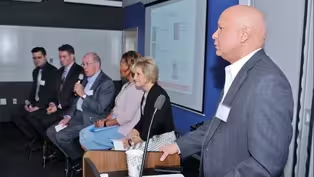
2024 Small Business Workshop tackles business adaptability
Video has Closed Captions
Clip: S52 Ep19 | 11m 34s | Small Business Workshop explores how to navigate an evolving business landscape. (11m 34s)
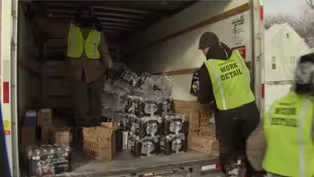
Progress and challenges a decade after Flint’s water crisis
Video has Closed Captions
Clip: S52 Ep19 | 12m 41s | Flint Mayor Sheldon Neeley reflects on the 10-year anniversary of the Flint water crisis. (12m 41s)
Providing Support for PBS.org
Learn Moreabout PBS online sponsorship
- News and Public Affairs

Top journalists deliver compelling original analysis of the hour's headlines.

- News and Public Affairs

FRONTLINE is investigative journalism that questions, explains and changes our world.












Support for PBS provided by:
American Black Journal is a local public television program presented by Detroit PBS