
Examining affordable housing shortage and a story from “Faith in Detroit”
Season 54 Episode 17 | 26m 46sVideo has Closed Captions
How churches are tackling the affordable housing shortage and our first "Faith in Detroit" story.
Our “Black Church in Detroit” series examines how churches are renovating or building homes to help ease the affordable housing shortage. We’ll talk with two local pastors about investing in their communities and meeting the needs of low-income families. Plus, we’ll hear a story from the “Faith in Detroit” project.
Problems playing video? | Closed Captioning Feedback
Problems playing video? | Closed Captioning Feedback
American Black Journal is a local public television program presented by Detroit PBS
Examining affordable housing shortage and a story from “Faith in Detroit”
Season 54 Episode 17 | 26m 46sVideo has Closed Captions
Our “Black Church in Detroit” series examines how churches are renovating or building homes to help ease the affordable housing shortage. We’ll talk with two local pastors about investing in their communities and meeting the needs of low-income families. Plus, we’ll hear a story from the “Faith in Detroit” project.
Problems playing video? | Closed Captioning Feedback
How to Watch American Black Journal
American Black Journal is available to stream on pbs.org and the free PBS App, available on iPhone, Apple TV, Android TV, Android smartphones, Amazon Fire TV, Amazon Fire Tablet, Roku, Samsung Smart TV, LG TV, and Vizio.
Providing Support for PBS.org
Learn Moreabout PBS online sponsorship- Just ahead on "American Black Journal," our Black Church in Detroit series examines how churches are renovating or building homes to help ease the affordable housing shortage.
We'll talk with two local pastors about investing in their communities and meeting the needs of low income families.
Plus we'll hear stories of faith in Detroit.
You don't wanna miss today's show.
American Black Journal starts right now.
- [Announcer] Across our Masco family of companies, our goal is to deliver better living possibilities and make positive changes in the neighborhoods where we live, work, and do business.
Masco a Michigan company since 1929.
Support also provided by the Cynthia & Edsel Ford Fund for journalism at Detroit PBS.
- [Announcer] The DTE Foundation is a proud sponsor of Detroit PBS.
Through our giving, we are committed to meeting the needs of the communities we serve statewide, to help ensure a bright and thriving future for all.
Learn more at dtefoundation.com.
- [Announcer] Also brought to you by Nissan Foundation.
And viewers like you.
Thank you.
(upbeat music) - Welcome to "American Black Journal."
I'm your host, Stephen Henderson.
Today we are continuing our series on the Black church in Detroit, which is produced in partnership with the Ecumenical Theological Seminary and the Charles H. Wright Museum of African American History.
As part of their mission of service, faith-based institutions have long invested in the community by building or renovating homes.
A recent report in Bridge Detroit examined how several Michigan churches are stepping up to develop homes to help address the state's affordable housing crisis.
Joining me now to talk about the church's role in housing development are Pastor Barry Randolph from the Church of the Messiah, and Reverend Dr.
Nicholas Hood III of Plymouth, United Church of Christ.
Welcome to "American Black Journal."
It's great to have both of you here.
- Thank you.
- Yeah, thank you.
- So I, I wanna start by talking just a little about where we are with housing and affordable housing.
We absolutely have a crisis, not just in Detroit and Michigan, but nationwide with affordable housing.
But I also feel like there is momentum in Detroit, in particular right now to address some of that and it's momentum we haven't seen in some time.
So I wanna start with both of you talking about the work that you're doing, but also put it in the context of what we see going on in a wider sense in the city.
Pastor Barry, I'll start with you.
- Yeah, so Church of the Messiah, we've been doing affordable housing for 48 years.
So we started way back in 1978.
And we were working to rebuild the neighborhood of Island View with Church of the Messiah is, and at that time we started working on the issue of affordable housing, 'cause we wanted to make sure that there was housing for the average Detroiter.
And fast forward now with 2026, we're looking at a lot of people coming and moving to Detroit.
But we wanna make sure that the average Detroiter have somewhere to live.
So we got a couple projects that's going to be happening in the community and neighborhood to build more affordable housing.
Hopefully we'll be breaking ground later this year in order to be able to do that.
But it's all about making sure that the average Detroiter has somewhere to live.
That's what we're working on now.
- Yeah.
Reverend Hood?
- Well, the Plymouth United Church of Christ, where I pastor, got involved with housing starting in 1960.
Believe it or not, my dad, the pastor, he was the pastor at the time.
We woke up one Sunday morning to read in the newspaper that our church was going to be taken for a new medical center.
- Wow.
- And it was to be, you know, by eminent domain.
And so we got into housing by necessity.
And it was interesting.
We built new housing, 230 units of low to moderate income housing in the same neighborhood.
Matter of fact, today is right across the street from Receiving Hospital.
But that's the area, old black bottom where the church was located.
We built the housing before we built the new church.
- Ah.
- But it's low of moderate income housing.
It's governed by a separate nonprofit housing corporation, the Plymouth Nonprofit Housing Corporation.
And that was really to protect the church.
But it's going strong.
It's paid for in 230 units.
And the church has a relationship with the housing.
Over the years we provided computers to the children, some feeding programs, number of people who live there in the housing development now take part of a feeding program.
We have in partnership with Trader Joe, but that's our housing.
We've also done some development with a mentally handicapped housing.
- I wanna talk about how, when a church builds housing, it kind of feeds the idea of church community, right?
That it's not just, well, people can live here, but you're building a community and you're adding to the church community.
What does that look like over near Church of the Messiah?
- Yeah, it's all about building community, providing opportunities for people.
And I appreciate what Reverend Hood just said because it is about also doing those wraparound services.
We also do a feeding program.
We also provide internet.
We inadvertently got into doing internet.
So we provide free internet for those who can't afford the internet.
We also do that, we have a marching band to help the kids get into school.
It's been all of these things where we find out that people need housing, but they need the other wraparound services that go along with it.
So it allows the church to be the center of the community and help meet the needs of the people in the community to be able to bring them up so that they can have opportunities to be the best that they can possibly be.
And then some people, they use the affordable housing as a stepping stone into buying their own home.
So that's another opportunity that affordable housing gives to people in the community.
- Yeah.
Reverend Hood?
- Well, the affordable housing, in our case, we started with low to moderate income.
Now I think the designation is affordable.
- Right, right.
- But you know, it just makes for a more complete community.
And you know, we have over the years a number of people who have lived in the housing have joined the church.
But more important than that, it's just a safe community.
In our case, because we're located right across the street from the Detroit Medical Center, a number of employees from the medical center, you know, live there.
- Live in the housing.
- Yeah.
They save on gas.
(all laughing) - Yeah, right.
You'll walk to work.
- And they save on gas if they live in the housing.
I don't know about your housing, but you know, we got started through HUD two 21D3 program where the utilities are paid for.
- Oh, wow.
- That's amazing.
- So it's a real, it's not just low rent, but- - But no utility.
- You know, which utility do they pay?
I think it's the electric they pay, but I think it's the gas and the water, free water.
- Yeah.
Wow.
- Yes.
Reverend Hood, you are on city council for a number of years.
- I was, eight years.
- And you ran for mayor at some point.
So, you've had an opportunity to think about this housing problem, not just as a pastor, but also as a public servant.
I wonder what you see in what your church is doing with housing that government or the city might borrow or learn from.
And even broader than that, what things do you remember seeing the city do that worked or didn't work to provide that affordable housing?
- Well, let me share with you the big question I have right now.
I was just talking to my wife last night about it, as we were riding through the city.
There's a lot of new construction in Detroit for apartments.
And I'm wondering, the bright people, you know, who come up with their concept of who the logical tenant will be, what are they really thinking about?
Because the kind of housing that your church is building, has built, the kind of housing we built, you know, has been for working people.
- Yes.
- And people who are not at the high end economically.
But with the new apartments that I see all through downtown and near downtown, I just don't know how a person who's not highly trained, highly educated, I don't know where the jobs are gonna be for them.
And I think there always will be a need for affordable housing.
- Always.
- But my question is, where will the jobs be?
What are the jobs of the future for a city like Detroit where robotics increasingly are going to out-distance, I think, human employees for the kind of work that Detroit has provided- - Has been doing a lot forever, right?
- Yeah.
And industrial work.
- A very good point.
- So I don't know where housing is really going, but I think there will always be a need for the kind of affordable housing, low to moderate income housing.
- Yep.
- Yeah.
- Just to balance the scales.
- Yeah, you make a very good point, 'cause I always try to figure out, as they said, I think the average rent in Detroit is like, not Detroit, but across the country is $2,000 a month.
And I'm wondering what are people's doing... What do you have to do for a living to pay that much money?
So where are these jobs that make sense?
And then you have a city like Detroit where we're fighting a the poverty rate and you want to really look out for the average person in Detroit.
What does that look like?
So, no, that's a very valid point.
I always think, what are the jobs that people are going to have to have- - To sustain this.
- To sustain this, yes.
- Well, to put that in perspective, I believe the rent for a one bedroom apartment in our development is still somewhere around $700.
- Ours is about the same.
- And that includes most of the utilities.
I mean, I just don't know where a person who's struggling, you know, just trying to get by can make it.
- No, I totally agree.
Totally agree.
- Could you build today a similar development to what you already have and make it work in the same way?
I mean, in other words, are all the tools still there to create through the church, you know, affordable housing that maybe a another kind of developer wouldn't want to do?
- I think the reverend could probably speak better to that, 'cause you know, we haven't built anything of this nature in some time at our church.
I mean, we're maintaining it.
But I really don't know, because, you know, our development was a $3 million project.
- Okay.
- 230 units.
And it was financed totally by hood.
- Right.
- You know, the church did not have to put up any money.
- Didn't have to pay for it.
- I don't know if that's possible now.
- I always think that developers, in my opinion, can do a lot better.
I think a lot of times we spend so much time looking at the bottom line on how much money that we can make.
But I think when institutions like churches do, we are looking at the whole human being.
And we take all of that into consideration.
We think about children, we think about seniors.
And I'm not saying that average developers don't do that, but I think that needs to be part of the equation.
Because, I mean, we are going to be building again on East Grand Boulevard and it's still gonna be affordable.
We're still gonna find a ways to make it affordable, and part of that is gonna have to be subsidized.
But we're going to find a way to be able to do it.
And I just wish more developers would make that part of what they do- - So you are planning to continue to build- - Yep.
- Affordable housing.
- Affordable housing.
Yes.
- What are the tools that make that possible?
Why can you do it and other developers don't seem- - Well, I think we make a commitment to be able to do it.
So when we go into it, we look at all of our partners, what do we need in order to make that happen?
So yeah, we look to make that happen.
That's just what it is that we do.
But I think that needs to be a question we need to talk about with development as a whole coming into a city like Detroit.
- What kind of things do you need from the city and the state, not just to make it easier for you to create affordable housing, but to make it easier and better for the community that you're serving to help create affordable housing?
- Well, I think one thing we need to do is to definitely look at the average Detroiter and think about the different ways that we want to improve their lives.
We want people to be able to make more money.
I went to the state of the city and I appreciated some of the things that the mayor said.
We need to get people into a higher wage.
We need to be on the cutting edge of looking at the future of what's going to happen in Detroit.
You know, we are not so much into manufacturing like we were before.
There is technology, there are other forms of revenues, there's entrepreneurship, there's other things we need to be looking into in order to make this happen.
And as long as we are looking at the development, looking to meet the needs of the people that we currently have, and looking towards the future, I think that's what we need to do.
- I think the best thing the city could do to help churches build housing is, one, make the city a safer place.
And number two, regardless of income, you know, the city just needs a better public educational system.
And the kind of public education that would attract young families.
There are a lot of families in your... I live near your church.
I don't know if you know that.
- Okay.
- You know, we're the lower East side Detroit near the river, - Best place to live.
- And there are a number of young families of all races that are moving, you know, into that area.
But the one thing we don't have are schools, you know, public schools that are not gonna cost a family any more money than the taxes that they're already paying for schools, that the families can be satisfied with, that their kid is gonna get a good education.
And I think- - That's still one of our biggest problems.
- That is one of our biggest problems.
- Number three, i think if we have those two things, we'll have more grocery stores.
And, you know, I'm a resident, you know, your person, somebody asked me what was my drive like coming into the studio today.
I said, "Well, it's like my drive wasn't bad because I live here."
I said, "But we live in a food desert."
- Yeah.
Yeah.
- It's getting better.
We have a couple more options than we used to.
But I remember when you ran for mayor, this was a major point of your campaign was that we live in the city without access to the necessities basics, - Where can you buy underwear?
- Yeah, yeah, I remember that question you asked during the campaign, - Where can you buy it today?
- Well, there's a couple places more.
You know, we have a Meijer on Eight Mile and another one out- - That's on the city border.
Yeah.
- They're not in the center of the city.
- That's in the city border.
- We got Rivertown.
- I mean, we, you know, we shrug our shoulders at that.
But those are real life issues.
And I think as the city does a better job of dealing with the necessities of life, then affordable housing will take care of itself.
But we have some real challenges in the city right now.
- We still do.
Yeah.
Okay.
Great conversation, guys.
Thanks for being here.
And good luck with the housing that you have and that you're creating here.
- Appreciate the opportunity.
- Thank you.
- Absolutely.
Earlier this year, we told you about the launch of a new initiative led by Christchurch Cranbrook that encourages Metro Detroiters to share stories of faith and resilience.
The four-year project is called Faith in Detroit, and it lifts up compelling stories lived out by people all across our region.
Detroit PBS is the lead storytelling media partner.
Today we're gonna hear from the reverend, Dr.
Mayowa Lisa Reynolds.
She's a minister at Detroit's Fellowship Chapel, and the principal of Detroit School of Arts.
Dr.
Reynolds spoke with Faith and Detroit director, the Reverend, Dr.
William Danaher, about her faith journey as she navigated her membership in the Baptist Church and her calling as a choreographer and a dancer.
(bright piano music) - It is been wonderful to study your career and also to study the vision that you bring to so many things as a principal and as a performer, and as a parishioner or congregation member, and minister here.
And I want to give you an opportunity to tell your story of faith.
- Wow, my story of faith is, I think it's fascinating, and the more I meditate and pray, I realized that it began before I recognized it.
So I'll probably start at the beginning of my remembrance, and that will be as a young girl in the neighborhood of (indistinct) and Seven Mile.
My neighborhood changed between the year I was five and six.
And so there were all these new children my age, and we went to school together.
And one summer, when I was about 10, there was a neighbor who took a bunch of us in her car to a church for vacation Bible school.
And it was on Elmhurst and (indistinct) True Faith Baptist Church.
The pastor was Reverend James H. Morton.
He eventually became a bishop.
And he's a brother of Bishop Paul S. Morton.
He was young, he was in his 20s, and he could preach and pray and sing.
Boy could he sing.
And I went to vacation Bible school.
It was so exciting.
And after it was over and he did the invitation, I was intrigued, interested, moved.
So I joined church.
At this time, my parents were not members of church.
And so every Sunday, my mom would allow me to walk around the block to Steel Street, the next block over, and ride to church with Ms.
Hill.
I was the only kid that started after vacation Bible school ended.
But for years, I went to church with Ms.
Hill, and then I developed my faith walk.
I was baptized and filled with the Holy Ghost all in that year.
And my parents came to bear witness.
And my experience was so phenomenal coming up out of the water, having the elders wrap their arms around me, these women who sat on the front row wearing white.
And I wanted to just run through the church.
But I knew better as a 10-year-old.
But I kept that memory in my heart.
And so for me, faith has always been personal, transformative, and community.
And so those three things have always been a part of my faith walk, something very deep and personal and transformative, and always within the context of a community, a community that affirmed me, that believed in me, that poured into me self-confidence when I may have been in situations, in worlds, in spaces that would try to deny me that right.
I understood that God was real and that Jesus had an open invitation for a young girl in Detroit to come to the table.
And I've been going to that table, I've been drinking from that well since then.
So it's been over 52 years now.
- Can you talk a little bit about your calling to be a dancer and a choreographer and your faith as well?
- I think that in faith, religion, right, and structures, there has been conflict, right?
That at this church that I received this experience was a Baptist church.
And so learning to dance, because it was around 13 that I got introduced to Clifford Fierce, who was an original Dunham dancer.
So this will all make sense because Catherine Dunham, this pioneer who created a dance technique in her honor, studied Haitian Caribbean African dance, and its connection to the ways of being for Black people throughout the diaspora.
So the body politic and moving the body as a part of a religious experience is right there in front of our eyes, right?
But people try to shape it and separate it, right?
And that comes from dogma and doctrine that says, when we take the Protestant worldview or your centric worldview, that the body should be silent and quiet.
And that's the same in ballet.
And so Catherine Dunham released that for us, like this movement is an organic part of our religious experience.
And so if you look at some churches and the way they shout, right, from the ring shout to today, if you turn the music off and put on African drums, it would make sense.
So for me, at an early age when I could not explain it theologically, but I understood it in my body to be right.
So if I was a part of a faith community that did not honor the arts, then I would kinda separate from that as I developed my artistic abilities.
But I longed for it because my faith was deeply rooted in my being.
And so that's why I was so excited when my cousins told me about Fellowship Chapel, a church where they supported the arts.
And I didn't believe them.
I actually came on a dare that I didn't think that existed because I had cultivated that for myself personally, but I had no place to connect to community with it.
I had my community of artists, I had my community of church people, but they didn't always end up in the same spaces.
So to be able to come somewhere and to be accepted wholly, fully as my faith expression, which is also artistic, which is also cultural, I found my home.
And I think everyone should, as they develop their faith journey, find a place that they can call home, because they're in that place, that space, they can be free and they can make the greatest contribution to community through their faith.
(bright music) - That's gonna do it for us this week.
You can find out more about our guests at AmericanBlackJournal.org and you can connect with us anytime on social media.
Take care, and we'll see you next time.
(bright music) - [Announcer] This program, this made possible in part by Lilly Endowment and Christ Church Cranbrook.
- [Announcer] Across our Masco family of companies, our goal is to deliver better living possibilities and make positive changes in the neighborhoods where we live, work, and do business.
Masco, a Michigan company since 1929.
- [Announcer] Support also provided by the Cynthia and Edsel Ford Fund for journalism at Detroit PBS.
- [Announcer] The DTE Foundation is a proud sponsor of Detroit PBS.
Through our giving, we are committed to meeting the needs of the communities we serve statewide to help ensure a bright and thriving future for all.
Learn more at DTEFoundation.com.
- [Announcer] Also brought to you by Nissan Foundation.
And viewers like you.
Thank you.
(bright music)
 New
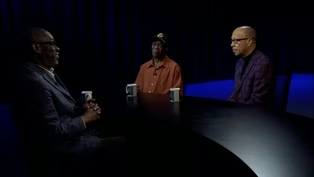
NewBlack Church in Detroit series examines church’s role in addressing affordable housing shortage
Video has Closed Captions
Clip: S54 Ep17 | 16m 40s | Pastor Barry Randolph and Rev. Nicholas Hood III discuss the church’s role in housing development. (16m 40s)
 New
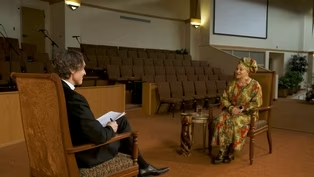
NewClip: S54 Ep17 | 12m 44s | Dr. Reynolds spoke with “Faith in Detroit” director The Rev. Dr. William Danaher about her journey. (12m 44s)
 New
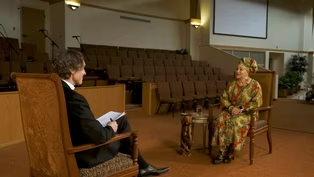
New“Faith in Detroit” storytelling project features The Rev. Dr. Mayowa Lisa Reynolds’ faith journey
Video has Closed Captions
Clip: S54 Ep17 | 7m 24s | Dr. Reynolds spoke with “Faith in Detroit” director The Rev. Dr. William Danaher about her journey. (7m 24s)
Providing Support for PBS.org
Learn Moreabout PBS online sponsorship
- News and Public Affairs

Top journalists deliver compelling original analysis of the hour's headlines.

- News and Public Affairs

FRONTLINE is investigative journalism that questions, explains and changes our world.












Support for PBS provided by:
American Black Journal is a local public television program presented by Detroit PBS