
“Faith in Detroit” storytelling project features The Rev. Dr. Mayowa Lisa Reynolds’ faith journey
Clip: Season 54 Episode 17 | 7m 24sVideo has Closed Captions
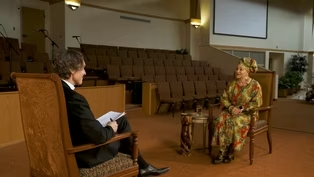
Dr. Reynolds spoke with “Faith in Detroit” director The Rev. Dr. William Danaher about her journey.
The Rev. Dr. William Danaher, rector of Christ Church Cranbrook and executive director of "Faith in Detroit," sits down for a conversation with The Rev. Dr. Mayowa Lisa Reynolds, minister at Fellowship Chapel and principal of Detroit School of Arts. She reflects on how she navigated her membership in a Baptist church early in her life with her calling as a choreographer and dancer.
Problems playing video? | Closed Captioning Feedback
Problems playing video? | Closed Captioning Feedback
American Black Journal is a local public television program presented by Detroit PBS
“Faith in Detroit” storytelling project features The Rev. Dr. Mayowa Lisa Reynolds’ faith journey
Clip: Season 54 Episode 17 | 7m 24sVideo has Closed Captions
The Rev. Dr. William Danaher, rector of Christ Church Cranbrook and executive director of "Faith in Detroit," sits down for a conversation with The Rev. Dr. Mayowa Lisa Reynolds, minister at Fellowship Chapel and principal of Detroit School of Arts. She reflects on how she navigated her membership in a Baptist church early in her life with her calling as a choreographer and dancer.
Problems playing video? | Closed Captioning Feedback
How to Watch American Black Journal
American Black Journal is available to stream on pbs.org and the free PBS App, available on iPhone, Apple TV, Android TV, Android smartphones, Amazon Fire TV, Amazon Fire Tablet, Roku, Samsung Smart TV, LG TV, and Vizio.
Providing Support for PBS.org
Learn Moreabout PBS online sponsorshipEarlier this year, we told you about the launch of a new initiative led by Christchurch Cranbrook that encourages Metro Detroiters to share stories of faith and resilience.
The four-year project is called Faith in Detroit, and it lifts up compelling stories lived out by people all across our region.
Detroit PBS is the lead storytelling media partner.
Today we're gonna hear from the reverend, Dr.
Mayowa Lisa Reynolds.
She's a minister at Detroit's Fellowship Chapel, and the principal of Detroit School of Arts.
Dr.
Reynolds spoke with Faith and Detroit director, the Reverend, Dr.
William Danaher, about her faith journey as she navigated her membership in the Baptist Church and her calling as a choreographer and a dancer.
(bright piano music) - It is been wonderful to study your career and also to study the vision that you bring to so many things as a principal and as a performer, and as a parishioner or congregation member, and minister here.
And I want to give you an opportunity to tell your story of faith.
- Wow, my story of faith is, I think it's fascinating, and the more I meditate and pray, I realized that it began before I recognized it.
So I'll probably start at the beginning of my remembrance, and that will be as a young girl in the neighborhood of (indistinct) and Seven Mile.
My neighborhood changed between the year I was five and six.
And so there were all these new children my age, and we went to school together.
And one summer, when I was about 10, there was a neighbor who took a bunch of us in her car to a church for vacation Bible school.
And it was on Elmhurst and (indistinct) True Faith Baptist Church.
The pastor was Reverend James H. Morton.
He eventually became a bishop.
And he's a brother of Bishop Paul S. Morton.
He was young, he was in his 20s, and he could preach and pray and sing.
Boy could he sing.
And I went to vacation Bible school.
It was so exciting.
And after it was over and he did the invitation, I was intrigued, interested, moved.
So I joined church.
At this time, my parents were not members of church.
And so every Sunday, my mom would allow me to walk around the block to Steel Street, the next block over, and ride to church with Ms.
Hill.
I was the only kid that started after vacation Bible school ended.
But for years, I went to church with Ms.
Hill, and then I developed my faith walk.
I was baptized and filled with the Holy Ghost all in that year.
And my parents came to bear witness.
And my experience was so phenomenal coming up out of the water, having the elders wrap their arms around me, these women who sat on the front row wearing white.
And I wanted to just run through the church.
But I knew better as a 10-year-old.
But I kept that memory in my heart.
And so for me, faith has always been personal, transformative, and community.
And so those three things have always been a part of my faith walk, something very deep and personal and transformative, and always within the context of a community, a community that affirmed me, that believed in me, that poured into me self-confidence when I may have been in situations, in worlds, in spaces that would try to deny me that right.
I understood that God was real and that Jesus had an open invitation for a young girl in Detroit to come to the table.
And I've been going to that table, I've been drinking from that well since then.
So it's been over 52 years now.
- Can you talk a little bit about your calling to be a dancer and a choreographer and your faith as well?
- I think that in faith, religion, right, and structures, there has been conflict, right?
That at this church that I received this experience was a Baptist church.
And so learning to dance, because it was around 13 that I got introduced to Clifford Fierce, who was an original Dunham dancer.
So this will all make sense because Katherine Dunham, this pioneer who created a dance technique in her honor, studied Haitian Caribbean African dance, studied Haitian Caribbean African dance, and its connection to the ways of being for Black people throughout the diaspora.
So the body politic and moving the body as a part of a religious experience is right there in front of our eyes, right?
But people try to shape it and separate it, right?
And that comes from dogma and doctrine that says, when we take the Protestant worldview or your centric worldview, that the body should be silent and quiet.
And that's the same in ballet.
And so Catherine Dunham released that for us, like this movement is an organic part of our religious experience.
And so if you look at some churches and the way they shout, right, from the ring shout to today, if you turn the music off and put on African drums, it would make sense.
So for me, at an early age when I could not explain it theologically, but I understood it in my body to be right.
So if I was a part of a faith community that did not honor the arts, then I would kinda separate from that as I developed my artistic abilities.
But I longed for it because my faith was deeply rooted in my being.
And so that's why I was so excited when my cousins told me about Fellowship Chapel, a church where they supported the arts.
And I didn't believe them.
I actually came on a dare that I didn't think that existed because I had cultivated that for myself personally, but I had no place to connect to community with it.
I had my community of artists, I had my community of church people, but they didn't always end up in the same spaces.
So to be able to come somewhere and to be accepted wholly, fully as my faith expression, which is also artistic, which is also cultural, I found my home.
And I think everyone should, as they develop their faith journey, find a place that they can call home, because they're in that place, that space, they can be free and they can make the greatest contribution to community through their faith.
(bright music)
 New
NewBlack Church in Detroit series examines church’s role in addressing affordable housing shortage
Video has Closed Captions
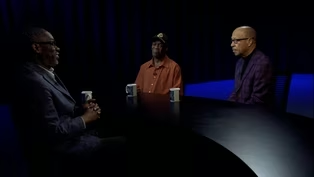
Clip: S54 Ep17 | 16m 40s | Pastor Barry Randolph and Rev. Nicholas Hood III discuss the church’s role in housing development. (16m 40s)
 New
NewClip: S54 Ep17 | 12m 44s | Dr. Reynolds spoke with “Faith in Detroit” director The Rev. Dr. William Danaher about her journey. (12m 44s)
Providing Support for PBS.org
Learn Moreabout PBS online sponsorship
- News and Public Affairs

Top journalists deliver compelling original analysis of the hour's headlines.

- News and Public Affairs

FRONTLINE is investigative journalism that questions, explains and changes our world.












Support for PBS provided by:
American Black Journal is a local public television program presented by Detroit PBS