
Analyzing Michigan's Two Ballot Proposals
Season 2026 Episode 19 | 28m 40sVideo has Closed Captions
Michigan voters to decide 2 statewide ballot proposals in 2026; experts explain on Media Meet.
Michigan voters will decide two statewide ballot proposals in the 2026 election. On this episode of Media Meet, Citizens Research Council of Michigan President Eric Lupher and Research Associate Karley Abramson explain the proposals, provide context and discuss what voters will see on the November ballot. (2619)
Problems playing video? | Closed Captioning Feedback
Problems playing video? | Closed Captioning Feedback
Media Meet is a local public television program presented by WNMU-TV PBS
Analyzing Michigan's Two Ballot Proposals
Season 2026 Episode 19 | 28m 40sVideo has Closed Captions
Michigan voters will decide two statewide ballot proposals in the 2026 election. On this episode of Media Meet, Citizens Research Council of Michigan President Eric Lupher and Research Associate Karley Abramson explain the proposals, provide context and discuss what voters will see on the November ballot. (2619)
Problems playing video? | Closed Captioning Feedback
Where to Watch Media Meet
Media Meet is available to stream on pbs.org and the PBS app.
Media Meet
Media Meet is WNMU’s weekly public affairs program which delves into the issues that are important to the Upper Great Lakes Region. During the half-hour program community leaders and special guests engage in intelligent discussion and candid debate regarding topics of local interest.Providing Support for PBS.org
Learn Moreabout PBS online sponsorshipMore from This Collection
Explore WNMU Public Media’s Election '26 candidate forums featuring races for Michigan’s 1st Congressional District, 38th Senate District, and 108th, 109th and 110th House Districts. Hear directly from candidates about the issues affecting voters and communities across Michigan’s Upper Peninsula. Find additional Election '26 coverage and voter resources at wnmutv.nmu.edu/community/election-26/.
Michigan 1st Congressional District District Candidate Forum
Video has Closed Captions
Election '26: Barr vs. Bergman MI-1 forum—candidates debate key Upper Peninsula, N. Michigan issues. (28m 25s)
Michigan 108th House District Candidate Forum
Video has Closed Captions
Election '26: Michigan 108th House Forum—Rachel Keys vs. Larry Johnson, key district issues. (27m 46s)
Michigan 110th House District Candidate Forum
Video has Closed Captions
WNMU Election '26: Michigan 110th House District Forum with Brian Irizarry & Greg Markkanen. (26m 44s)
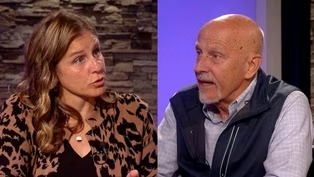
Michigan 109th House District Candidate Forum
Video has Closed Captions
Media Meet: 109th Michigan House race—interviews with Anna Aho Rink, Karl Bohnak, key issues. (28m 44s)
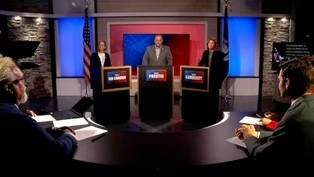
Michigan 38th Senate District Candidate Forum
Video has Closed Captions
Michigan 38th Senate District Forum: Prestin (R), van Ginhoven (D), Cambensy (I) debate key issues. (1h 24m 56s)
Election '26: A Primary Preview
Preview of Michigan Primary 2026: voting eligibility, key races, and clerk insights. (28m 21s)
Providing Support for PBS.org
Learn Moreabout PBS online sponsorshipProduction funding for Media Meet is provided by the Ray and Peg Hirvonen Foundation.
There are a lot of important races for you to decide this election year.
Then, of course, there are the two ballot proposals.
What two ballot proposals, you ask?
Well, you're not alone.
So far, proposals one and two have received relatively little media attention, but we're changing all that next when we discuss them with experts from the Citizens Research Council of Michigan.
Analyzing Michigan's two ballot proposals is next on Media Meet.
[music] [music] [music] Hello everyone, I'm Mike Settles.
Welcome to WNMU's Media Meet.
The political ads are just about impossible to escape, but if you've caught some of them, you know they are primarily about the candidates that are running and not the issues we will be deciding at the November 3rd general election.
There are two proposals on this year's ballot.
One regarding whether to hold a rare constitutional convention in our state and the other on whether to prohibit campaign contributions from certain regulated utilities and government contractors.
Today's show is all about those two ballot questions along with a history lesson about the century old organization that's analyzed those questions.
That organization is the Citizens Research Council of Michigan.
Joining us through Zoom from downstate is the CRC's president, Eric Lupher, and one of its research associates, Carly Aramson.
Eric and Carly, welcome to Media Meet.
Thank you for having us.
Thank you.
It's I so appreciate you taking the time to help us understand these two ballot questions, and we're going to get to the nuts and bolts of those in just a moment.
But I suspect quite a few of our viewers and listeners may not be familiar with the Citizens Research Council of Michigan.
So, let's let's dissect that a little bit.
Uh, Eric, uh, you all have been around for a few years.
Yes, we've been around for 110 years.
The organization was created in Detroit in 1916 and the founders at that time understood that government was evolving.
The city was evolving, the state was evolving, but the civic leaders, the elected leaders weren't quite sure what good looked like.
And there was organizations like ours created in other states that they modeled um our organization after um the idea to find the information so that people can understand public policy issues and the elected leaders can make more informed decisions.
I like to equate this to like um car and driver or popular mechanics or things like that.
If you're going to go out and purchase a major product, a car, dishwasher, a lot of times we do the research first.
And we want the same thing for our elected officials to not just be ba based their decisions on politics um what they hear and and talk about with each other, but to find the facts and and agree on the facts.
And then you can apply your big government lens or small government lens.
But if we don't start with an understanding of the facts and how issues come to be public policy matters, then they're really not going to fix the problem and we'll be dealing with it for a long time.
Hey Carly, what are the range of public policy concerns that uh you've researched and reported on and how do you decide what's worth CRC's attention uh and what isn't?
That's a very good question.
And so I am technically the health policy associate but um as we have written about um in different pieces health policy is very very broad.
We cover you know a wide range of public health issues and that can be anything from you know crime to health insurance um you new medications all sorts of things.
And so anything that really affects the public health and well-being of the state um we have we have covered.
and choosing topics.
Sometimes it can come from things that are in the news, things that we know people are interested in, and so we want to talk about them if we sense that there's any sort of public confusion or there's a need for that, you know, anchored part uh nonpartisan voice um amongst all of the partisan rhetoric about certain issues, but then there's other things that aren't in the news um that we would like to bring to people's attention.
And so it's kind of that balance between commenting on what people are already focused on and then shining a light on things that we think are important that aren't actually being discussed.
So that that the balance between those two.
Uh Eric, the you said you've been around 110 years.
How has the core mission uh survived or adapted over that time in terms of uh the political and social transformation here in Michigan?
Yeah, it's I'm really proud of the idea that if you look at the mission statement 110 years ago and look at it today, it is pretty much the same to find the information about public policy issues and informed concerned citizens, elected officials and civic leaders on those issues.
And I think [clears throat] um an organization like ours exists for 110 years because we became a trusted voice that Republicans and Democrats and Green Party and and Labor Party and everyone else knows um that we're providing this information without spin, without effort to um tell you that one policy is better than another, but to provide an understanding of the issues and the alternatives um and and then you can apply whatever lens you want to it as I said so um I think it's a year of trust and and being around for a long time we've gotten into an era the last uh 30 years of term limits and so there's more churn of people coming into the legislature coming into the executive branch um but really proud of the idea that lobbyists and people that have been around a long time tell those newcomers, "Go find the Citizens Research Council.
Make sure you're plugged into their work and and you can find the information you're looking for in whatever public policy topic is important to you."
So, Carly, would you say your primary audience would be the legislators or the policy makers, or is it the general public or all of the above?
all of the above.
Um, and sometimes different pieces uh are more directed at one versus the other.
Sometimes it depends on the topic, but usually we try to make all of our, you know, all of our reports um whether whether they're short issue briefs or longer reports something that anyone from the public could, you know, pick up and read.
Um, at least at the very least read the executive summary about it to get a good handle on the issues.
Um, but also things that are important for policy makers to know.
So, um, we, you know, we're very mindful of making sure that we can lay out what can often be very complicated issues, um, in a very easy to understand way, um, that, you know, can benefit someone who just wants it to inform their voting or for the policy makers to kind of guide them and lay out the pros and cons of different different options that that they have.
um so that they know how to uh move forward and um kind of just balance different interests as they try to do that.
And Mike, I think that's really a really important point that we try to provide all of our information so that anybody can pick it up and understand it.
So we try to stay away from the government speak, the the lingo that insiders use.
try to put um topics in to words that everybody can understand um the topic.
And so it really depends on the subject matter who we're writing it for.
In the case of these ballot issues, we're trying to explain to the voters because now they become the policy makers um and and they're the primary audience.
other things we're writing for the legislature, for city councils, for county commissions, for school boards.
It really depends on the subject.
So, you said you don't really take a position um well, let me say this.
You don't you don't lobby or endorse candidates.
Uh that's right.
I assume it's kind of the same approach with the issues.
Yeah, we're trying to explain the issues.
We're not trying to pe get people to vote yes or no on these issues, but um by the time they choose to cast their ballot, whether that's an absentee ballot, early voting, or showing up at the precinct on November 3rd, we want them to be informed on this subject so they're not reading about these proposals for the first time and trying to decide on the spot, do I like that or not like that?
So, we're trying to get the information out there uh in a very independent nonpartisan way and then people can take their own life experiences, their own understanding of how the government's working around them and decide on their own what to do with these questions.
U I I want to get to those proposals in just a moment here, but again, I think it's been important for those that don't know about the CRC to kind of establish who you are and why you do what you do.
Eric, in terms of funding the CRC and your positions, how does that work?
Who who's paying for this?
You know, we're a 501c3 not for profofit organization.
So, we're uh always out hustling trying to get people to understand the value of the work we do.
Uh how it helps inform their private lives, informs their government.
We get funding from businesses, from foundations.
philanthropic foundations and from individuals.
And a little bit of the work that we do is um I would want to say for hire.
We're not a a hired gun, but it's funded research funded either by foundations or by uh interest that go find the information and put it out there.
Uh all of the work we do is owned and edited by ourselves.
Um, we're very careful to make it people aware that they can't come to us with result and find a way to get there.
We're going to follow what the information u shows us and and publish it that way.
And Carly, give me a couple examples of uh projects you've taken on that go beyond these two uh ballot proposals that we're going to be talking about.
Sure.
So, um the most recent large report that um that I did that I just uh presented on um actually the other day uh was a large report on social determinance of health and kind of trying to lay out um for policy makers in particular kind of what what this concept is and where they should be really focusing their energy and efforts and to do a very thorough assessment of what the data tells us because one of the things that CRC does that is so valuable is uses facts to at the very least identify what the what the problem is.
Um, and you know, oftent times we uh we can't even agree on a a problem, let alone what the solution is.
And so this was an example of a report that did a very thorough review of all of that data to try to identify where Michigan has been lagging um and you know where what kinds of pieces um where we would get the most bang for our buck if we focused our policy lens um on on those particular pieces.
So that was that was one very large all um encompassing report.
I've also focused on more of those specific changes to Medicaid and uh health insurance that have been happening recently.
So those both of those um reports are good examples of the range of what CRC does because we can tackle an individual issue and try to lay out you know what we think might happen, who the stakeholders are, what people need to know about it when it comes to a very specific thing that is happening, but also doing those very indepth broad um you know assessments that are very data heavy to try to uh help policymakers ers understand how they should use their time and resources.
Well, we are about to break down the two ballot proposals that you will be voting on during the November 3rd general election.
My guests are from the Citizens Research Council of Michigan, a 110-year-old nonpartisan, nonprofit public policy research organization.
They include its president, Eric Lupher, and researcher Karley Abramson.
If you would like to learn more about proposals one and two, what they propose and why, the Citizens Research Council has a wealth of information at uh your disposal.
In fact, they will be holding webinars on both proposals.
Proposal one, the constitutional convention question will be discussed on September 22nd.
And proposal two, the one known as money out of politics.
That webinar will take place on October 1st.
For more information about those proposals and to register for the webinars, head online to their website, which is crcmish.org.
Again, that's cric.org.
Okay.
Uh, Eric, I know you're kind of been the spokesperson for proposal one and Carly proposal two.
So, let's get started with number one.
This is a pretty big decision for voters and it's on whether to hold a constitutional convention or what you've all been kind of explaining is a con uh for short act.
What is a constitutional convention and why on earth are we voting on that right now?
Yeah.
If you think back to your high school civics class in the 1780s when delegates from 13 different colonies came together in Philadelphia, they create they held a constitutional convention.
Uh the idea of drafting a a fundamental document that defines the powers and responsibilities of government and the limitations on the the different branches the way government acts.
We have the same thing happen in each of the 50 states.
They each have a state constitution that says there will be a legislature, a governor, a judicial branch.
Here's the form of local government and the responsibilities of the the different entities and defines the um powers and limitations of taxation and finance and uh they all have a a declaration of rights of some sort.
So, um, Michigan's first constitution was drafted upon statehood in 1835, and we've had four constitutions since then.
In 1850, they introduced the idea, let's check in with the voters on a regular basis.
Let's not just draft these documents and put them forward and uh hope that we got it right.
let's check with the voters on how it's working and whether we should blow up the current constitution and draft a new one.
So every 16 years this appears on the ballot and um the last time was in the 1960s they drafted what we now call the 1963 constitution and so it's been 60 plus years.
We've amended the constitution many times since the 1963.
Um, but there's some things that haven't been addressed by amendment.
There's some things that could be fixed.
And the question is to the voters, do you like the current way it's currently working or should we draft a new document and see if we can make it better?
I'm trying to understand how extensive, if voters were to approve a con, how extensive would this rewrite be?
I mean, do you throw the baby out with the bathwater or is it just a matter of doing some fine edits to the existing constitution?
Yeah, there's no limitations on it.
So, um, they could start with a clean piece of paper and ask each other what do they want the state and local governments to look like.
Um ultimately whatever they come up with they have to come back to the voters and say this is what we the constitutional delegates propose for a new constitution and the people have to vote on it.
So if it's too radical from the current uh constitution, they have a harder time selling it.
And what we've seen in the past in Michigan, but also in other states, is it tends to be incremental change, moving the needle on some things, um trying to fix problems that they identify in the thenexisting constitution, um but not radical change.
But it is a clean slate.
It is not a constitutional convention just to fix the executive branch, just to fix the declaration of rights where we have uh a lot of the real social issues that separate us as as a society today.
Um everything is on the table and everything could be addressed by a constitutional convention.
Let me ask what are the what what are you finding to be the primary arguments to go ahead and hold a constitutional convention and then uh likewise uh the opponents of this thought what why would we not want to do that?
I think the argument why to do it is there um the last constitution was drafted in 1963 and so it's 60 plus years old and for much of that time dating back to the mid70s early 70s Michigan's been pretty stagnant our population hasn't been growing uh the p capita personal income um we've lost jobs, we've lost um uh just you know sort of middling as a state and and the question is is it because the constitution is holding back um the ability to perform things our local governments and and move the state forward.
Um there's certain provisions that have been addressed by amendment, but others just don't raise to the level of having uh the people concerned enough to circulate petitions or to go to their legislature and get things done.
Uh the argument against it is um we're really divided state lately.
you know, Republicans and Democrats, roughly 50% of the population, and you'll be electing delegates um who are not public officers right now.
um delegates that are concerned citizens and want to be involved, but we don't know will they come in and draft a document that's friendly to the conservative form of government, a more progressive form, and it really opens a can of worms for what that might look like going forward.
Hopefully, I'll have time for a couple more questions for you, Eric, but I do want to pull Carly in to talk about proposal two.
Um, again, uh, commonly known as money out of politics.
Uh, Carly, break it down for us.
What is it we'll be looking at on our ballots November 3rd?
Yeah.
So, um, generally this is a group uh, Michigan Money Out of Politics that is concerned about the influence um, of corporate dollars um, affecting our campaigns and elections.
And so what this proposal does is target different uh pieces of the Michigan Campaign Finance Act.
And it's a little bit complicated.
It, you know, some of the the really thorough understanding of it kind of requires a deeper dive into campaign finance, but essentially it does a few different things.
Um one, it uh tries to amend some of the language uh when it comes to campaign ads.
Um, and basically what one of the things that that it it would do would expand the language to encompass ads that are explicitly um on the uh on the internet.
Um, right now the way the language is written um I think it applies to radio and TV and so it's just not it doesn't explicitly encompass those kinds of ads.
Um and so it's kind of just broadening and expanding that um that piece of language to make sure that those things are encompassed along with that.
Um when it comes to those campaign ads, it um will attempt to close a particular loophole um when it comes to disclosing uh who paid for the ad.
And so right now the way it works is that any kind of express campaign ad requires disclosure.
Um, however, there are some issue ads which are things that essentially are like vote on this particular thing, but they don't identify a candidate.
Some of those issue ads um are very clearly about a particular candidate without officially identifying one.
Um, and those some of those issue ads can currently kind of evade that disclosure requirement.
And so another piece of what this does um is try to close that that loophole so that basically anything that you know even if it's not a specifically identified vote for this person uh in the ad if it is clear that it's trying to link this issue to a particular candidate that it will then encompass that ad which will require disclosure.
So, that's kind of one piece.
And then there is another piece about campaign contributions and those specifically targeting government contractors and utilities um and trying to place uh limitations on donations from certain entities associated with those uh government contracts and utilities.
So, um it's very it's very broad and it kind of there's different issues depending on which piece of it you look at, but in general that's those are the overarching uh goals of of the initiative.
And uh quickly, who's backing this proposal and are the utilities fighting it?
So, the Michigan money out of politics is made up of different member organizations.
I think it includes the clean uh clean water action, um the climate cabinet, uh hip hop caucus action fund, uh Michigan League of Conservation Voters, um voters not politicians, a few other kind of member organizations.
Um I have not actually heard much from the utilities themselves about um how much they are themselves fighting it.
There has been a lot of conversation about the constitutionality of certain pieces of this and um you know the potential impact.
It it touches on a long-standing tension um between free speech and um campaign contributions with which has uh the Supreme Court uh um has um several cases about.
And so, um, a lot of the controversy in in the conversation is about, uh, balancing those free speech interests with the, um, you know, the desire to minimize any sort of corruption or pay for play that we have, uh, in, you know, that is allowed in our current system.
Well, in the final few minutes we've got here, let me pull Eric back in with you, Carly, to I I was curious with both of these proposals, do they tend to um when voters go to the polls on them, do they tend to align with uh party politics and is Republicans backing these proposals more than Democrats or the other way around?
Um or do folks from all sides of the political spectrum uh vote differently on them?
I think on the constitutional convention question uh there is no party alignment with it.
Um some elements of the constitution are going to have some um progressive or or what we would think of democratic voters um weary of the new found reproductive rights, the uh collective bargaining rights for civil servants, things like that.
um where conservatives might glean more onto some of the issues in finance and taxation and the property tax limitations and things like that.
So, uh everybody has elements of the con current constitution that they might want to protect and uh certain elements of it that they might want to dig into, but I don't think there's a party lines on why people might decide to vote yes or no on this question.
And Carly, real quick.
Yeah.
um there, you know, I don't think it is um necessarily divided by party lines.
There is a clear concern about utilities, but there are reasons um on both sides of the aisle to have concerns about utilities.
So, it's not it's again it's not quite as um you know across the board as con, but there's uh there's definitely um a basis for the concern on both both sides.
So, well, um, gosh, folks, I had so many questions I wanted to ask you.
I will say, uh, once we see what happens on November 3rd at that con is approved, I'm going to be knocking on your door again, Eric, to see, uh, to to help lay out for us how this process would move forward after election day because there there would be a whole lot to focus on the next couple of years if if Kong Con is approved.
Uh, again, by the way, thanks to both of you for joining me today.
Um, if you do want to learn more about those proposals, number one and number two, I can't think of a better resource than the Citizens Research Council of Michigan.
Everything, what little we were able to just discuss today and a whole lot more is available on their website at crcmish.org.
Again, if interested, you can also participate in CRC's two webinars about the ballot proposals.
Proposal one, con, that webinar will take place on September 22nd.
Proposal two, money out of politics.
Uh that webinar is scheduled for October 1st and they'll go a whole lot longer than this media meet episode.
I can tell you that you can register for one or both of them at their website which again is crcmish.org.
Once again, my thanks to the CRC's Eric Lofer and Karley Abramson for joining us today.
I am Mike Settles.
We will look for you next time on Media Meet.
The preceding program was produced by WNMUTV Northern Michigan University Public Television in studios located in Elizabeth and Edgar Harden Hall.
Production funding for Media Meet is provided by the Ray and Peg Hirvonen Foundation.
 New Episode
- News and Public Affairs

Top journalists deliver compelling original analysis of the hour's headlines.
 New Episode
- News and Public Affairs

FRONTLINE is investigative journalism that questions, explains and changes our world.
 From My Station
 New Episode
 New Episode
 New Episode
 New Episode
 New Episode
 New Episode
 New Episode
 New Episode
Support for PBS provided by:
Media Meet is a local public television program presented by WNMU-TV PBS