
Washington Week with The Atlantic full episode, 8/21/26
8/21/2026 | 26m 46sVideo has Closed Captions
Full Washington Week with the Atlantic broadcast from August 21, 2026.
Full Washington Week with the Atlantic broadcast from August 21, 2026.
Problems playing video? | Closed Captioning Feedback
Problems playing video? | Closed Captioning Feedback
Major funding for “Washington Week with The Atlantic” is provided by Consumer Cellular, Otsuka, Kaiser Permanente, the Yuen Foundation, and the Corporation for Public Broadcasting.
Washington Week with The Atlantic full episode, 8/21/26
8/21/2026 | 26m 46sVideo has Closed Captions
Full Washington Week with the Atlantic broadcast from August 21, 2026.
Problems playing video? | Closed Captioning Feedback
Where to Watch Washington Week with The Atlantic
Washington Week with The Atlantic is available to stream on pbs.org and the PBS app.
Buy Now
10 big stories Washington Week covered
Washington Week came on the air February 23, 1967. In the 50 years that followed, we covered a lot of history-making events. Read up on 10 of the biggest stories Washington Week covered in its first 50 years.Providing Support for PBS.org
Learn Moreabout PBS online sponsorshipVivian Salama: Mixed messages are emerging from the Trump administration this week after the national debt hit an all-time high of $40 trillion.
J.D.
Vance, U.S.
Vice President: We inherited this debt bomb.
Scott Bessent is very much on top of it.
Scott Bessent, Treasury Secretary: There's nothing magic about the $40 trillion number.
Vivian Salama: As the debt climbs, the White House is getting a makeover.
Donald Trump, U.S.
President: This is pure white granite, very high quality.
We get the best stuff.
Vivian Salama: Tonight, the numbers and the optics as this year's midterm elections come into view, next.
Good evening, and welcome to Washington Week.
I'm Vivian Salama in tonight for Jeffrey Goldberg.
$40 trillion, that's 13 zeros if you're counting.
That's the staggering new high that the national debt has soared to this week as the United States racks up debt at a pace that is increasingly difficult to ignore.
President Trump, who campaigned on reducing the nation's debt, faces a fiscal picture that has continued to deteriorate.
All the while, the president has seemed preoccupied with helipads and ballrooms and flagpoles and landscaping.
Joining me tonight to discuss this and more, Zolan Kanno-Youngs is a White House correspondent for The New York Times, Mary Louise Kelly is a host of NPR's All Things Considered, Michelle Price is a White House reporter for the Associated Press, and Matt Viser is a staff writer for The Atlantic.
Thank you all so much for joining me.
So, this week, we basically had a split screen going on, where on the one hand, we learned that the national debt had reached this new high of $40 trillion, and on the other hand, President Trump seemed to take the press on an impromptu tour of the White House to showcase some of his latest renovations.
And, obviously you know, we want to be clear this money is coming from different places.
But the optics and the timing, especially in this midterm election year where people are really struggling to pay, you know, groceries and gas, that's been noticeable.
So, Michelle, I want to start with you.
Let's just focus on the debt first.
What should Americans understand from this new figure, the $40 trillion debt that was announced?
Michelle Price, White House Reporter, The Associated Press: Sure.
Well, there's a couple things to understand.
First of all, this has been going over several administrations, but the short of it is that the U.S.
has been spending more than it's taking in, and that is just continuing to exacerbate as costs are rising and politicians for political reasons are not really willing to make some of the deeper cuts that they need to kind of rein this in.
And at the same time, we've had a series of tax cut packages over the years that has reduced how much revenue we are taking in.
Now, we've heard the president, he does not seem -- I mean, the White House can do multiple things at once, the administration, like you can do renovations.
But the way the president speaks about this, he does not seem to treat this like it is an urgent concern.
He was asked about it today, and he said, well, you know, we'll solve it with some growth.
We have not really heard a really detailed plan from the administration on what kind of probably painful cuts they might make to kind of address this issue.
Vivian Salama: And I definitely want to circle back to that and the president's comments today.
But psychologically, Zolan, $40 trillion is a massive number.
What does it mean for the president politically at this stage?
Zolan Kanno-Youngs, White House Correspondent, The New York Times: Well, let's t- step back and remember that it's something that he very much campaigned on addressing, right?
During his political rise, there were numerous moments where he talked -- where he criticized his predecessors for not doing enough to address the nation's debt.
Vivian Salama: And I actually want to stop you because we have some of those clips here looking back at some of the president's comments about the debt.
So, why don't we play that?
Donald Trump: I think it's catastrophic that we owe $15 trillion.
We have $19 trillion in debt.
It's going to be very soon $21 trillion, not billion, $21 trillion in debt.
And I will tell you, we are sitting on a time bomb.
We have $21 trillion in debt, a number that is, you know, unthinkable.
But that will go down very quickly.
We have $34 trillion in debt, we got to pay it off, and we don't want to do anything stupid.
Vivian Salama: So, to your point -- Zolan Kanno-Youngs: Right.
So this is emblematic of something broader, right?
The president, overall, has campaigned on addressing the nation's economy and the cost of living of everyday Americans.
How many times did we see in the 2024 election him talk about the Biden administration not doing enough to lower consumer prices?
Since he's been in office, we've seen that inflation remains staggering.
We've seen economic anxieties among Americans remaining a top concern, including among his own base, too.
And instead of going out and talking about things like Trump Accounts and sort of the tax cuts and having a focus on that, which I know many Republicans would like him to talk about more, we're seeing him more often leading reporters on a tour of sort of these legacy projects, right?
And then you ask yourself, does this now speak to a break between the priorities of a president focusing on his own legacy and a party that has their eyes on the November elections and the future as well?
Vivian Salama: Absolutely, and we're going to get more into that question in a moment.
But, Mary Louise, Treasury Secretary Scott Bessent says this isn't a magic number.
He -- both he and the president, as Michelle just said, say that we can grow our way out of this debt.
And so are they right?
And why haven't they done so if that's the case?
Mary Louise Kelly, Host, NPR: They're certainly right that growth would be helpful.
The challenge, as our chief economics correspondent, Scott Horsley, was explaining it on air today, was, is you need the growth to outpace the growth of the debt, as you were outlining, Michelle.
And right now, we have the economy growing at an annual rate of give or take 2 percent.
You have the debt piling on at an annual rate of closer to 6 percent.
It's hard to square those numbers and see that as a healthy recipe for fiscal growth and stability.
I think the -- Vivian Salama: Especially when what's driving it are some things that are just necessary, you know?
Obviously, some shocks to the economy like COVID cannot be helped, but you also have an aging population in the United States where healthcare costs for Medicare, Medicaid, Social Security drive a lot of that debt.
How do you escape that?
It's almost impossible.
Mary Louise Kelly: Absolutely, and I think the adjacent question of what's the trajectory?
Like $41 -- $40 trillion is a staggering number.
But the question is, is it moving in the right direction?
Is there a trajectory where it will change?
And the consensus appears to be no.
The government needs to bring in more money.
The easiest, obvious way to do that is raise taxes.
That's a hard sell at any moment, and it's a really hard sell when one of the knock-off effects of this is inflation.
Groceries are costing more.
Gas is costing more.
Paying your mortgage, taking on credit card debt, all of those things, you want to raise taxes too?
That's a very hard sell for Congress.
It's a very hard sell for the White House particularly in an election year.
Vivian Salama: And so, Matt, we just played that montage of the president over the years talking about, you know, the catastrophic effects of a growing national debt.
Other Republicans have spoken about it too.
They've called it existential threat.
They've linked it to national security.
And so, you know, the Republican Party used to be the -- essentially the sound of the debt alarm.
What has happened there?
Matt Viser, Staff Writer, The Atlantic: Yes, I mean, I, as long as I've been covering politics, that has been a core part of the DNA for the Republican Party.
It was a big part of the Tea Party movement and the rise of that, and it forced Barack Obama to create a whole commission on reducing the debt with Erskine Bowles and Al Simpson trying to come up with different solutions.
But like so much of our politics, Trump has changed a lot of it.
And I think you -- right now, you have control of Washington for Republican -- Republicans control the House, the Senate, and the presidency.
The one piece of legislation that Trump pushed through and sort of his signature piece, the big, beautiful bill, added $4 to $5 trillion to the debt.
So, they've had their opportunity now, controlling all levers of power, and haven't really put a major focus on it.
I think the question is whether voters -- whether this still resonates with voters, whether there's going to be a political price to pay.
And I think Trump is kind of banking on no, this is not resonating.
And so they can sort of get away with adding to the debt because it's off in the future.
It's hard to imagine.
It's not tangible.
Vivian Salama: And so much of it is messaging, right, where if the president can kind of message it and be like, we're taking care of it, a lot of voters will believe it because it's not something that's so tangible as, you know, the price of gas, and especially if they've kind of decoupled them, right?
Matt Viser: Yes.
It's future generations, and they're not voting you know, right now.
So, I think that's kind of, you know, the, the gamble that Trump and Republicans are taking.
Zolan Kanno-Youngs: It's hard to decouple -- Mary Louise Kelly: I noticed that you cited the -- sorry, you cited the how many zeros is on that figure.
Vivian Salama: 13.
Mary Louise Kelly: It's -- your eyes glaze over about seven digits in, and you just can't compute.
Well, I mean, what's another trillion between here?
Zolan Kanno-Youngs: It's hard to decouple this, though.
I mean, when you have people that are seeing sort of their gas prices go up and seeing the price at the grocery store, and then you even see it headlined with this big of a number, maybe if you -- you struggle to understand like what that actually means, the deficit.
But it does send a message of, okay, things are out of control.
To your point, too, on this administration moving away from that traditional stance on the Republican Party, when that bill was being negotiated last year, at one point, there were concerns from fiscal Republican hawks.
The White House sends down Stephen Miller, and him and Lindsey Graham basically say, we're going to pass this bill despite the concerns that you have.
The priority is on getting this funding for the immigration agenda.
Michelle Price: And this is not just a far-off the road impact, and we saw this week, the bond market getting very shaky about these numbers and that was one of the drivers of it.
And when those bond yields get high, that increases borrowing costs for all Americans.
So, there are immediate impacts, too, as those concerns about the debt and kind of a lack of a serious plan to address it start to ripple out.
Vivian Salama: I mean, these are all really important issues that we have to continue to watch.
All the while, just before the new debt record was announced, President Trump embarked on a little tour of the White House where he took reporters around the grounds to showcase some of the new renovations and upgrades that he has been pursuing.
And to be clear, the renovations are not what's fueling the national debt, but, of course, the optics are there.
Let's just give viewers a little glimpse of where he took us.
Donald Trump: This is the highest quality stone you can get.
This is pure white granite.
It's very high quality.
This grass is the highest quality.
This is a great pole.
This is the top of the line.
I'm very good at flagpoles.
A lot of times I get criticism, and then when they see the final product, they say, that was great.
Vivian Salama: I've got a long list in front of me of just some of the renovations that are taking place, not just for the White House, but around D.C.
You got the ballroom, which, of course, the Supreme Court today ruled that the Trump administration can continue construction on, Rose Garden makeover, the new helipad he was just talking about, the executive -- Eisenhower Executive Building.
I mean, the list goes on and on.
Not to mention the Reflecting Pool, which Matt Viser has a PhD in the algae condition of that, we'll get to that in a second.
But, Zolan, what is the president actually trying to accomplish here?
I mean, is it aesthetic or is this a political effort here?
Zolan Kanno-Youngs: I mean, he's made comments about this, and said that at times he thinks he is more of a builder than actually a politician.
Vivian Salama: Right.
Zolan Kanno-Youngs: He, now in this period, where he's cementing his legacy, clearly, this is where he, what he wants to focus on.
Vivian Salama: It's a happy place.
Zolan Kanno-Youngs: Ballroom, Reflecting Pool, it's his happy place.
And also, we saw like little sprinkles of this in term one with the border wall focus as well.
Like he wanted to talk about something that is tangible and that he could build, and now you're seeing that translation to the ballroom and the Reflecting Pool.
But, again, I think it's worth emphasizing, like you campaigned on addressing the cost of living and daily issues of voters.
Vivian Salama: It was his thing.
Zolan Kanno-Youngs: Of course.
It was his main sort of driving issue, that and immigration.
And now, you do hear these concerns from Republicans quietly of, you know, we really could use a consistent strategy from the White House.
We really could use a consistent message to address these economic concerns.
And when you have a president focusing on the gold in the Oval Office or the ballroom, that isn't exactly the empathetic tone that you might expect you would have in a midterm year for voters that many of which are struggling.
Vivian Salama: Just to be clear, Mary Louise, you know, renovating the White House is not unprecedented.
Other presidents have.
President Truman rebuilt the interior partly because it was falling apart, out of necessity.
FDR made many renovations, both to the inside and to the vicinity of the White House.
So, why is President Trump's remodeling getting so much blowback, even amounting to legal challenges, we said, going to the Supreme Court?
Mary Louise Kelly: It's a great question.
I mean, I think the legal challenges are one piece.
If we just look at public opinion, I have to wonder if it has to do with these are real things you can see, you can touch.
Most of us will never -- you know, most of us are not at the White House every day.
I'm not at the White House every day.
But my morning jog takes me past the Kennedy Center, which has been tarped and, you know, is behind massive fences to this day.
We can't verify what is on the wall, what name is written on the wall.
And then I keep going, and I jog as close as the National Guard will let you to the Reflecting Pool.
And I think it's the -- so many norms are broken every day in this country.
We're in a moment where I know on air I'm often struggling, you know, talking about the uncharted waters we find ourselves in here, a norm that has never been tested in the courts before here.
You can go to the edge of the Reflecting Pool and look and see it, and it looks really weird.
And I think it's something that is just tangible with all of the changes and stresses that we're seeing on the system right now of you can look and say, this is -- whether you love the changes or not, they're unusual.
They're -- we haven't seen anything like this.
Matt Viser: I think it's also the degree to which this president focuses, almost on a daily basis, to his renovation projects.
Not a day really goes by that he doesn't talk about the ballroom or the Reflecting Pool or the Kennedy Center or the gold statues that -- Vivian Salama: He had done so tonight.
Matt Viser: Yes.
And tonight, you know, this is a good example where just before we came on, he's in South Carolina campaigning for Darline Graham, who has said her number one issue is affordability.
Vivian Salama: This is the sister, of course, of the late Lindsey Graham.
Matt Viser: The sister of Lindsey Graham.
And the special election that's on Tuesday.
And she talks about affordability, and she does use the word affordability, which President Trump calls a Democratic hoax.
But he gets there, and he opens the rally by talking about the ballroom.
And he devotes several minutes to talking about his project.
So, I just don't know that it resonates as deeply with voters across the country.
We see it on our daily commutes and every day.
But, like, it's not the things, the pocketbook issues, that I think the midterms are probably going to be about.
Vivian Salama: But Zolan was just saying, you know, it's his thing.
Obviously, he comes from that background as a real estate -- you know, real estate person and, you know, a builder in general.
Does he see this, though, as governing, or, you know, is it just some passion project for him?
Matt Viser: I think it's part of what he views as his legacy.
And monuments and things that he's building are harder to take down than executive orders that can be changed by the next president.
Mary Louise Kelly: Well, maybe.
We'll see.
Matt Viser: Yes.
We'll see.
Vivian Salama: Legacy is one thing, and sort of the obligation of the job is another.
And so, you know, I'm wondering where there's - - is there any overlap there?
Zolan Kanno-Youngs: I think this is an example of him doing something- Yes -- Because he can.
It's an example of the difference between Trump one and Trump two, which is he surrounded himself and designed an administration based off of people that will say yes and do what he wants.
Dissent is not embraced.
And when that happens, then your impulses and wishes as a president are going to be pursued.
Also, there's a question about the funding for these projects as well, too.
Vivian Salama: You literally took the words out of my mouth.
So, talk a little bit about where the money is coming from for these things.
Zolan Kanno-Youngs: Well, I think there's a question about it.
What we were told initially is that this was mainly going to be funded by private donations and the president's own giving.
We have seen that there's a good amount of money that's been transferred from the Secret Service budget to fund the ballroom, as he's changed his argument to basically say this is a national security imperative, pointing to the bunker that would be under the ballroom.
That's taxpayer money, right?
So, we've also seen a shifting explanation in terms of the need for this ballroom, going from we want to host bigger groups for social events to it's a national security imperative, and also a shift in terms of this is going to be 100 percent private donations to now we're taking from the Secret Service.
Mary Louise Kelly: And the private donations are controversial as well.
Zolan Kanno-Youngs: Yes.
Mary Louise Kelly: Because what are you buying?
Matt Viser: He's also transferred a lot of money, like from the National Park Service, to pay for, you know, gilding the statues, you know, next to the Lincoln Memorial, the Reflecting Pool, which has gone up.
These are taxpayer dollars that he's using on a lot of these things.
Vivian Salama: Michelle, how does the White House actually address any questions about the optics of this?
Michelle Price: They often describe this as like a user experience that is being improved for everybody.
It's the people's house, so he's making it more beautiful.
And some of the renovations around D.C., there's an argument they make that, you know, this is beautiful for everyone.
Tourists will come, and this is better for them to look at.
But some of these, that's a stretch.
I mean, how many people are going to be going to events at the military complex/ballroom, which he calls it, or the helipad this week, where he was touring the granite.
You know, the president was speaking about this as a place that might host cocktail parties, and this is a president who for a long time campaigned on draining the swamp, and it seems he's paving it and making it glitzier.
And talking about how people will be enjoying these spaces in a very elite way seems totally divorced from the message he long had about what he was going to do when he got here.
Vivian Salama: All the while, Mary Louise, the Reuters/Ipsos poll that came out this week shows that the president's approval rating is at a record low, 33 percent approve of the job he's doing.
Obviously, we are two months away from early voting starting in certain states.
The president has to take that on.
J.D.
Vance was on the campaign trail today trying to pitch the economy.
You know, the messaging here, you know, is that everything is fine.
Are voters - - is that resonating with voters at all?
Mary Louise Kelly: Well, if you stick with the ballroom, the public polling is also showing that a majority of Americans don't think it's a great idea and disapprove of it, so that's one tiny slice of this.
I don't know.
You know, between now and the first week of November is an eternity in politics, and we will see what issues stick.
I've been fascinated in a midterm election year by how much focus there has been on foreign policy.
This does tend to happen when you start a war in the Middle East.
But I am curious to see what issues start to resonate and to what extents the White -- to what extent the White House aligns the messaging with what polling is showing people actually care about, which does usually go back to it costs a dollar more per gallon to fill up my car than it did six months ago.
Vivian Salama: You mentioned war in the Middle East.
Obviously, while the president is building a physical legacy here in Washington, there's another part of the presidency which is much harder to make permanent, and that is -- or much harder to control, I should say, and that is the war in Iran.
Where does it stand tonight in particular because the president has now threatened -- took to social media and threatened economic pain on Iran if it does not comply with his demands?
Mary Louise Kelly: Well, we know that talks have stalled.
We know that the Strait of Hormuz is still not operating at anything close to the level that it was before the war.
So, the latest is this threat of an economic D-Day.
Not a lot of specifics on what that looks like.
It raises two questions in my mind.
One is, what would actually change?
Because Iran is already one of the most heavily sanctioned nations in the world, and economic pain has thus far not been effective at causing its leaders to bend to the will of the U.S.
Because, you know, they're still going to have gas in their car.
They still have dinner on their table, the hardline leaders of Iran.
So, the pain hits Iranian people, and in an autocracy where the supreme leader is not accountable to voters, the suffering of the Iranian people is not, sadly, a very coercive measure to, you know, get its leaders to change their behavior.
The other related question is just sanctions in the service of what?
What is the U.S.
goal at this point?
Is it stopping Iran from getting a nuclear weapon?
Is it degrading military, naval, missile capabilities, proxies in the region?
Vivian Salama: Does it change every week?
Mary Louise Kelly: Is it supporting protesters and human rights in Iran?
We haven't heard a lot about that.
Is it getting the Strait of Hormuz back to where it was before the war?
Would we take that at this point?
So, it's very hard to gauge how these new sanctions, this economic D-Day might work, and would it be effective when we don't know what the specifics are and what they are designed to try to achieve.
Vivian Salama: And so, Michelle, you know, President Trump has basically gone out there and essentially declared the U.S.
as -- the Strait of Hormuz as U.S.
territory.
Michelle Price: Yes.
Vivian Salama: He says that ships are passing through, although there's a lot of dispute about that.
I mean, at this point, is the -- even the reality on the ground a question?
Michelle Price: Yes, I mean, I think we've reached a point, I think there's actually been some members to back this up, right, where we would see the president make declarations that we're winning the war, the strait is open, we have a deal, that you'd even see like the market react thinking, okay, this is happening.
And there's -- the markets are not even reacting now that there's a credibility kind of crisis for these statements.
And we have heard over and over again that the strait is open, that things are moving normally.
And then we see reality and that the ships aren't getting through or that they get attacked.
And it's kind of hard for you to wish cast, for the president to wish cast this to be one way when you have hard facts on the ground and you see images of, you know, a ship being attacked.
Vivian Salama: Zolan, we have less than a minute left.
The president obviously on the one hand threatening economic pain, on the other hand, there's still talk of a deal maybe on the distant horizon at this point.
What is the hope for that?
Zolan Kanno-Youngs: I'm not hearing much momentum as far as the talks right now.
There could always -- they could always resume.
We could always see that speed back up.
But right now, it seems like we're in an economic endurance test.
It's gone from a full military assault into an economic tug-of-war, and who's going to feel the pain and who's actually going to give in.
And, I mean, we'll see if the president actually makes good on this threat to also go after people that are supporting Iran economically.
That would include China.
We haven't seen him take that aggressive - - approach against China when it, in the context of this conflict.
So, we'll have to see.
But at this point, it seems like we're in an economic endurance test with heightened rhetoric and not a lot of specifics.
Vivian Salama: Definitely something to keep watching.
Well, we're going to have to leave it there.
And thank you to our guests for joining me.
And thank you at home for watching.
To read more of Matt's great reporting on Washington's makeover, please visit theatlantic.com.
I'm Vivian Salama.
Good night from Washington.
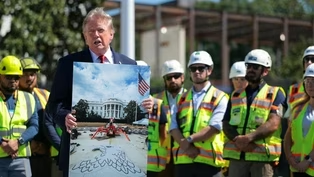
As national debt climbs, Trump gives Washington a makeover
Video has Closed Captions
As the national debt climbs, Trump gives Washington a makeover (13m 48s)
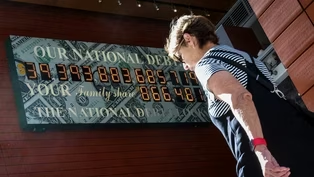
Trump shrugs off $40T national debt after vowing he'd cut it
Video has Closed Captions
Trump shrugs off $40 trillion national debt after campaigning on cutting it (9m 46s)
Providing Support for PBS.org
Learn Moreabout PBS online sponsorship New Episode
- News and Public Affairs

Top journalists deliver compelling original analysis of the hour's headlines.

- News and Public Affairs

FRONTLINE is investigative journalism that questions, explains and changes our world.

 New Episode
 New Episode
 New Episode
 New Episode
 New Episode
 New Episode


Support for PBS provided by:
Major funding for “Washington Week with The Atlantic” is provided by Consumer Cellular, Otsuka, Kaiser Permanente, the Yuen Foundation, and the Corporation for Public Broadcasting.