
May 22, 2026
5/22/2026 | 55m 55sVideo has Closed Captions
Peter S. Goodman; Mamoud Ahmadinejad; Kelli María Korducki
NYT global economic correspondent Peter Goodman describes the havoc the war with Iran is wreaking on the global economy and food access worldwide. A look back at a conversation with former Iranian president Mahmoud Ahmadinejad amid news that the US and Israel are considering him as a leader for Iran today. Kelli María Korducki reports on the burden falling on women caring for their aging parents.
Problems playing video? | Closed Captioning Feedback
Problems playing video? | Closed Captioning Feedback
May 22, 2026
5/22/2026 | 55m 55sVideo has Closed Captions
NYT global economic correspondent Peter Goodman describes the havoc the war with Iran is wreaking on the global economy and food access worldwide. A look back at a conversation with former Iranian president Mahmoud Ahmadinejad amid news that the US and Israel are considering him as a leader for Iran today. Kelli María Korducki reports on the burden falling on women caring for their aging parents.
Problems playing video? | Closed Captioning Feedback
How to Watch Amanpour and Company
Amanpour and Company is available to stream on pbs.org and the free PBS App, available on iPhone, Apple TV, Android TV, Android smartphones, Amazon Fire TV, Amazon Fire Tablet, Roku, Samsung Smart TV, LG TV, and Vizio.
Watch Amanpour and Company on PBS
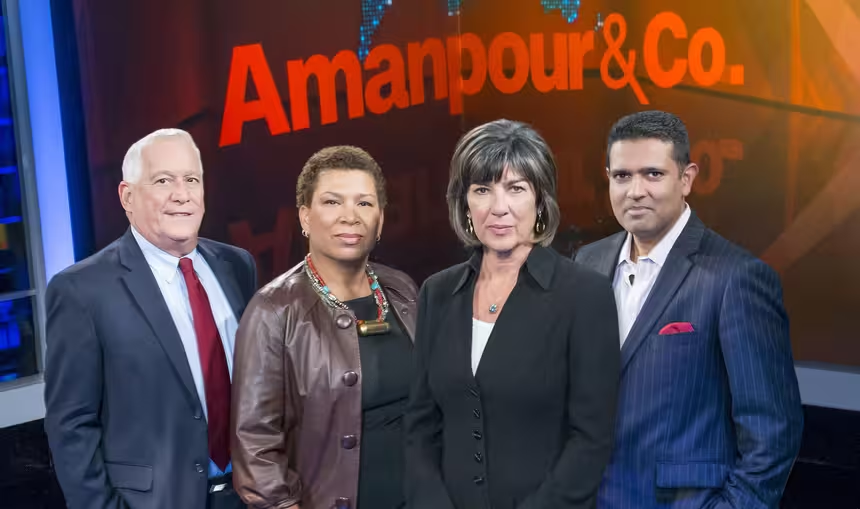
PBS and WNET, in collaboration with CNN, launched Amanpour and Company in September 2018. The series features wide-ranging, in-depth conversations with global thought leaders and cultural influencers on issues impacting the world each day, from politics, business, technology and arts, to science and sports.Providing Support for PBS.org
Learn Moreabout PBS online sponsorshipHello everyone and welcome to Amanpour & Co.
Here's what's coming up.
The fact that this is all entirely avoidable makes it quite frankly enraging to see up close.
Food, fuel and fertilizer shortages as the war against Iran drags on.
Tens of millions of people around the world are thrown into poverty.
We examine one country that's suffering an unchecked emergency.
Then... If the people's need for freedom is not answered, they could lose hope.
We are telling the people and their leaders that there is a real danger.
A revolutionary journey.
Inside Iran, the situation becomes ever more dangerous for those who want a different future.
From my archives, the young people who risk everything for a taste of freedom.
Also ahead, the daughterhood penalty.
Journalist Kelli Maria Korducki tells Michelle Martin about the growing burden falling on American women to care for their aging parents.
(upbeat music) - Amanpour & Co.
is made possible by the committed to bridging cultural differences in our communities, and by contributions to your PBS station from viewers like you.
Thank you.
- Welcome to the program, everyone.
I'm Christiane Amanpour in London.
As the war in the Middle East grinds on, grave repercussions are mounting across the globe, and hitting the most vulnerable, of course, the hardest.
Not only has the closure of the Strait of Hormuz triggered the biggest energy shock in decades, but agricultural supply chains have been strangled, leaving the poorest nations starving.
If the conflict continues beyond next month, those facing acute hunger could surge to 363 million, according to the World Food Program, which is an increase of 45 million since the war started.
And what makes it all so much worse is the total evisceration of foreign aid funding led by the United States, dismantling USAID, and now other Western nations forced to increase defense spending.
Somalia, on the horn of Africa, has been plagued by violence and famine for decades, and now this most vulnerable country is headed toward the same disaster again.
It gets very little attention, but The New York Times reporter Peter Goodman has just returned, and along with his photographer, Finbar O'Reilly, brought back the searing images and stories of a forgotten people, hammered by cuts to the relief system, and now a faraway war.
And Peter Goodman is joining me from New York.
So firstly, welcome to the program.
Thank you.
Great to be here.
Listen, Peter, we've crossed paths in many different places, and I've covered famines in Somalia for sure, and in Ethiopia, plus like you, the tsunami, which was terrible for people.
But you've come back from this extensive journey to Somalia, saying that you were shocked beyond anything you've seen before.
What made it so specifically shocking to you, a veteran?
Well, you know, it's true.
I mean, like you, I have seen some harrowing things up close.
I mean, what struck me as I went around looking at babies in hospital wards with feeding tubes attached to oxygen to survive because food aid has been cut, because health clinics have been closed by these cuts to the humanitarian relief system, what struck me again and again was that unlike in the tsunami, which was a horrible disaster that also confronted us with images we will not soon forget, this was made by the political system.
I mean, Somalia is a victim of climate change, though it probably has produced less industrial emissions than just about any country on earth.
It's ravaged by drought.
Now it's been hit by this cut to the humanitarian relief system, a system that goes back to the Marshall Plan at the end of World War II.
And, of course, it has nothing to say about this war in the Persian Gulf, which has doubled the price of food.
It relies on imports for 70 percent of food.
Energy as well, which makes things like clean water more expensive.
So it's getting all of these crisis hitting at once.
And while the tragedy may be familiar to those of us who spent time in natural disaster zones and conflicts, the fact that this is all entirely avoidable makes it quite frankly enraging to see up close.
Yeah, I mean, it's just so -- I can just -- all these things are flashing before my eyes as you speak.
I'm going to take a couple of the stories and some of the incredibly searing pictures by your photographer.
So this one, you talk about a couple you met near the Ethiopian border.
They had carried their 3-year-old on their back for nine days, trying to walk towards some kind of international aid organization that they had heard were there.
When they arrived, they were not there.
Tell me the story, and we've got some of the pictures.
Yeah, you bet.
So this is a family that, like, literally millions of people in Somalia has been hit by a series of droughts over recent years.
They had something like 50 head of cattle.
That's their life savings.
Somalia is largely pastoral.
And these animals fell.
There was no there was no ability to grow food.
The waters ran dry.
So they went on a 140 mile walk for nine days.
Yes.
Carrying their three year old on their shoulders.
And they thought they were going to refuge on the Ethiopian border.
This town of Dolo where traditionally there are international humanitarian relief operations set up.
UNHCR, USAID, you know, all of the World Food Program, UNICEF.
And when they got there after this nine-day journey, they were horrified to discover that while there were roughly 100,000 people there in these makeshift tents, like you see in internally displaced persons camps or refugee camps around the world, there was essentially no aid.
So, you know, the day I visited with them, and they told me this story, their next-door neighbor in another tent was holding her two-day-old baby in her arms.
She had gone into labor.
She'd been taken to the local, you know, previously UNICEF-funded health clinic.
There was a lock on the door.
She had to beg.
I mean, she's in labor.
She had to beg to amass the fare to take a motorized rickshaw, a tuk-tuk, into town.
The fare doubled because the price of diesel has gone up.
She's bouncing over a rutted dirt road for 30 to 40 minutes, where she delivered this baby who's now come into the world at this extraordinary moment.
It's a cascade of terrible, terrible things.
And you mentioned UNICEF.
You say it's now shut down a quarter of its network, i.e.
205 of its 800 clinics in Somalia have gone.
Is there any doubt that this is because the cut in USAID and other nations which are now essentially following USAID lead because they here in Europe are being forced to take on an added military spending burden?
There is no doubt.
I mean, traditionally, the US has been the most generous donor in Somalia.
As recently as 2024, Somalia was receiving about a billion dollars a year in humanitarian relief from the United States.
That got cut to 467 million or so, if the numbers in my head are correct.
Last year, that's when USAID gets dismantled.
As of April, we're looking at 3 million this year.
So, I mean, this is to the point where there's this kind of surreal hierarchy of suffering that international relief organizations have to deal with.
They are in the position where they're engaged in what they call hyper-prioritization.
I mean, they can't just sort of cut here and cut there anymore.
There are 90 districts in Somalia that used to be served by various forms of relief.
They're down to serving 21.
So, what I saw, what I described to you, where this family emerges from their nine-day walk and this baby comes into the world, this is one of the better off places because it didn't make the cut.
The 21 districts that actually are still receiving aid are deemed, you know, so far toward famine that they get what's left.
Yeah, I mean, it's awful.
And some of the pictures that Finn Barth took of the malnourished children in what should be nutrition camps, so to speak, nutrition clinics for them, and all of that nutrition paste also is barely available.
I just wonder what you think going back listening to, for instance, Secretary of State Rubio and the others who said no life-saving, you know, agencies or operations are being cut.
I mean, that's patently not true.
Look, I mean, I'll answer the question this way.
I was taken to UNICEF Hospital in Mogadishu, where Finbar took a striking and really quite wrenching photo of this 18-month-old boy whose ribs are distended, folds of skin, you know, falling from his arms as he's nestled up against his mother, he's had to, he's required oxygen, feeding tube.
Now, he's one of the happier stories, right?
This hospital's still functioning.
He was about to be discharged.
They've managed to treat him.
Well, they told me at that hospital that they have seen a doubling of the caseload just in the last couple of months.
So this is the impacts of the Persian Gulf War landing atop the cuts to the humanitarian relief.
And because they don't have these nutrition centers out in rural areas, they can't assess kids early, they can't treat them early, and so they slide quickly all the way down to the point where they need oxygen just to breathe.
And the doctors there told me that roughly a third of the cases they're seeing could have been avoided at this stage had those health clinics been there.
I spoke to the guy who runs UNICEF programs, Sheldon Yett, in Sudan, who was having difficulty getting food aid shipments, which are delayed because of shipping problems, traffic jams at ports in places like Oman.
And even the stuff they've got in Port Sudan, they can't truck it to the areas where the World Food Program has already declared famine because the diesel prices are up so much because of the war, and trucking companies won't go at any price because they're worried they won't even be able to physically find the fuel to come back.
So the idea that, you know, no life-saving aid has been cut is just patently false the minute you start looking for the impacts.
Exactly.
And look, Peter, you and I know that when we do go and look for the impacts of natural disasters or even these political calamities, and when we tell the stories like you are, or when television goes and puts the moving images on the stories, it does create a spike of sympathy, empathy, donations, and mobilization.
People are generally compassionate and generous.
But you write that, as I said, you went with Mercy Corps.
Kate Phillips Barrasso of the organization who went with you said something really striking.
She said, "This is the era of indifference."
Do you find that?
I mean, what did you think when she told you that?
Well, it's a complicated thought because she was talking about the people who are actually in control of the money.
Kate's actually based in Washington.
She's been there for 20-plus years and she actually made the point that the public is, to your point, moved by these stories.
Congress has even appropriated humanitarian relief money.
There is money that recently the administration informed Congress they're going to hold on to unspent at USAID to close out those accounts rather than distribute them for the purposes that Congress itself already allocated.
So she's talking about indifference in terms of the people in control of the purse strings and the large political actors who have moved on to other things besides the legacy of the international humanitarian relief system.
Peter, can you just repeat that?
You're telling me that there is money in accounts that haven't yet been spent, but the U.S.
is not going to send it to relieve what's happening right now, even though Congress says it should?
There's a battle happening between the Office of Management and Budget and the State Department and Congress over what should happen to roughly $19 billion in funds that is supposed to be used according to the administration in a congressional notification to close out the USAID accounts.
And that money is actually sitting, we're not sure where, we're trying to get to the bottom of that one, but that money is sitting in some accounts in Washington.
It's very difficult for even members of Congress to get a handle on where it is precisely, how much exactly, but this much we know, that the administration has informed Congress that it plans to use what remains of this money to close out accounts, which means dealing with legal challenges to people's firings, as opposed to dealing with this humanitarian catastrophe.
Oh my God.
Did you say $19 billion?
$19 billion is what has been reported by members of Congress.
I mean, this is something that we're actively digging into.
Good.
I hope you do because I expect the American people potentially might be pretty upset to hear about this.
Just tell the American people or others through this channel why it matters when children starve in places like Somalia, Ethiopia.
What is the blowback for the rest of the world when that kind of state collapse happens?
Yeah, I'm glad you're asking that question.
I mean, humanitarian reasons could be enough to justify making zero sacrifice.
I mean, let's understand, to maintain this international humanitarian relief system that dates back to the end of the Second World War, you know, does not require wealth taxes.
Jeff Bezos doesn't have to give up any yachts.
You know, our lives don't change appreciably.
We're talking about scraps in the grand scheme of U.S.
spending, spending in the U.K., in Germany.
But if that's not enough to justify coming to the rescue of people in harm's way, let's remember that people do not just simply sit in their villages and starve when famine sets in.
They go on the move.
And experts assume that we are cooking up what could be the mother of all migration crises as people do leave areas where agriculture is now untenable, where it's not clear how they're going to support their families.
I'm not here to fearmonger about migration, but if your perspective is, you know, I don't want even just the political and societal disruption that comes with large numbers of people coming in from elsewhere to my home nation, this is something that way back at the end of the Second World War, you know, the victorious allies said, "We better rebuild Europe."
And part of it was charity.
Part of it was, "This will be a great way to sell manufactured goods, you know, made in American factories to Europeans."
And part of it was security.
And there are definitely national security and trade dimensions to humanitarian assistance.
- Of course.
And again, it's a minute portion of any budget, and that's what's really important to point out.
This also happens amid a new Ebola crisis in the Democratic Republic of Congo.
There are already deaths.
There's already an American doctor who's being affected and being treated now in Europe.
And this is escalating.
And also, again, a lot of problems with cutbacks in aid and Ebola clinics.
David Miliband, head of the IRC, talked about that.
But he also said in a recent speech, "The anchor role the U.S.
played in the global system is not coming back, whoever is elected president."
He's basically saying Trump is not just an aberration, it is a permanent shift.
Do you believe that, or do you think the aid community will try to get things up and running again in the future?
I honestly do not know.
Things are so subject to renegotiation in the country that I'm sitting in, the United States, that it's very difficult to predict.
I mean, in the same way that, you know, when Biden came in after Trump won, we didn't get a return to traditional trade policy because the terms of trade are so different.
It's unclear what will happen to overseas development, humanitarian relief.
Certainly there is a tendency in American politics to talk about, "Hey, we have problems at home."
We certainly do have problems at home.
There certainly are lots of needs.
But it's a false binary.
This idea that we can either deal with schools, transportation, inflation, jobless crisis, or we can rescue people who are literally threatened by famine, we can't do both.
Arithmetic takes care of that one.
We have plenty of resources on planet Earth to feed everybody.
These are economic distribution problems, they're political problems, they're not problems of actual scarcity.
Peter Goodman, thank you so much for that searing report and that very important reality check.
Thank you.
I really appreciate it.
So as the endless standoff between the United States, Israel and Iran continues, there is also mass layoffs, economic hardship and poverty.
But what has not changed is the level of repression against the people there.
Crackdowns, arrests, even executions have been stepped up, and the economy is in free fall.
We thought it would be instructive to remember just how long ordinary people have been suffering and struggling for freedom.
The late 1990s saw a brief moment of hope with the overwhelming election of the more moderate Mohammad Khatami, who vowed to reform the system and seek better relations abroad as well.
I went to see for myself, filming a documentary called Revolutionary Journey that aired on CNN in January 2000.
We start with an exclusive look into a student party behind closed doors.
Every weekend the young and the affluent in the suburbs of North Tehran get together and These are the sons and daughters of the Islamic Revolution Students, government workers and entrepreneurs Here, the conversation is about how to pay off the police if the party gets busted.
No one has ever shown this side of Iranian life on television before.
Single men and women are never allowed to mix like this, especially when they're dressed like this.
But these young people want their story told, and that's why they took a chance and let our camera in.
They all know what the dangers are.
Just a year ago, this is what happened to their friend Amir.
He got 70 lashes when one of these parties was busted.
I lied on a bed and he did like... Did you cry?
No.
You didn't scream?
No, because I was very angry, you know.
It was some kind of... Resistance?
Yeah, resistance that... I don't want to scream or something.
Do the lashings work?
I mean, does it make you stop going to parties, stop doing things?
No.
That's because at this moment in Iran, their need for freedom is greater than their fear.
And their frustration is shared on the streets, where the struggle is even more dangerous.
For a few days last summer, this was ground zero in the battle to change the system.
It looks just like the 60s youth movement.
Young people on a college campus facing off against the police, telling the whole world they won't wait for freedom any longer.
The protests started when authorities closed down a liberal newspaper.
A demonstration at Tehran University led to police and hardline fundamentalists storming the dormitories and savagely beating dozens of students.
These are the students who led the demonstrations.
They are deeply religious, and yet they're the ones who are fighting to reform the Islamic revolution.
In the United States and in Europe, in France, in the 1960s, student movements changed their governments.
They changed the world.
They stopped a war in the United States.
They achieved immense reform in Europe.
Do you feel your student movement is that powerful and strong and determined?
He wants to kill us.
Nah.
He said, "Do you want to get us killed?"
We're laughing, but in fact, students say several demonstrators were beaten to death last summer, and some are still in jail.
Your organisation has said that President Khatami's reforms are the last chance for the survival of the Islamic Republic.
What do you mean by that?
What do you mean, last chance?
If the people's need for freedom is not answered, they could lose hope.
We are telling the people and their leaders that there is a real danger.
What he just said to us sounds like a warning.
He's warning the hardliners that if they don't agree to these reforms, things will get out of their control.
Is that right?
Imagine if in the United States, the government of the people is abolished.
What would happen then?
These young men want nothing less than a government of the people.
When all of the people or the majority of the people have something that they want, an idea, an ideal, then no government or no governor can stop them from reaching that ideal.
Iran's young people are putting their lives on the line for the promises made by this man, Mohammad Khatami.
He was elected president three years ago in a landslide.
A moderate intellectual with a charisma rare among Iranian politicians, he's achieved a sort of rock star status.
"Khatami, we love you" the crowd shouts, but the conservatives who cling to power do not, and so far they've done everything they can to block Khatami's reforms.
Khatami promised a lot of freedoms for people, personal freedoms.
Are people disappointed or do they think he's come through with his promises?
No, a lot of things that were supposed to happen have not happened.
Leyla, the art student, simply wants creative freedom.
Yeah, I mean at university even if you draw a figure you can never show it at the end of the term.
I couldn't paint anything naked.
If they're covered with a headscarf and everything, the women, you can show it.
So what do you paint?
I draw cups and saucers and plates and trees and that kind of stuff.
Since Islamic law dictates what she can draw at her university, after school, in a private art class, Leyla paints the way she wants to.
I think sometimes I've lost a lot of things.
I'd love to go out in the middle of the street, on the street and paint something, but I know I'd end up in prison or something for doing it.
Those reforms are running up against a wall of resistance, from men like Movahedi Savoji, a member of parliament and one of the hardest of all the hardliners.
I've been talking to many, many Iranians since I've been here.
I've talked to religious people, I've talked to more secular people, I've talked to young people, to old people, village people, city people.
They say they want freedom of expression, freedom of political expression, they want political reform, and they say they've had enough of hard-line conservatives like yourself.
Our people have been free since the revolution.
Of course, I believe that Ms Amanpour has spoken to a limited number of people.
Sir, every time I ask a hard-liner, a conservative, this same question, they tell me that I'm asking and talking to the wrong people.
80% of the people of Iran voted twice in presidential elections and in municipal elections for reform and for freedom.
So are you saying that 80% of the people of Iran don't know what they're talking about?
They voted for Khatami because they hoped he could solve the economic problems.
In other words, they didn't vote for Khatami so that he would bring political changes.
To me, you sound slightly out of touch.
Everybody we talk to says they want freedom.
And if they don't get their freedom, there's going to be an explosion in Iran.
There's too much pressure building.
Do you accept that?
No.
The busiest place in Tehran each morning is the local newsstand.
Aren't you amazed about all of this, all of these newspapers?
It's great.
Everybody can get a piece of the action.
Get a piece of the action.
What is the action?
The action is just reading and enjoying what's going on in society.
Right.
It was not possible before.
It wasn't possible before?
It wasn't possible before.
In fact, that's the point.
Ever since I've come here, people keep telling me that they simply cannot believe what they're reading in the newspapers today.
There's literally an explosion.
Look at all of these papers that have emerged since Khatami's election.
And it's a battleground.
These here are aligned with the hardline conservatives, and these over here in the front support Khatami's reforms.
Democracy in Iran is literally being born in these newspapers.
But of course, democracy is coming at a very high price.
Journalist Hamid Reza Jalalpour has been arrested, imprisoned, even threatened, for criticising the hardline conservatives, his opponents in the fight for freedom.
One month ago they stopped our newspaper, Neshat.
After that we opened two newspapers.
And maybe if they stop our newspaper, again, maybe in near future they will see four newspapers, I think.
Iran's young people have staked out one battleground in the struggle for freedom, and the other one is in the newspapers.
As a journalist myself, the same age as Jalalipour, I can't help identifying with him and admiring his courage.
They've tried to silence you.
Last year, when they closed down our newspaper, they sent us to prison.
Did you have to go to prison?
Yeah, I was in prison.
27 days in single room.
27 days in solitary confinement?
How many times has your newspaper been shut down?
Four.
Four times.
The first time Jallohi Poor's newspaper was shut down, it was because he printed a photograph of people exercising.
Hardliners said they were dancing, a violation of Islamic law.
They closed down your first newspaper... Yeah, yeah, according to this picture.
..because they thought people were dancing?
Yeah, yeah.
And they were just exercising?
Yeah, just exercising.
And so they close you down and accuse you of insulting Islam.
But what the clerics really object to, says Jalalipour, is this.
For the first time, they're being held accountable.
Not just before God, but before the Iranian people.
For us, everybody, from top official to down, should respond to the people.
You mean should be accountable?
Should be accountable.
Muvahedi Savoji, the Member of Parliament, has been trying to pass a draconian anti-press law.
You're closing newspapers, you are sending journalists to jail, and the journalists who are being restricted think that you're just trying to silence them.
You're trying to silence the voices of opposition.
I don't think that's the case.
I don't think there is a place in the world where freedom means people can say whatever they want, where they can lie or make whatever accusation they choose.
For example, in the United States, can someone say or write something against the country's national interest and security?
Yes.
Yes, they can.
I have a question for Ms.
Amanpour.
Don't you think it's possible that these are a few disturbed individuals?
I turned to the translator to make sure I was hearing correctly.
These are unhappy people?
No, not unhappy.
People who look for trouble.
These people are looking for trouble.
They're not quite balanced.
They're not balanced.
They're unbalanced and they're looking for trouble.
The journalists.
The journalists, yes.
I think these are very brave journalists.
And I think they're battling for freedom.
And I think that they're getting closed down because you don't like what they're saying.
And so I think it's actually brave every time they start again.
If that's being brave, then we can say that all prisoners are brave, whatever the crime, because they too had the courage to break the law.
When I ask the conservatives why they close down the newspapers, they say that you lie, that you write falsehoods, basically that you're a bunch of criminals.
Do you think you're a criminal?
No, I'm educated.
A lawyer.
And the man conservatives accuse of insulting Islam is in fact deeply religious.
An observant Muslim and the father of five.
Yet the danger for him is very real.
Shortly after I left Tehran, a top editor at his newspaper was arrested and sentenced to three years in prison.
You keep writing controversial things in your newspaper.
You keep talking like this.
You've been in jail once.
Are you not afraid?
Sometimes, when I was in prison, some pressure group phone to my family and treat them.
Threatened your family?
Without any name and something like that.
What, threatened to kill them?
Yeah.
You know, Mr.
Jalalipour, writers have been killed in the last few years, in the last year or so.
But let me tell you the role of independent press.
Just they kill four person, but they couldn't continue because of press.
The press alone stopped the killings?
Yeah, yeah, yeah.
because they could mobilize the public opinion.
That's a big victory.
Yeah, very big victory.
How long can you keep playing this cat and mouse game with the conservatives?
Politically, the conservatives have the army, have the pressure groups, have all of that.
And what do you have?
We have got public opinion.
Very important things.
They have got good political power, but they haven't got social power.
And in the end of this century, social power is important.
Yes, that power was important, but the hardliners managed to squelch Khatami's reforms.
And in 2005, Mahmoud Ahmadinejad was elected president and became notorious for his Holocaust denial, threats against Israel, and increasingly backing Iran's accelerating nuclear program very aggressively.
In 2009, his disputed re-election sparked protests dubbed the Green Revolution and a brutal crackdown.
So I was floored this week by a New York Times exclusive that Israel and the United States were considering Ahmadinejad as a possible Delsey Rodriguez figure to lead a future more pliant Iran.
I've interviewed Ahmadinejad several times.
Here's a little reminder of his views back then.
Do you accept at all that the United States, Europe, they are deeply suspicious about your intentions?
They just think that you want to build a bomb.
Do you understand that?
And why do you want to have this crisis?
[speaking in foreign language] Yes, you see, we understand, we know that their intentions are bad intentions.
Their intentions towards us are bad.
When have they ever shown or have had clean, clear, pure intentions towards us?
We don't have expectations for anything else coming from them.
What rights do they have?
When they want to talk about such issues to us, they need to proceed according to international laws.
They cannot say that we don't like the intentions, what we think are the intentions of your country, therefore we want to prevent you.
If you are referred to the Security Council and if sanctions are imposed on Iran, will you take countermeasures?
Already some of your officials have threatened to provoke a rise in oil prices, have potentially threatened to pull out of the NPT.
What will you do if sanctions are imposed?
I think any intelligent, healthy, smart human being should use every resource in order to maintain his or her freedom and independence.
So you could see interfering with oil prices.
I doubt that the leaders of the United States and Europe are that far removed from reality.
I think they're smarter than denying us this legal right.
It is natural.
Of course, they will use whatever they have in their hand, which is the UN Security Council.
And our nation has the means to defend and obtain its own rights.
Do not doubt that our people will not lose.
It sounds very aggressive, what you're saying.
It sounds like we're headed for a real confrontation.
No, we have no such intentions.
You have come and you are interfering in our internal affairs against international laws.
Who is at fault?
Who is being aggressive?
And indeed, that real confrontation, of course, has come now, 21 years later.
Still, it's astonishing that Israel would choose this individual as a plausible candidate to lead a kinder, gentler Islamic Republic, or what?
Next, the daughterhood penalty, a growing social issue that's too often overlooked.
Journalist and author Kelli Maria Korducki explores the disproportionate financial, emotional, and professional burden that's falling on women who are caring for their aging parents.
And she joins Michelle Martin to discuss the failures of America's care system amid a rapidly aging society.
Thanks.
Kelli Maria Korducki, thank you so much for talking with us.
Thank you so much for having me.
You've been writing about something called the daughterhood penalty.
What is the daughterhood penalty?
Yeah, well, the daughter penalty is the kind of unspoken tax that often falls onto adult daughters of aging parents who make sacrifices, career sacrifices, time sacrifices, to care for their parents and to provide unpaid care.
And yeah, that adds up to lost earning opportunities.
- You actually give a number.
You say that on average, you call it the millennial daughter tax, it's on average, women are losing out in $300,000 on average of savings over their lifetimes, over their sort of career lifetimes because of this daughterhood penalty.
I mean, that's crazy.
Why is that?
- Well, it's pretty simple.
The amount of time that it takes to be available, to show up and to attend to a progressively declining elderly person, it ends up eating into other responsibilities.
There's only so much time in which to attend to various responsibilities in one's life.
And often it's the career that ends up taking a hit.
And with that comes past promotions, missed opportunities to earn more, or even job loss or having to leave the workforce.
And then that contributes to implications for long-term retirement security and savings.
So really there's this cascading effect that just stems from the need to plug this gap.
- Why is it a daughterhood penalty and not just a caregiving penalty?
You're very specific about this.
You say this is daughters.
This is not everybody.
Why is that?
- Well, I should clarify that the gap, the gender gap in caregiving for family members, unpaid caregiving, is really, really narrowing.
There's an almost equal distribution of handling any caregiving responsibilities between the genders.
But when you look at the hours spent, when you look at who ends up becoming the primary caregiver, when we're looking at extended families or children of the elderly or friends, it's women disproportionately shoulder the largest share.
And so, that really comes down to societal gender norms.
It comes down to the way things have kind of always been done.
And women also pay a steeper price professionally when they are called away to attend to elderly parents or kids.
We've heard about the motherhood penalty too, which is kind of a similar phenomenon that employers are not always the most flexible.
There's not really the kind of infrastructure to accommodate people who need to take care of other people outside of their jobs and who need to divide their time in that fashion.
How did this story come to you?
I mean, you profile a number of people who have had this experience.
And we're going to get to that in a minute.
I do want to hear some of their stories.
But how did this story come to you?
Yeah, well, we've been hearing about this caregiving crisis for a long time.
And 2026 is kind of a milestone year in that the very oldest baby boomers are turning 80 this year.
So with the boomer population rapidly aging, this is going to become a rapidly compounding crisis.
It already is beginning to.
It's really mind-blowing.
This is such a huge issue and people are so kind of at the ends of their ropes, really feeling kind of alone and isolated in this seemingly intractable problem.
And the thing about it is you follow women who are, I'll just put this in air quotes, doing everything right or who had done everything right.
I mean, these are people who had stable jobs, they had built their careers, they had savings, they were planners, they thought they had kind of set up systems to address these issues.
This isn't something that people just kind of, you know, gave no thought to and they still find themselves depleted, overextended, going broke, having to dip into, you know, not just exhausting their parents' savings to take care of them, but dipping into their own savings, which then compromises their own retirement, which they then are sort of worried about passing on the same legacy to their kids, you know, if they have kids.
Why is it like that?
Like, what's the big picture here?
Is there something about the way we have thought about or not thought about aging in America that is leading to these outcomes?
I mean, is it, I mean, Social Security in part is supposed to have addressed this, isn't it?
Yeah, well, one of the huge issues is that when these programs were put into place, the average life expectancy was much shorter.
I think the average life expectancy was something like 68 years for the average American when Medicare was put into place.
So, you know, now people are living a lot longer and the retirement phase of life can span decades.
So there's that.
And also just the costs of care and caregiving have dramatically risen.
Healthcare costs in general have dramatically risen over the years.
And we just don't have the kind of financial investment and long-term planning that's necessary to meet these needs.
I mean, most of us are going to need some long-term care for probably years.
And there is very, very little foresight into just structurally dealing with that.
And also at the individual level, it's just not something that anybody wants to think about.
You point out in the piece that 7 in 10 Americans over the age of 65 will need long-term care, yet more than 60 percent of adults over 50 don't realize that Medicare does not cover it and that gap is important because people sort of in their 50s should be thinking about - should be - but you know, thinking about what's coming down the pike.
And at that point, it's harder to catch up from a savings perspective.
What are some of the stories that you - that you report - some of the people's stories that you reported on that stood out to you?
- Yeah, so I spoke with one woman who's in her early 40s and her mother actually is not particularly aged.
She's a middle boomer in her, I believe, late 60s, early 70s.
And this woman is in her early 40s and basically like dropped everything at the age of 23 to become her mother's full-time caregiver after her mother had a surgery to correct a degenerative congenital spinal condition that completely inhibited her mobility.
She needed full-time care after that.
And so this woman who'd been working as a manager at a beauty supply store in New York City, quit her job, moved in with her mother.
And 17 years later, she's still living with her mom.
Her entire life is about caring for her mom.
Her mom needs help bathing, dressing, dealing with wound care.
She's at a very high risk for falls.
She needs to be monitored.
How does she feel about it?
It's been really hard.
I mean, she doesn't think of it as a waste.
But she does think of it as a sacrifice.
It's been a huge sacrifice.
And she's given up a lot.
She's given up a career.
She's given up the ability to save for her own future.
She's terrified about what's going to happen when it comes time for her own retirement.
She has no savings.
It's been really, really hard.
And also very just socially isolating.
She told me, "I really, really wish that I had just some kind of a partner in crime.
I wish that I had a sister who would help or any support."
I take it she's an only child.
Yeah, she has a brother.
She has a brother.
Okay, so let's ask the hard question about that.
Like, why isn't the brother helping more?
Like, why isn't this burden responsibility, let's put it that way, more equally shared?
I do know that there's some estrangement there, but this is a common story.
Like the people who are the closest geographically or who are the daughters are the ones who end up stepping up because it's what needs to be done.
Filial duty is a critical part of most cultures.
I mean, most cultures acknowledge the fact that children have a responsibility to their parents.
You know, they have a duty to... And I would say that that comes through in this phenomenon.
It's just, it seems to be more acutely felt by daughters.
I'm just trying to sort of think, some people are going to hear our conversation differently.
Some people are going to be, I mean, some people will listen to that and say, you know, "So what?"
You know, that's just how it is.
That's how it's always been, right?
And, but some people might argue that these women are making choices and that they could make different choices.
Like, what would you say to that?
They could make the same choice their brothers are making.
I asked versions of that question and the resounding answer was sort of like, that wasn't an option.
Like, just doing nothing is not an option.
Whatever career situation or professional opportunities or whatever is at stake for me, like, I'm not going to risk putting my parents in a subpar... Or in danger.
Because some of the cases that you spoke about, some of the people, many of the people who you profiled in the piece, I mean, the fact of the matter is these seniors could not live alone.
Yeah.
Or the care that they require, partly because of dementia, is that they can't, it just isn't safe for them to live alone, and it's just a lot more expensive to care for folks who are living with some of these health conditions than perhaps was envisioned when these policies sort of took hold.
I am curious if you think that given that so many people are dealing with these circumstances, whether there's any policy energy around dealing with this as a society.
I mean, I'm thinking about, for example, New Jersey Senator Andy Kim, a United States Senator from New Jersey, has talked publicly about his father's Alzheimer's and the difficulty of caring for him.
And he, of course, has a demanding job and he's a son, but feels a sense of responsibility.
And I just wonder if you're seeing any sense of sort of policy momentum around this.
- So there's the WISH Act, which was a 2025 bipartisan proposal for federal long-term care insurance benefits that would help older adults afford home-based care, which is kind of the goal for most people, is to keep their older loved ones at home.
And that's also aimed to reduce the reliance on Medicaid for long-term care for those who are eligible.
The idea is that that would be funded through a payroll tax on employees and employers, which seems like a very sensible move.
But yeah, it's really been difficult to get serious momentum on this issue.
I think for a number of reasons, one of them being simply that it's not something that people like to think and plait about, but also it's sort of seen as women's work and I think deprioritized for that specific reason.
It's interesting because you know with child care there's all these this this sort of I don't know heat I guess around it like you know the whole question of should this country do more to support women in the workforce because now of course we have a counter movement where people are saying well women should stay home with their kids but you know again you can choose to have kids or not but you can't choose to be somebody's child that's a decision that's made for you and so one of the things I guess that strikes me about it is there's all this heat there's there's a lot of heat and some sort of you know I guess I would sort of say you know kind of cultural sort of anger and back and forth about child care but there's almost silence about this about taking care of elders and I just wonder why that is I think is it because people are just so exhausted just by living their lives they don't have time to be involved in the public space or or what is it do you know what I mean?
Yeah I think that might be part of it but also you know for all the heat and discussion about child care that hasn't really generated much in terms of actual policy has it?
Certainly not at the national level.
It is interesting that there is this conversation happening on the one end and maybe not so much on the other.
Part of that also I think has to do with, again, what I said earlier is just people don't like to think about aging.
People don't like to think about this stuff until it's already in their faces because it's kind of scary and unpleasant.
And also just what aging means and looks like now is so new.
20, 30, 40 years ago, it wasn't common to live kind of for 20 years, 30 years after retirement.
And with increasing health and mobility and perhaps cognitive limitations during that period of time, like there are people who need long term care now for 20 years, 30 years, and that's, that's pretty increasingly common.
Before we let you go, have you... Forgive me for asking this, but you know I'm going to ask.
Has doing this reporting made you think differently about what's next for you?
Like how you might have to live your life going forward?
It's something that I think about all the time.
Anyway, my parents are boomers, and I don't live near them.
And I'm the only daughter of three.
That being said, my brothers are wonderful.
And I know that my brothers will step up and that we'll be a team when the time comes.
But yeah, I think about it all the time.
Like where will I live?
Will I stay where I'm currently living?
Will I move to be closer to my parents?
Yes, I think about it all the time.
It's a reality.
- Kelli Maria Korducki, thanks so much for talking with us.
- Thank you so much for having me.
- And of course, we all know women who are taking on the bulk of that burden.
That is it for our program tonight.
If you want to find out what's coming up on the show every night, sign up for our newsletter at pbs.org/amanpour.
Thanks for watching, and goodbye from London.
 New
NewThe “Daughterhood Penalty” in America’s Caregiving Crisis
Video has Closed Captions
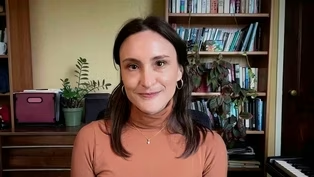
Kelli María Korducki discusses the burden falling on women caring for their aging parents. (15m 59s)
Providing Support for PBS.org
Learn Moreabout PBS online sponsorship
- News and Public Affairs

Top journalists deliver compelling original analysis of the hour's headlines.

- News and Public Affairs

Today's top journalists discuss Washington's current political events and public affairs.











Support for PBS provided by: