Virginia Home Grown
Growing Shiitake Mushrooms on Logs
Clip: Season 26 Episode 7 | 7m 42sVideo has Closed Captions
Discover techniques for cultivating mushrooms in a natural environment
Serome Hamlin visits Francis Ngoh at Rock Creek Run Farm in Goldvein to learn how to grow shiitake mushrooms from logs in the forest floor. Featured on VHG episode 2607, September 2026.
Problems playing video? | Closed Captioning Feedback
Problems playing video? | Closed Captioning Feedback
Virginia Home Grown is a local public television program presented by VPM
Virginia Home Grown
Growing Shiitake Mushrooms on Logs
Clip: Season 26 Episode 7 | 7m 42sVideo has Closed Captions
Serome Hamlin visits Francis Ngoh at Rock Creek Run Farm in Goldvein to learn how to grow shiitake mushrooms from logs in the forest floor. Featured on VHG episode 2607, September 2026.
Problems playing video? | Closed Captioning Feedback
Where to Watch Virginia Home Grown
Virginia Home Grown is available to stream on pbs.org and the PBS app.
Providing Support for PBS.org
Learn Moreabout PBS online sponsorship>>Hey, Francis.
We're walking around in your woods and can you explain what is going on with all of the logs you got?
>>Well, welcome to Rock Run Creek Farm.
And I started the farm on the basis that I had some product and the product was shiitake mushrooms to start with.
Okay, everything else is outside of that, but this is where the passion is.
So I learned through the process of producing shiitake mushrooms that you need fresh logs to be able to grow it in there, thus the name shii and take.
So oak mushroom.
And so to be able to do it, I don't do substrate production, but I do fresh logs.
>>Straight from the logs.
>>Yes, fresh from the logs.
>>And preferably oak.
>>Oak.
Oak is the best.
White oak is the actual best of it.
Everything else pales in comparison because of the longevity of the wood.
And this is a five-year process with the oak, and even the premium of it is the white oak because the layers are over each other.
So once it starts cracking, then you get mushrooms, but they're very resilient in keeping the bark together, which helps anchor the mushroom to come out.
>>Okay.
>>So we have to fell the log, make sure that the cambium layer is fresh.
And then, as soon as we cut it, the time starts ticking.
>>So the cambium layer is actually moving the fungi throughout.
>>That's it.
Yes, yes.
If the cambium layer is dead, nothing moves, because it's the natural process.
>>I see, here, we're starting to get a few mushrooms starting.
>>Yes, you have some pins.
And so, within two weeks, this will look totally different.
>>They're starting to come in.
So the mushrooms prefer a cooler season?
>>Yes.
It's a strain.
It's called night velvet.
And night velvet is a fall strain.
That's why beginning of fall, going towards the middle fall, this whole place will be loaded with mushrooms.
And all the logs all over the place are in different years.
This is the first of this year, which is from last year.
And then, we'll go into two years ago and three years ago, and then they keep rotting and going, and then we- >>So the production, as the years go on, the production of the actual mushrooms in the particular logs would start slowing down as it ages?
>>Yes, exactly.
They start and hit a peak, and the peak is about two, two-and-a-half years, or three years.
And then, it kind of goes down, because the log gets very aged, the elements fall off.
The cambium layer is where everything resides, goes away.
So you see how it comes, and you see the destruction by the- >>The wildlife.
>>The wildlife eats some of it, too.
But as soon as it becomes abundant, you will see it all over the place and it can't eat at all, so we share.
>>Yes, so you gotta share with nature a little bit.
>>Exactly, 'cause it's outside, it's open.
I don't have anything like netting on it or I don't have plastic on it, and that's the natural way.
>>And I see you've got a production area over here where there's logs that haven't been drilled yet.
Can you explain how you get from your natural logs to actual production of the mushrooms?
>>Well, I mean, okay, it has to be at the comfort of the producer so that it can last for as long, as big as the pile is and everything else.
So I have this set up and I set my ladder here, and the way the wood is cut, it's cut to size so it just falls in place.
All right, so I come here and that's my working environment.
First thing to do with this is lay out the logs just as they are.
And then, next thing for me is like, okay, I have a fast drill.
(drill whirring) >>Oh wow.
>>And I drill some holes.
(drill whirring) Right?
>>That's a really good bit.
So it's specially designed just for this?
>>The drill bit is such that this fits right on top of the hole I have drilled, and then- >>It all just goes in, so you push it in- >>So the process is I have this, this is like a spring-loaded thing.
See that?
It fills that gap.
>>Let's see some.
>>See?
Okay.
>>So this sawdust is inoculated with the spores.
>>Yes.
That's what's gonna fill the gap.
And I can show you, you see it come into your hand when you look at it like that, flush.
>>So you just push it right in.
>>You push it right in, do the next, and everything is all speed dependent because, again, time, you know?
>>So you've got to use this before the cambium layer dies out, so you've got a very limited amount of time?
>>Yes.
It's an active layer.
So as soon as I put it in there, the wetness of it goes through and then has the connection.
As it has the connection, it's absorbed into the wood, in the cambium layer.
Because the cambium layer is fresh, what happens is it still thinks that it's supporting the tree.
The old-fashioned way is to put wax on it, but since we have a lot of it, we just pile it up.
By the time insects, ants, whatever else wants to suck it up, it's already in the wood.
>>Oh, so the wood is already taken up, so you don't have to- >>You've inoculated the wood and that is it.
>>'Cause that was gonna be one of my questions is worried about covering the top, but if it's already in, it's already getting into- >>If I did this as a solo and kept it like this, I'm gambling on time because everything is exposed, and the elements, natural, you know, ants and everything else can go and eat it up.
But the idea is that once I do that, and you see the product, just like all the other ones, I don't have to worry about anything invading them.
If you pile it on top, that's the better, which means you exclude those holes from being sort of foraged or whatever it is, and that's the natural process that I like is this.
>>So if a homeowner wants to get started with growing mushrooms on their own, what would be good tips to get them started?
>>It is a slow process.
Setting up is very methodical, starting from actually getting the logs.
Nobody wants deforestation, but if you have the logs and you're doing forest management, you can find the logs, one tree here, one tree there.
Make sure you have enough time so that when the tree is fell, you can utilize all the possible options you have, the logs that you have there.
And then, once you get that, you buy the spawn.
Usually they come in 4-pound bags.
You get it from a trusted source, which is mycologists who have tried it and it's working, not just anybody who's selling it.
Once you get it, you have to get the tools.
Then you go through the process that we went through.
>>You just need the proper tools- >>Exactly.
>>And the want to do it.
>>Wanting to do it.
Great expectations is that it's a long process.
It's not a two day, a three day.
It's a one-day process to do your logs, but then you're gonna sit there in hibernation with the logs outside wherever you put them.
Don't put them directly under the sun because, of course, the log is gonna die quicker- >>Gonna dry out too quick.
>>And then, you're not gonna have a long-aged group.
>>All right, excellent.
Well, thank you for having us out here, again.
Just learning about the shiitake mushrooms and the process of how to get them growing in logs is very fascinating, and I appreciate your time for having us.
>>Well, thank you very much.
I've been part of the process for a long time.
I still enjoy it.
When I get tired, then I guess I won't do it.
(Serome and Francis laughing)
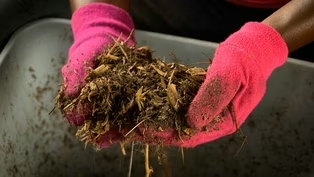
How to Amend Soil with Wood Chips
Video has Closed Captions
Clip: S26 Ep7 | 3m 19s | Learn tips for improving your garden soil with wood chips (3m 19s)
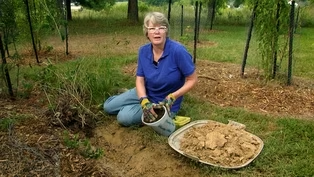
Video has Closed Captions
Clip: S26 Ep7 | 3m 23s | Give your garden beds a boost with mushroom compost (3m 23s)
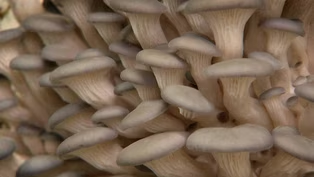
Video has Closed Captions
Clip: S26 Ep7 | 7m 55s | Meet mushroom farmers growing a variety of gourmet shrooms indoors (7m 55s)
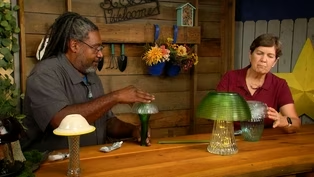
Video has Closed Captions
Clip: S26 Ep7 | 5m 44s | Learn how to create unique mushroom inspired sculptures for your garden (5m 44s)
Video has Closed Captions
Clip: S26 Ep7 | 5m 17s | Discover native moss varieties and tips for their care (5m 17s)
Providing Support for PBS.org
Learn Moreabout PBS online sponsorship















Support for PBS provided by:
Virginia Home Grown is a local public television program presented by VPM