
Cybersecurity Expert Talks Recent Water System Hacks
Clip: 8/13/2026 | 7m 18sVideo has Closed Captions
Several water systems from Minnesota to Georgia suddenly went offline in late July.
Several water systems from Minnesota to Georgia suddenly went offline in late July. While officials restored them, cybersecurity experts now say the outages may have been linked to Iranian hacking groups.
Problems playing video? | Closed Captioning Feedback
Problems playing video? | Closed Captioning Feedback
Chicago Tonight is a local public television program presented by WTTW
WTTW video streaming support provided by members and sponsors.
Cybersecurity Expert Talks Recent Water System Hacks
Clip: 8/13/2026 | 7m 18sVideo has Closed Captions
Several water systems from Minnesota to Georgia suddenly went offline in late July. While officials restored them, cybersecurity experts now say the outages may have been linked to Iranian hacking groups.
Problems playing video? | Closed Captioning Feedback
Where to Watch Chicago Tonight
Chicago Tonight is available to stream on pbs.org and the PBS app.

WTTW News Explains
In this Emmy Award-winning series, WTTW News tackles your questions — big and small — about life in the Chicago area. Our video animations guide you through local government, city history, public utilities and everything in between.Providing Support for PBS.org
Learn Moreabout PBS online sponsorship>> What appeared to be innocent malfunctions and municipal water systems could actually be something more serious at the end of July's several water systems from Minnesota to Georgia.
Southern went offline while officials restored them.
Cybersecurity experts now say the outages may have been linked to Iranian hacking groups raising larger questions about the security of America's critical resources.
Joining us now with more is Jacob Ron executive director of the Cyber Policy Initiative at the University of Chicago and former acting principal cyber director under the Biden administration.
Welcome back.
Thanks for joining Thanks, friends so take us back to the end of July.
What happened when the city's first realized something was wrong with their water systems?
Sure.
So the cyberattack attacked a PLC which is a device that helps control the it system.
And a commands to the physical system.
So the actual pumps and so on that that work make the water utility work, as you suggested, there's the assumption is that the Iranians were behind this attack and we think that this attack is not really about a specific or utility here or there.
It's really trying to send a message to the administration and the American people.
>> About where we're vulnerable.
And I think that what they're trying to do, Israeli show the administration that they can shut off the water to our military assets.
They can shut off the water to what may be the key economic driver in the country right now, which is our AI data centers.
And finally in the country that's deeply divided over the war are ready.
It it.
They're showing that they can undermine public trust government's ability to perform even the most basic life getting services like making sure the water turns on how to officials eventually realize are determined that they were dealing with cyber attack.
>> Well, once the this PLC device starts, you know, kind of malfunctioning and going screwy, people start looking at, well, how does this happened?
And when they looked into it, they see see this this thing done just randomly break somehow was a cyber attack.
It was done via technology came through the it system in the water utility.
And since the this particular device, this PLC devices pretty throughout the water.
Use utilities in America.
Once they saw the start popping up here and there and now it looks like we're up to over a dozen states that doesn't happen by just some random vice randomly breaking it.
It happens because of a coordinated cyberattack.
>> How are they gaining access to our water systems?
Well, they just warm their way through the Internet.
Unfortunately, most of the utilities that were successfully head where the smaller utilities that don't have budgets.
>> 2 higher big cyber companies are cyber professionals and make sure they have all the newest cyber defenses in place.
And so those were the low hanging fruit that the that presumably Iranian hackers we're able to attack.
And you said this.
I mean, you know, they did this sort of shot across the bow for now, right?
What are like the broader national security implications of the water system attack.
could be worse.
>> Oh, for sure.
And I think that's what the Iranians were trying to signal to the U.S.
It's I think it's no accident that this happened in the middle of negotiations and so on to show that, you know, they they have other cards to play.
What what's been the recent history of cyber attacks like these are these common have other countries experience something similar in the past?
There are in fact, there was a report today of cyber attack against water plant.
But the reason I actually want to getting involved in this issue was when I was at the White House was when the Chinese were pre positioning malware on our water utilities that support military assets around the country.
Presumably to U.S.
military know that if there's a conflict, assuming over Taiwan that they could shut off the water to a bunch of key military assets and unfortunately, nearly all of the military assets in the country are supported by civilian water, utilities and this is just water, right?
Like could there be similar implications are concerns other utilities, energy gas.
>> Yes, well, and in fact, the Iranians have been quite active and hitting other critical infrastructure.
So, for example.
>> Years ago when we launched a cyber attack against their nuclear program and it came to light.
They did a massive attack against our banking system and shut off online banking for weeks and weeks.
And by the way, we were able number, we were never able to stop it.
They just kind of got bored with it after a few weeks stop doing it on their own.
We also know they've been involved in our elections, not to our knowledge with actual hacking per se, but with MIS and disinformation, which is always coupled with different types of cyber attacks.
And then of course, we've seen the Russians and the Chinese act in similar ways and then ransomware groups have been attacking all types of critical infrastructure for years.
Now.
>> Is there anything that we can do that or that we should be doing to increase the security of our water systems?
>> Well, I absolutely we launched a program recently with the National Rural Water Association and a host of cyber providers around the country.
2 be able to deliver cyber security, too local water utilities around the country, its one of the big problems in the spaces that there's 150,000 water utilities, the country and delivering cyber to them.
This is a pretty intractable problem.
Many of these places we were talking to one in Alabama the other day where it's ran by one guy and he also runs the 4th of July parade for the town.
So the idea that these folks are going to be able to do their own cybersecurity, us, not going to work.
and to.
Well, that's why we launched this program.
>> One of the things you mentioned, but so many military installations are dependent on civilian water supply.
Should that be different?
Said our military installations have their own water supplies that even possible.
>> It would be possible it would cost an enormous amount of money.
And I think that while there are thousands of military installations who are supported by water, utilities.
Without big dog is budget, there's that would be a drop in the bucket to.
To support the cybersecurity.
Those utilities.
>> Has the administration been responding to these attacks?
Well, I think that >> there's been.
the president come out and of course and not agree that it's necessarily Iran.
But I think he's also the middle of an information war himself, obviously, and I think doesn't want to give them credence to been to be able to say that they were able to do this and also doesn't scare American public.
So I think they've been somewhat muted in this.
And I understand why I know that the cyber agency under Homeland Security has been doing a lot of outreach to local water utilities to try and tell them what they can do to to support our to deal with this problem.
But really at the end of the day, the federal government has to fund a solution for this.
And one of the reasons we launched this effort with the National Rural Water Association is because they've been funded by the federal government for about 50 years to provide technical assistance, albeit not got
 New
NewRainbow Cone Celebrates 100 Years
Video has Closed Captions
The Original Rainbow Cone started in 1926 on the Far South Side. (3m 58s)
 New
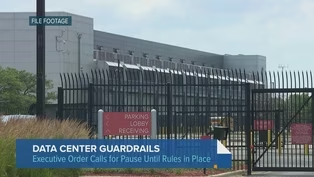
NewWhat Sustainable Data Center Development Could Look Like in Chicago
Video has Closed Captions
The rapidly evolving industry has become a flashpoint in communities across the country. (8m 32s)
Providing Support for PBS.org
Learn Moreabout PBS online sponsorship New Episode
- News and Public Affairs

Top journalists deliver compelling original analysis of the hour's headlines.

- News and Public Affairs

Today's top journalists discuss Washington's current political events and public affairs.




 New Episode
 New Episode



 New Episode
Support for PBS provided by:
Chicago Tonight is a local public television program presented by WTTW
WTTW video streaming support provided by members and sponsors.