
Readers Club 304: Wilding | Isabella Tree
Season 2026 Episode 14 | 33m 17sVideo has Closed Captions
PBS Books Readers Club welcomes British author and conservationist Isabella Tree
PBS Books Readers Club welcomes British author and conservationist Isabella Tree to discuss her inspirational non-fiction book Wilding. Wilding: Returning Nature to Our Farm chronicles the real-life experiences of Isabella Tree and her husband Charlie Burrell as they take on rewilding their 3,500-acre Knepp Castle Estate in Sussex, England. A land ravaged by centuries of farming.
Problems playing video? | Closed Captioning Feedback
Problems playing video? | Closed Captioning Feedback
Readers Club 304: Wilding | Isabella Tree
Season 2026 Episode 14 | 33m 17sVideo has Closed Captions
PBS Books Readers Club welcomes British author and conservationist Isabella Tree to discuss her inspirational non-fiction book Wilding. Wilding: Returning Nature to Our Farm chronicles the real-life experiences of Isabella Tree and her husband Charlie Burrell as they take on rewilding their 3,500-acre Knepp Castle Estate in Sussex, England. A land ravaged by centuries of farming.
Problems playing video? | Closed Captioning Feedback
Where to Watch PBS Books
PBS Books is available to stream on pbs.org and the PBS app.
Providing Support for PBS.org
Learn Moreabout PBS online sponsorshipMore from This Collection
The PBS Books Readers Club is a monthly digital-first series that brings its members into conversations behind the stories of your favorite books & shows. You can watch the online on the PBS App, with extended interviews available for PBS members on PBS Passport.
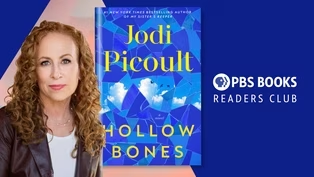
Readers Club Episode 309 Hollow Bones | Jodi Picoult
Video has Closed Captions
PBS Books Readers Club welcomes prolific author Jodi Picoult to discuss her newest novel (46m 12s)

Video has Closed Captions
PBS Books Readers Club welcomes author Andy Weir to discuss his best-seller Project Hail Mary (40m 24s)
Readers Club Episode 307: Booking It Across America
Video has Closed Captions
This month, PBS Books Readers Club celebrates America 250 with a special episode (15m 49s)
READERS CLUB Episode 306 : Our Favorite Books for Summer
Video has Closed Captions
Our hosts of the PBS Books Readers Club, share their perfect picks to binge beachside this summer (18m 45s)
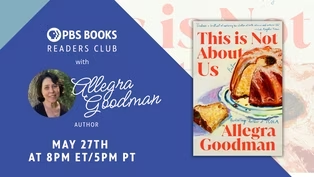
Readers Club 305: This Is Not About Us | Allegra Goodman
Video has Closed Captions
New York Times bestselling author Allegra Goodman of Sam and Isola to discuss her brand-new novel (36m 31s)
Readers Club- Debbie Horsfield | The Forsytes
Video has Closed Captions
The PBS Books Readers Club takes on John Galsworthy's classic novel series The Forsytes. (32m 36s)

Readers Club | 302 Book Picks for Black History Month with Lauren Smith and Princess Weekes
Video has Closed Captions
PBBS Books Readers Club recommend their favorite Black History Month reads. (16m 16s)
Readers Club | Ep 301: Charlotte McConaghy | Once There Were Wolves
Video has Closed Captions
PBS Books Readers Club hosts author Charlotte McConaghy to discuss her novel Once There Were Wolves. (58m 55s)
Readers Club | Ep. 212: Our Favorite Books of 2025
Video has Closed Captions
PBS Books Readers Club celebrates the wrap of its second season with a highlight of 2025 (47m 55s)
Readers Club | Ep. 211: America's First Daughter | Stephanie Dray & Laura Kamoie
Video has Closed Captions
PBS Books Readers Club welcomes co-authors Stephanie Dray and Laura Kamoie (1h 1m 45s)
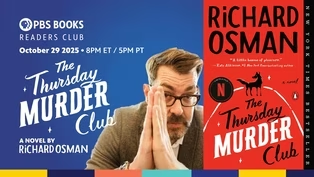
Wed Oct 29 2025 | Readers Club | Ep. 210: Richard Osman | Thursday Murder Club
Video has Closed Captions
PBS Books Readers Club welcomes celebrity writer Richard Osman to discuss his best-selling novel (52m 44s)
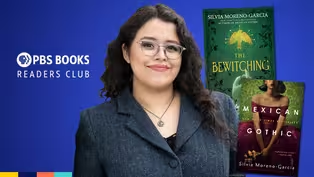
Readers Club | Ep. 209: Silvia Moreno-Garcia | The Bewitching and Mexican Gothic
Video has Closed Captions
PBS Books Readers Club welcomes award winning author Silvia Moreno-Garcia to discuss her new book. (52m 42s)
Providing Support for PBS.org
Learn Moreabout PBS online sponsorship(lively orchestral music) - You know, our backs were against the wall.
We were 1 1/2 million pounds in debt.
And my husband had to make the big decision to stop farming and to sell the farm equipment, to sell three wonderful herds of dairy cows, and really to think again.
- Well, hello and welcome to the "PBS Books Readers Club."
- Today, we are so excited to welcome author Isabella Tree.
She wrote this incredible book, "Wilding," and it is the perfect book pick for Earth Month.
- Well, it really is, and it's about the reintroduction of species and wildlife on this estate in Sussex, England.
But first of all, I must say I'm delighted by the Dickensian idea that her name is Isabella Tree.
- Oh, it's so perfect.
I love this story because so often when you're reading about environmental issues, it's a little doom and gloom.
There's a lot of negativity, and you can feel hopeless, feeling like all is lost for sure.
But what's so fascinating about this story is she and her husband took this centuries-old farm on Knepp Castle.
How amazing is that?
- [Fred] Really.
- [Lauren] And they let it go.
It wasn't working.
The farm was failing, and they just let nature take over without intervening.
And of course, they had all kinds of controversy along the way.
It's the English countryside.
Things are supposed to look a certain way.
They have other neighbors that are farmers that are worried about the weeds getting into their crops.
All kinds of challenges.
But over the course of 20-plus years, the amazing thing is that nature has survived and thrived.
And it's a really positive feel-good story.
- It sure is.
And it's an experiment, really, in real time.
First of all, humans, not the bad guy in this story.
I mean, we inhabit this planet as well.
It's our home.
But over time, over the centuries, maybe we've done too much.
And this illustrates with this experiment for conservation.
They took the estate that was failing, and they went to the Oostvaardersplassen in the Netherlands- - Well done.
(laughs) - And they figured how they could replicate that.
And the takeaway... And I'm very excited to talk to Isabella about this.
The takeaway is almost to me like raising kids.
Like create the conditions for success, step back and let the earth succeed.
- Yes.
- Which is something you never hear.
All you hear now is do nothing or the place belongs to us, and we can do anything we want.
This really strikes a middle chord of reasonable and moderation.
- And it's a fascinating story.
It is a piece of nonfiction, but the writing is so gorgeous.
She really sets the scene, tells the story.
There's history in here, there's biology, but it doesn't read like a textbook.
It is so, so interesting.
What is also exciting is that there was a film created based on this book, and it is absolutely amazing.
- "Wilding" on PBS and available right now on pbs.org and the free PBS app.
- We are excited to talk to Isabella Tree.
She is standing by, but we also wanna hear from you.
If you've read this book or if you have recommendations for other environmental stories that our Earth Month friends should read about, please pop them in the chat.
We'd love to hear from you.
And make sure that you subscribe to our e-newsletter as well.
Visit pbsbooks.org/subscribe so you can be updated with all kinds of fun, stories, and book recommendations right to your inbox.
- It's the place to be.
Isabella Tree standing by to talk to all of us.
But first, all of this is made possible by viewers like you.
And we would love to have you make a contribution to your local PBS station.
And when you do, we have, well, some pretty fun thank-you gifts, including the PBS Books coffee mug; you see the label there.
And also on the reverse side, "My Weekend is BOOKED!"
- [Lauren] (laughs) Yes, it is, it is.
'Cause I have some books for you to read.
I also love the PBS Books tote bag.
You can fit five, six library books in this thing.
It's amazing.
One of my favorites.
We would love for you to join us in supporting this program so we can make more possible.
- And now let us turn the page and welcome in our guest this month, author Isabella Tree, the book "Wilding."
Isabella, welcome to the "PBS Books Readers Club."
- Thank you so much.
Wonderful.
Lovely of you to have me.
- We're so glad you're here.
For those who haven't read the book yet, tell everyone a little bit about your incredible true story behind "Wilding."
- Well, it's a bit of a surprise, really, to us.
But I thought I'd married a farmer, and for 17 years, we tried to make our heavy clay soil in West Sussex in England, work and make it profitable.
And we failed dismally.
I mean, the soil is just completely the wrong thing to be doing modern, intensive farming on.
And it took us 17 years to realize that.
But when we finally did, you know, our backs were against the wall.
We were 1 1/2 million pounds in debt.
And my husband had to make the big decision to stop farming and to sell the farm equipment, to sell three wonderful herds of dairy cows.
And really, to think again.
We managed to shed our debt, which was a huge relief.
But I think, you know, what was extraordinary is if you've ever been in a failing business, you know, you are stuck in a rut.
You are basically thinking, "How do I survive to the next month, the next year?"
You don't look at the bigger picture, but when you have finally made that break, you have the headspace to think differently.
And that's when we began to absorb all these new ideas about how we could do something different with our land.
And we began to look to Europe, where they're doing amazing rewilding projects, introducing free-roaming animals onto the land to generate creation of habitat again, to get wildlife back.
And we thought, wouldn't it be exciting if we could do something like that with our dysfunctional, polluted, degraded farmland and bring wildlife back.
- Well, Isabella, first off, nonfiction should be applauded as such a difficult discipline.
On top of that, a nonfiction book about something you were experiencing in real time.
Talk about the taking all of this on.
What inspired you as a writer to tell this story?
- Well, I think it was just such a story of hope.
You know, we were seeing all the time, I mean, every week, signals that amazing wildlife was returning, you know?
And it's now been 25 years since we made the decision to stop farming and to start rewilding.
And we are now one of the most significant biodiversity hotspots in Britain, with some of the rarest species.
I mean, species that elsewhere, you know, are going extinct.
You know, their population is booming here at Knepp.
So we felt that we had this amazing story to tell, and I was longing to tell it.
But funnily enough, I was working on another book that had sort of sent me down a bit of a rabbit hole, was taking me much longer to write.
And it was lucky that I delayed writing "Wilding," I think, because by the time I got to write it... This was in about 2016.
It was published in about 2018, 2019, I think.
We had far more results, scientific results that we could actually, you know, say, "Look, here is the solid evidence that wildlife has come back.
That huge changes have happened to our landscape, and we've been able to measure them."
But also, I think we'd had that many more conversations over, you know, late-night whiskeys around the kitchen table that had really distilled the ideas.
And so when I got to writing the book, it was almost, it was unlike any other book I've written.
It just was like a kind of fruit falling from the tree, you know, it was really ready to be written.
And I just loved writing it for that reason.
It was a mature idea, a mature story.
The evidence was there, and it was just so full of hope.
It was just a joy to write.
- So in the book, you talk about the process of rewilding, and that word can mean different things to different types of conservationalists.
And you titled the book "Wilding."
Tell us a little bit about those words and what they mean to you.
- Well, it was a bit tongue-in-cheek.
It was a bit facetious, I think, to call it "Wilding."
But at the time, and remember, you know, this was over a decade ago, nearly two decades ago, rewilding, you know, had specific connotations.
And I think the word was originally coined in the States, where it was very much associated with carnivores.
"Cores, corridors, and carnivores" I think was the original mantra from the States in the I think it was like the '80s or '90s.
And so when we talked about rewilding in Britain, you know, people were thinking, "Oh, my God!
They're gonna bring wolves back, and bears," you know?
And the other connotation of rewilding is that that little "re" prefix suggests that you are trying to return to the past.
And obviously that's impossible.
And we were getting shot down for that.
You know, "Well, they can't recreate Eden.
They can't recreate what would've been here 1,000 years ago or 5,000 years ago, or even 10,000 years ago."
And we know that.
You know, the Earth has... We've changed the Earth as humans so irrevocably that we can't possibly retrace our steps.
Animals have gone extinct; species have arrived of their own accord or through us.
You know, we've changed the whole landscape.
But what we can do is create or allow nature to evolve, give nature the tools to work on her own, to create novel ecosystems.
So it's really about being informed by the past and what processes work in nature, but allowing nature to evolve and create new ecosystems.
So we called it wilding to drop that problematic "re" word that kept people thinking we were going back to the past.
- And I'm glad you mentioned that because what jumps off to me is a couple of different tracks.
One, the history, those policies of kings, major wars, and then the science.
So you have the past, science oftentimes rooted in the past, but also more face of the future.
When it came to the science, did you need to do extensive research, or did you sort of learn it along the way?
- Well, we learned it along the way.
My husband and I are not scientists.
And in a way that that was a kind of positive, I think, for the book, because I had to write it for a layperson, which was myself.
I had to get my head around these scientific terms and papers and digest it and, you know, kind of pull out the sort of, you know, a meaning that made sense to me in normal everyday layperson's life.
But what we did from the very beginning, and what we would always advise anybody doing a rewilding project of any scale, is to have an advisory board of the scientists.
So we have an advisory board of about 20, 25 ecologists, scientists, conservationists, who we all felt were kind of on the same page with us, or at least excited enough about this idea that could we do a process-led nature project, you know, introducing herbivores, restoring water systems, and then just sitting back and letting nature take the driving seat.
And we found enough people that were really excited by this idea who agreed very kindly to come on board and be our advisors.
And often they disagreed with each other, and it was very difficult to make sense.
One of the advisors said it was like trying to put frogs in a bucket.
You know, every time we thought you had the frogs in a bucket, a few of them would jump out again.
But it made for really, really interesting discussions.
And above all, I think it gave us moral support because we knew that there was legs in this project, that there was serious people who were seriously interested in it.
And in the early days, that was really important to us because we got a lot of negative sort of criticism from locals, from farmers, from, you know, just the general public or from other ecologists who didn't agree with what we were doing.
- Yeah, so it wasn't a straight line from farm to a nature preserve, essentially.
Talk a little bit about that tension and those moments that you had with your neighbors and with scientists that maybe didn't agree, and also those struggles within yourself.
Like, did you and Charlie ever have a moment where you felt like, ugh, this isn't working?
Like, did you ever doubt yourself along the way?
- I think there were some very, very uncomfortable moments.
And when I was writing the book, it was so interesting to go back 10 years or so and relive those uncomfortable moments that, you know, short-term memory glosses over and makes you forget.
And looking at the emails and the letters and the press coverage, you know, brought back how painful it was actually at times.
I think we always had confidence that we were doing the right thing.
But it wasn't really until we had our headlines, you know, that we had nightingales back and turtle doves.
These are birds on the verge of extinction in Britain.
And that was when the tide began to turn, and public opinion began to fall into step with us.
I remember in the very early days we had a letter from a woman, a local woman, and it was very personal.
And I think, you know, Charlie took a lot of brunt of the personal attacks because this estate, you know, belonged to his family.
And she wrote a letter saying, "What you've done is you've destroyed something beautiful, and you've turned it into an abomination, and your grandparents would be rolling in their graves."
And that was a kind of typical letter that we were getting at the time.
But about 10 years later, when we'd had all, you know, this evidence of these amazing creatures coming back and just spontaneously finding Knepp and breeding here, she wrote a letter of apology.
And I would always thank her for that because she said, "I was wrong to fly off the cuff like that.
I walk Knepp every week.
And I love it because I realize it is beautiful, but it's just beautiful in a very different way."
And I think that's what has to happen, is that fundamental change in aesthetics, you know, that I had myself.
You know, I grew up thinking that, you know, our green and pleasant land, that the British countryside, was something that was controlled and manicured and orderly, and that was what I considered beautiful.
And now I see it as dysfunctional and unproductive, and positively dangerous.
And I see something that somebody else might consider scruffy and messy around the edges as being where the life is and where their productivity is.
So it's a big mind shift that has to happen, and it happens to different people at different stages and in different speeds, I guess.
- So what you're saying is that I no longer need to weed my garden, and I can just let it go to scruff.
Yes?
- That would be very lovely thing to be able to say.
But no, I think the smaller you get, the smaller... We've done a lot of work now, we've just rewilded our own garden.
We took a long time to even look at our garden, you know, which was had manicured lawns and sort of, you know, weeded flower beds.
Very conventional.
And we have now completely rethought it, and we've dumped 350 tons of crushed brick and concrete onto our manicured croquet lawn and created a sort 3D, amazing wild garden.
Totally different.
I did a TED Talk about it just recently.
And so really the smaller the area you are rewilding, and I think everyone can rewild, you know, but the smaller the area, the more interventions you have to make to mimic the processes that happen naturally in nature.
So in your own garden, you have to be the beaver.
You know, you've gotta be the bison.
You've gotta be the wild boar and create those disturbances that bring in insects and all the other life that surfaces in their wake.
- Be the beaver.
I'm gonna take that away with me.
(laughs) - Tell everyone that your garden is beautiful chaos.
- Yeah.
(laughs) - Which is representative, of course, in the book and the film on PBS, the pbs.org, and the PBS app.
The other thing, Isabella, that I really love about the narrative is we live in a world where folks are so diametrically opposed.
We should do nothing to the environment, or the world is ours to do with the what we please.
You're carving out this nuance.
Humans are native to the ecosystem, and you're guiding us to finding our role.
It's a lot like raising kids, creating conditions for success.
Talk more about the specifics about what we should do related to our ecosystems and our role in it.
- Yeah, it's really interesting, you know, that we, you know, as human beings, and I think this is particularly a Western, you know, cultural perspective, we feel very divorced from nature, you know?
We've been taught, you know, that, you know, nature is somehow separate and apart from us, but of course, we are very much integral to nature.
So we can become keystone species too.
We can do incredible things to enable nature to evolve.
You know, you think of kind of coppicing or pollarding in woodland, you know, cutting trees and managing hedges and scrub, you're just mimicking essentially the large herbivores, the animals that would've been there browsing and grazing before you.
You know, that that vegetation has learnt to co-evolve, to coexist with large browsing, you know, animals.
So when you are pruning your roses in your garden, you are being the nibbling teeth of a wild pony or a deer.
- Well, you've written a practical guide too, if there are folks that are interested in experimenting with some of this in their own small pieces of land.
- Beautiful chaos.
- Yeah.
Tell us a little bit about that book.
- So that's "The Book of Wilding and really off the back of "Wilding," and we now have thousands of people coming to visit Knepp all the time.
And it's amazing.
And I think because it's such an exciting story that people feel very galvanized by it, very kind of empowered.
And, you know, the biggest question in our mailbag is, "I don't have 1,000 acres.
I don't have 100 acres.
How can I rewild my schoolyard, my cemetery, my roadside verges, my back garden?"
Like you've just, you know, asked.
And so this was really a book to give a direction of what you could do, how you could start thinking about rewilding a smaller space.
So it's using the experience we've had at Knepp from rewilding the wider landscape, and how you can kind of apply those principles to much smaller spaces.
- Well, there were some beautiful stories in the book and in the film.
One of my favorites was this crisis you had of the creeping thistle, and then what happened with that.
Tell folks that haven't read the book that amazing story.
- Well, I mean, you did ask earlier on if there were any moments where we sort of thought that, "Oh, my God!
What have we done, and should we give up now?"
And I think that was one of them.
So yes, I mean, you know, creeping thistle is a kind of clonal plant.
Most gardeners will be familiar with it, and it's almost impossible to get rid of because you know, you can pull it up, you can trowel it out, you know, but little tiny fragments of roots stay behind, and it bounces back again.
But it also spreads clonally.
So it's like the "Day of the Triffids."
And this plant came in, creeping thistle, and it started covering acres and acres of the rewilding project.
And two years in, it just got more and more entrenched.
Three years in, you know, it was getting pretty serious.
And we were getting loads of letters and complaints, people writing to our MP trying to get the government to withdraw funding for the project.
And with our old farmer's hat on, we'd have gone straight out there with the weed killer and sprayed the whole lot and topped it and got rid of it.
But we'd made this kind of pledge that we were gonna let nature stay in the driving seat.
So, you know, with this white-knuckle ride, we just let the creeping thistle do its thing.
And then suddenly, one summer morning, we woke up to see these painted lady butterflies just flying past our bedroom window, like kind of tracer.
It was extraordinary.
And we ran outside to see where they were going, and tens of thousands of butterflies were landing on this creeping thistle.
It was a kind of boom year for the butterfly migration that starts in Morocco and comes all the way up through Europe, through Britain, and up to Iceland.
And millions of these butterflies had come that year.
And they lay their eggs on the creeping thistle, their caterpillars hatch out, they eat the thistles, and within weeks, there was nothing left, and those thistles never came back.
So it was a real lesson to us to sit on our hands and just be patient, and nature will find a solution.
- Yeah, throughout reading the book and, of course, watching the film, I couldn't help but think about the Churchill quote about how cats look down on you, dogs look up to you, but pigs look you dead in the eye and treat you as equals.
So, we should be so lucky.
- (laughs) Yeah.
- If you could boil it down to some sort of Churchillian bit of wisdom, what should we do to be equal to pigs, to bison, to be the beaver?
(Lauren laughs) - (laughs) I think we have to learn how to stop being control freaks and to stop micromanaging and to take a little humility and feel that nature has had millions, if not billions of years, to do R&D.
And we've only been here for a blink of an eye in terms of planetary lifespan.
So let nature do it and just get messy.
- I love that.
My kids will like that: "Just get messy."
I'm on board.
- Kids read it.
- I'm on board.
- They're born rewilders.
- (laughs) Yeah, they are.
They are amazing.
For our readers that do have a passion for animals and the environment, and nature, do you have any other books that you would recommend as additional reading for folks that are wanting to dive more deeply into the topic?
- Gosh, into rewilding.
I mean, it's not terrestrial, but one of the books that I've read recently that I absolutely loved was "My Life in Sea Creatures."
And it's just the most beautiful book because again, I think it changes a mindset.
It makes you realize that when you look at creatures, particularly in the sea, or I suppose you could look at insects on land, they have very, very complicated life cycles, very complex.
And they morph through different stages of their lives, and they can change sex, and they can do extraordinary things.
And I think often we feel as human beings, we are, you know, one thing as a person, and we have grown up, and this is who we're gonna be forever.
And I think it is very, very freeing to look at animals with complicated life cycles and realize that we can change ourselves, too.
We can rewild ourselves, and we can become someone different, or we can evolve in a different direction.
I've found that book particularly freeing from the point of view of how do we change our own culture that has been ingrained in us.
- Well, thank you.
I'll add that to the list.
- Well, I think one of the greatest benefits to this experiment was your commitment to writing about it.
And I wonder about you personally.
Did you always know yourself as a writer?
- I'd always longed to write, you know?
I grew up, you know, as a child writing plays where I was the heroine, the boy I fancied in school was the one, you know, who was going to carry me off, that kind of thing.
And my sister was my slave.
But I always grew up writing, and I guess I had a... I don't know if you are familiar with the novelist, English novelist called Iris Murdoch, but she was a friend of my great uncle's, and he always used to come for lunch at home.
And when I was about 14, he brought Iris Murdoch to lunch, and she sat next to me, and she said, "What do you want to be when you grow up?"
And I said, "Well, I want to be a writer."
Imagine telling a brilliant writer that that's what you wanted to do, such a precocious teenager.
And she said, "So what are you gonna study at university?"
And I said, "Well, English, of course."
And she said, "Well, there's absolutely no 'of course' about it.
You know, you must do the classics, you must do Latin and ancient Greek."
So that's what I studied at university, and actually, I think that again gave me a deeper sense of historical perspective that has really helped me in my writing, and I'll always, always thank her for that.
But yeah, no, I don't know where the writing gene comes from, but I've always, always wanted to write.
- Do you have any advice for other aspiring writers?
- Yeah, just keep at it.
I mean, I think it's a discipline, isn't it?
I think it's like, you know, learning how to flex a muscle.
I mean, you know, you need a sense of discipline to sit down every day, read brilliant books of people that you love.
And that kind of, sort of seeps into you by osmosis, I think.
But also just to chip away every day and not get disheartened and rewrite, rewrite, rewrite.
- Do you have any final words of wisdom or thoughts that you'd like to leave our readers and viewers with?
- Well, I think only really that, you know, wilding or rewilding is such a wonderful, hopeful thing to be doing.
And we can all do it.
That is the joy of it.
And you know, we may feel that, you know, the crises that we are facing, you know, in terms of climate crisis, you know, environmental crisis, pollution, everything is too, you know, huge for us to even contemplate.
But I think the only answer to eco-anxiety is to get your hands dirty and do something.
And the joy that can come from even transforming a window box.
If you can change the plants in your window box so that you are now attracting night-flying moths and hoverflies, and all the forgotten pollinators, you're making a difference.
And that feels just so fantastic.
It is a joy.
- The book is "Wilding," the film adaptation on pbs.org, and the PBS app.
Author Isabella Tree, thank you so much for joining us on the "PBS Books Readers Club."
- Pleasure.
Thanks so much for having me.
- Well, that was amazing.
What a hopeful discussion.
What stood out to me was that one story that she told about her neighbor.
That at the beginning of their rewilding project, with all of the weeds and all of the animals, she said that their grandparents would be rolling over in their grave.
And that what they were doing was an abomination.
And then 20 years later, she writes another letter saying, "Thank you.
This is so beautiful to see nature return to where it is."
And just this idea that nature can change, and people can change too.
I think it's such a hopeful story.
- So hopeful, "a beautiful chaos" landed with me, and with viewpoints, mindsets can change.
What was once beautiful, or the idea of a perfect landscape, can shift with more knowledge and history, and science, and that's from reading, and that's a good thing.
- Well, we love to know what you thought of the interview.
Drop your favorite moments into the comments and join us in thanking Isabella Tree for joining us here on the "PBS Books Readers Club."
- And if you would love to see this book come to life, check out pbs.org or the PBS app for the film documentary adaptation called "Wilding."
- It is absolutely amazing.
You will love watching this book come to life, especially all the animals I love.
The images in this film are absolutely stunning.
And we'd also love to leave you with some additional recommendations for Earth Month, if you're curious about more books to read in this space.
I know you've got one.
- Top of my list: "Once There Were Wolves" by Charlotte McConaghy.
Incredible book about the reintroduction of wolves into the Scottish Highlands, which is fantastic, but also one of my favorite interviews.
And you'll find that on the "PBS Books Readers Club" YouTube page.
- I have another book on my to-be-read list.
This book is called "When the Forest Breathes" by Suzanne Simard.
It reveals the hidden life of forests, the ways that they talk to each other through vast underground networks, and the powerful lessons they hold for healing our world.
- Well, and the best way to not miss any of this powerful content is to join us on our "PBS Books Readers Club" Facebook page.
You won't miss a single interview or a single story.
- You get lots of great book recommendations and lots of fun chatter between book clubbers.
So I highly recommend that Facebook group.
Make sure you also subscribe to our YouTube channel.
There are hundreds of incredible author interviews, lots to inspire your next great read.
And don't forget to subscribe to the PBS Books e-newsletter.
Just visit pbsbooks.org/subscribe, and you will get all of our best book recommendations and author interviews right to your inbox.
PBS Books Readers Club relies on support from viewers just like you.
You can support the program by contributing a super thanks on YouTube which directly supports PBS Books.
whether its 2 dollars or 500 dollars your support makes a huge difference.
- All right, time now to reveal our next book pick.
Lauren, do the honors.
- I have it right here.
It's in the bag.
This is the next novel by bestselling author Allegra Goodman.
You probably know her work from "Isola" and "Sam."
She is an incredible author.
Her next novel is "This Is Not About Us."
And I know you're gonna love this story as much as I did.
It's all about a decades-long family rift, and the story traces the tangled lives of a Jewish-American family where grief, grudges, and deep affection collide in a sharp, intimate story about what binds us and what pulls us apart.
I know that every family is gonna be able to take something away from this.
I know that I did.
There's a lot of people in here that remind me of my own family members.
I think that you will absolutely love this book.
I hope you'll read along.
And join us next time for our interview with Allegra Goodman.
- Generational drama.
Certainly a universal theme.
And don't miss out.
Simply follow "PBS Books Readers Club" on our YouTube channel.
- Until next time, thanks for watching the "PBS Books Readers Club."
(lively orchestral music)












Support for PBS provided by: