
Natalie Surina: Crafting Ireland's Celtic Harps
Clip: 9/9/2026 | 2m 42sVideo has Closed Captions
An Irish harpmaker handcrafts elegant Celtic harps using centuries-old traditions.
In Ireland, master harpmaker Natalie Surina crafts exquisite Celtic harps by hand, combining traditional woodworking with remarkable precision. From shaping fine hardwoods to voicing each instrument, she preserves one of Ireland's most iconic musical traditions while creating beautiful heirloom instruments that connect musicians to the country's rich cultural heritage.
Problems playing video? | Closed Captioning Feedback
Problems playing video? | Closed Captioning Feedback
Support provided by:

Natalie Surina: Crafting Ireland's Celtic Harps
Clip: 9/9/2026 | 2m 42sVideo has Closed Captions
In Ireland, master harpmaker Natalie Surina crafts exquisite Celtic harps by hand, combining traditional woodworking with remarkable precision. From shaping fine hardwoods to voicing each instrument, she preserves one of Ireland's most iconic musical traditions while creating beautiful heirloom instruments that connect musicians to the country's rich cultural heritage.
Problems playing video? | Closed Captioning Feedback
Where to Watch Made With Love
Made With Love is available to stream on pbs.org and the PBS app.
Buy Now
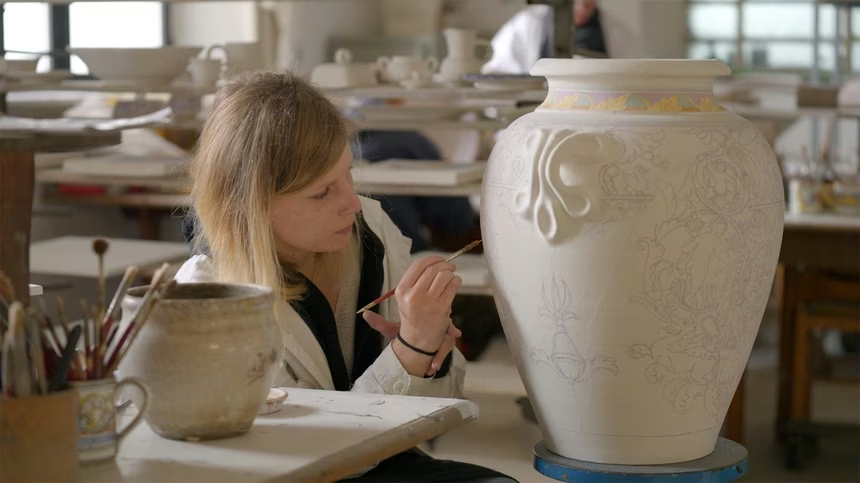
Made With Love
Made with Love celebrates the artisans keeping age-old traditions alive — an intimate journey into their workshops, kitchens, and the passionate hands behind extraordinary craft. Without them, a piece of our shared heritage would be lost.Providing Support for PBS.org
Learn Moreabout PBS online sponsorshipI'm Natalie.
I'm a harp maker from Galway.
Narrator: The earliest Irish harp was made more than 7 centuries ago.
Back then, Irish harps were played all over, but by the 18th century, they had fallen out of favor, and making them was a dying art.
I think there was so much knowledge which is forgotten, and there is so much experience which is forgotten.
Narrator: Natalie fell in love with the classic harp while doing research for her Ph.D.
in Irish studies.
There was just one problem.
Natalie: I couldn't afford it, basically.
[Chuckling] It was so expensive, so I thought I'd make a harp for myself.
Narrator: Since then, she's dedicated her life to making her own harps, copies of those that survive from centuries ago.
Natalie: I like to replicate, 'cause it gives me an idea of how things were done back then.
Narrator: It takes an entire year to make a harp, as Natalie slowly turns huge pieces of local Irish willow into an elegant instrument.
First, she marks the outline for the 3 key pieces of the harp: the soundbox, the pillar, and the harmonic curve, or neck.
It's the same basic blueprint harp makers relied on centuries ago.
Natalie: Very little is known, actually, about these instruments, why things were done that way, so I try to copy the way the old masters were doing it.
This is all the joys of being a female woodworker.
[Electric saw whirring] ♪ Narrator: After the pieces are cut, Natalie hollows out the soundbox, which amplifies the sound made by the strings.
She will often spend several weeks getting it just right.
Natalie: I'm just finishing the sides of the soundbox.
So the idea is to make them completely flat.
When I get to the fine bits, I start using hand tools quite a lot 'cause there's more control.
Narrator: The soundbox needs to be just the right thickness.
Too thick, it produces a dull sound; too thin, the wood will break, and then she'll have to start all over.
Natalie: It's not a kind of a science, you know.
It's just trial and error.
That's it.
[Different tapping sounds] Can you hear it here?
It's much louder and kind of brighter.
This dull section, I need to kind of improve it.
 New Season
- Drama

Hugh Bonneville stars in a crime drama inspired by one of the largest robberies in British history.
 New Season
- Drama

Benjamin Wainwright stars as Maigret in the contemporary adaptation of Georges Simenon's novels.

 New Episode




 New Season
 New Season
Support for PBS provided by: