
WETA Arts October 2023: Music, Art, and Live Performances
Season 11 Episode 2 | 28m 59sVideo has Closed Captions
Grammy-winning folk music duo’s cancer journey; street photography; behind 9:30 Club’s suc
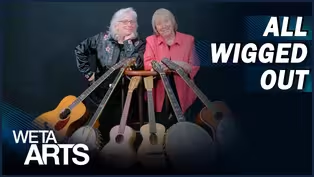
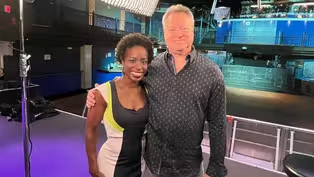
October’s episode introduces Grammy-winning folk music duo Marcy Marxer and Cathy Fink and All Wigged Out, their concert film about Marxer’s experience with breast cancer. Arlington-based street photographer Ashley Tillery takes viewers on a photo shoot, and host Felicia Curry gets a tour of the 9:30 Club with club owner and independent concert promoter Seth Hurwitz.
Problems playing video? | Closed Captioning Feedback
Problems playing video? | Closed Captioning Feedback
WETA Arts is a local public television program presented by WETA
WETA Arts October 2023: Music, Art, and Live Performances
Season 11 Episode 2 | 28m 59sVideo has Closed Captions
October’s episode introduces Grammy-winning folk music duo Marcy Marxer and Cathy Fink and All Wigged Out, their concert film about Marxer’s experience with breast cancer. Arlington-based street photographer Ashley Tillery takes viewers on a photo shoot, and host Felicia Curry gets a tour of the 9:30 Club with club owner and independent concert promoter Seth Hurwitz.
Problems playing video? | Closed Captioning Feedback
How to Watch WETA Arts
WETA Arts is available to stream on pbs.org and the free PBS App, available on iPhone, Apple TV, Android TV, Android smartphones, Amazon Fire TV, Amazon Fire Tablet, Roku, Samsung Smart TV, and Vizio.
Providing Support for PBS.org
Learn Moreabout PBS online sponsorship[Theme music plays] Hi, everybody.
I'm Felicia Curry, and welcome to "WETA Arts," the place to discover what's going on in the creative and performing arts in and around DC.
In this episode, Grammy-winning folk musicians Marcy Marxer and Cathy Fink made a film about dealing with breast cancer.
Marxer, voice-over: One of the most important things to remember is that we have choices.
Curry: A street photographer goes to Georgia Avenue to search for the perfect shot.
Woman, voice-over: On a day like the 4th of July, what I'm looking for is the intersection of people and history.
And Seth Hurwitz, the owner of the 9:30 Club, looks back on the iconic venue's history.
I want both the band and the audience to feel like "This is the best show I've ever seen."
It's all ahead on "WETA Arts."
[Theme music playing] [Folk music playing] Curry: Singer/songwriter duo Marcy Marxer and Cathy Fink are Grammy-winning musicians known for folk, bluegrass, and children's music, playing guitar, banjo, mandolin, ukulele, and more.
After more than 30 years of gigging, teaching, and making albums, they have also made a concert film called "All Wigged Out."
We found them at the film's local premiere at the Silver Spring Cultural Arts Center.
Fink: Tonight's event is the celebration and DMV premiere of our film called "All Wigged Out."
The film is a comedy musical theater piece about Marcy Marxer's experience with breast cancer.
That's not generally an uplifting subject, but there are things in cancer treatment that seem odd or unusual, and we spent a lot of time poking fun at all those things.
♪ We're gonna hold each other up ♪ ♪ We're gonna lift each other high ♪ Fink, voice-over: It's important to know that this is a film about hope, about love, about advocacy, about finding your own power as a patient or a caregiver.
It's not a bummer.
Our event tonight is also a fundraiser for a fabulous local organization, Hope Connections for Cancer Support.
Woman on microphone: Let's find our seats so we can get started.
Marxer, voice-over: The film is about how you make adjustments.
You really don't know what's coming next.
You have to deal with fear, anxiety, and keeping your life going all at the same time, so that's why I wrote the "All Wigged Out" tune.
♪ A panic struck my mortal soul ♪ ♪ And just like that began to roll ♪ ♪ Around my stomach like a lump of coal ♪ ♪ It burned and churned and twisted round ♪ ♪ Till all that's left was just the sound ♪ ♪ Of the wind chimes, bell inside the door ♪ Both: ♪ All wigged out ♪ ♪ The temperature's risin' ♪ Both: ♪ All wigged out ♪ ♪ There'll be some compromisin'... ♪ Marxer, voice-over: One thing that I was doing in this project was trying to find ways not to be a victim, so if I could poke fun at something, I was on top of it.
Fink, voice-over: As Marcy went through treatment, we were, both separately and together, keeping all different kinds of notes, and those notes turned into monologues, they turned into skits, they turned into pieces that eventually we realized, "Oh, this is a musical."
A word search puzzle book.
Marxer, voice-over: When I wrote the monologue about us all looking like family, I was really just reflecting on the chemo room that I was in and the people that were in it.
I was in Sibley, where, at that time, we all sat in one room and there were a bunch of big chairs, everybody had IVs, and as time went on, we looked more and more alike.
I just felt a kinship with every person there.
Cancer patients have so much in common.
It's really almost like having new family members that you've never met.
We all start to look alike right away.
At first, we look like this.
[Scattered audience laughter] But as your hair, eyebrows, and eyelashes fall out, and you look a little puffy from the steroids that fool your body into accepting the chemicals, well, there's a look to that.
We all look related, regardless of our skin color or background, and we are related.
I'd see somebody who was a little puffy, obviously in treatment, and we acknowledged each other, and it was very, very powerful to feel like we were part of a family with the same goals, the same hopes, the same dreams of being in remission.
♪ It takes two to tango ♪ ♪ Two for a pair ♪ ♪ Two to make twins ♪ ♪ Two rocking chairs ♪ ♪ One more time... ♪ Fink, voice-over: It was a very organic process.
We were very open to every direction that the muse might come.
♪ You steal my ice cream ♪ Yeah.
Both: ♪ That's part of the deal ♪ ♪ I have to slow ♪ ♪ Down for me ♪ ♪ We get to do it again ♪ It's not just doing something for the sake of doing something.
It's a heck of a lot of work.
♪ You complete my-- ♪ You got to sing the line.
Dang it!
[Laughter] Fink, voice-over: We had almost a walk-through... and two times to film the whole show.
And now, with 41 years together... [Laughter and applause] [Rim shot] we're aging fast, right here in front of your eyes.
[Audience laughter] Fink, voice-over: The live audience is what makes it come alive.
It would never have worked in a different scenario.
Marxer, voice-over: I think it's really important for everyone to see it because everyone in life is gonna be touched with some kind of disease.
[Audience cheering] I think this can provide people's first experience with knowing someone who's a patient, knowing what to say, knowing how to chat with medical personnel.
Now it's time to talk to our panelists, and then we're going to have some time for more questions.
Fink: We've been doing programs in all different kinds of places where people have requested for us to come and bring the film and show it.
Marxer and Fink: ♪ Brother, lay your head down ♪ ♪ Find a little peace along the way ♪ We, for years, have done educational projects, things that reach out to community.
It's kind of what our lives are about.
♪ Find a little peace ♪ ♪ Find a little peace ♪ Folk singers really love where we can create a piece of art that has value, but can also help a big community.
[Cheering] Woman, voice-over: I absolutely loved it.
It was fun.
It was...sweet.
They were the most endearing couple, and their music was fantastic.
Woman, voice-over: You could have heard a pin drop, except when people were laughing or clapping or crying.
It was an ability to get the word out that you don't have to do this alone, to help people at their lowest moment and help them help themselves.
What more could you want?
I think one of the most important things to remember about this film and this project is that we have choices, and every day, we make the best choice we possibly can.
Tomorrow, we may be set with a whole different set of circumstances, and we have to go through that process again of making the best choice we can for that day.
Curry: "All Wigged Out" is now streaming on many video on-demand platforms and is also available on DVD.
For more information about how to see the film or even book a private screening, go to cathymarcy.com/allwiggedout.
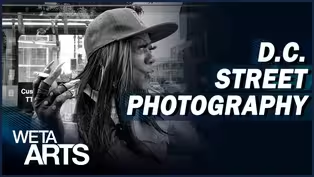
When Ashley Tillery discovered street photography, she found her calling.
She is capturing and amplifying images of the black community in the DC area.
To find out why, we followed her on a shoot on July 4th.
Woman: All right.
Tillery: And everybody get as close together as possible.
Tillery, voice-over: I'm a photographer, not by trade or anything, but just by passion.
The focus of my body of work is communities of color wherever I find them.
Tillery: Thank you, guys, so much.
Thank you!
Tillery, voice-over: I really focus on street portraiture.
[Camera shutter clicks] Street photography is a medium where you're looking for chance moments that are inherently ephemeral, and you're capturing them for future generations.
Can I get you guys right here?
Tillery, voice-over: With street photography, you have to show up as your authentic self because those interactions are sometimes very short.
It's like you guys have done this before.
[Both laugh] Tillery, voice-over: What you need to be a street photographer is you.
You and, obviously, a device to capture an image...
Stunning.
and when you are engaging somebody on a human level... And then you kinda look towards her.
it's an act of trust.
Perfect.
Thank you, guys, so much.
Tillery, voice-over: In portraiture, the photograph is not what happens in the camera.
[Camera shutter clicking] The photograph is what happens on either side of the camera.
It's a document of a human connection.
Curry: Tillery got lots of experience meeting new people while she was growing up.
She moved six times before she graduated high school.
Tillery: My mom's an attorney, and my dad's a retired colonel.
My growing-up experience as a person of color was actually very isolated.
Fast-forward to when I went to Tuskegee University.
I was immersed for the first time ever in a Black life.
I saw that there was more to the Black experience than either my parents or what was presented on the news at the time.
My parents got me these cameras, uh, because they wanted me to stop doing street photography because they thought it was dangerous.
Heh heh!
So they were like, "Hopefully, this would motivate her "to move into, like, just working in a studio, in a sanitized environment."
When people see a camera like this come out, people tend to become more wary.
All right.
It makes it a challenge to get the intimate shots that I really look for.
In some ways, shooting with a cell phone is the most American thing you can do.
A cell phone is a very democratizing piece of equipment, and anybody who has a phone has the opportunity to tell their story and to tell it honestly.
When I go taking pictures on a day like the 4th of July, what I'm looking for is the intersection of people and history.
[Camera shutter clicking] It's really important to go out there and capture images that provide narratives that tell more inclusive stories, more diverse stories that I think are truer to what it means to form a more perfect union.
We're going to start pretty near the, uh, Georgia-Petworth Metro station.
And Georgia Avenue has a tremendous amount of history.
You have the Sankofa bookstore over there.
You have the Howard Theatre.
You have Howard University itself.
And I wanted to know if I could take your portrait.
Tillery, voice-over: What I'm looking for in a subject, first and foremost, is something in our shared humanity and history that sets something off in me.
And where are you from?
DC?
Yes, I am.
Tillery, voice-over: The next thing is what type of backgrounds do I have to pull from here, and I guess the third thing is do they seem amenable to me asking them?
You have Frederick Douglass hair, which is very appropriate on the 4th of July.
Tillery, voice-over: I think, for photographers, Black photographers, especially... Look at me with your eyes.
[Click] photography can be a weapon.
It's a voice, it's an opportunity to say that the narratives that you present are not true and to reassert the place of African Americans in the American story, to put us in a narrative in a way that reflects our inherent dignity and worth.
So that's a large reason of why I take the, um, pictures I do.
In truth-- Hello.
I am so sorry to bother you.
I saw you walking down the street, and you are absolutely beautiful.
I know that's crazy to say to a man.
Do you mind if I take your portrait?
All right, cool.
And just stand forward in the door.
Awesome.
Tillery, voice-over: The stories sort of present themselves, especially when you're on Georgia Avenue, right?
I didn't even see your braces!
Tillery, voice-over: When we think about braces, we usually think about sort of an innocent time of life, so having him talk about being in jail, but also having those braces, I think it serves to humanize him and say, you know, maybe this person isn't as dangerous or menacing or whatever as the larger society may choose to view him.
I really appreciate you so much.
Thank you.
Curry: Tillery started street portraiture in response to the way photos of slain teenager Trayvon Martin were used by news outlets.
Tillery: What I found so disheartening was not only was this another Black boy gone, but how they chose to portray him in the media, and I started taking photographs of those individuals that I encountered in the neighborhood.
[Camera shutter clicking] And I think part of the exercise for me was processing the national moment that we found ourselves in.
And for me, during that time, it was not only asserting the value of Black life to myself, but raising the grandeur and inherent dignity of everyday life.
It is very important that we control our own images.
[Camera shutter clicking] Curry: Tillery displays her work in galleries on the Web and on Instagram.
Tillery: The point of putting the images on Instagram goes back to Frederick Douglass, of all people.
Frederick Douglass actually sat for a lot of portraits during his time.
And the reason he did that, according to him, is that what the camera sees is the truth, and so, when he would sit down and take those photographs, it was, in a way, calling everything else in the media landscape a lie.
[Camera shutter clicking] The point of posting the images to Instagram is to provide a counternarrative to much of what you see in the news and to ensure that people of color occupy the imagined spaces that are going to be created by AI.
AI's a technology that can only produce results based on what went before, and so I do think it's incredibly important to have a wide variety of images of people of color present on the internet, and so what I'm hoping is that the worlds that we create on the internet don't mirror the same historic inequalities that we've had in this world.
[Camera shutter clicks] It's participating in the dreaming and the narrative creation.
I am so sorry to bother you.
My name's Ashley.
I'm a photographer.
You look so cool.
Thank you.
Do you mind if I take your portrait?
Oh, sure.
It's always great when I meet someone like Angela, where all those various threads come together in a single person.
Not only was it the 4th of July, but this was a Black woman who owned a fireworks stand with her brother.
She was clearly very patriotic, but she was also wearing a "Black Lives Matter" T-shirt, right?
I hope the people who see the pictures stop and consider, "What do all these things mean together?"
On one hand, you want to celebrate liberty.
On the other hand, you realize that if you are not free to survive in your skin, that's not a form of liberty, and it's definitely not life or the pursuit of happiness.
Beautiful!
Now one with no smile, just... [Click] Tillery, voice-over: For me, street photography is not just taking pictures of people, but also better understanding myself and my history in the context of this great American experiment.
Ashley Tillery is a member of the DC Street Photography Collective, and you can see her work on their website, thedcspc.com.
And if you want to meet others discovering street photography, check out Exposed DC, which connects photographers of all levels with networking, mentoring, and exhibition opportunities at exposeddc.com.
Washington, DC is considered a mecca for punk rock, the loud countercultural music genre.
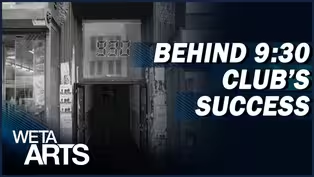
Since opening its doors in 1980, the 9:30 Club has been a staple of this scene.
That same year, a young man named Seth Hurwitz started a concert booking company called It's My Party, or I.M.P.
for short.
Hurwitz went on to book for the 9:30 Club and eventually bought the place in 1986.
Since then, Hurwitz has presented more than 20,000 events and amassed a small empire of concert venues.
I visited Seth Hurwitz at the 9:30 Club to learn about this historic spot.
Hi, Seth.
Hey.
So good to see you.
Thanks for coming.
Welcome to "WETA Arts."
Shirley Manson: ♪ I'm only happy when it rains ♪ ♪ I feel good when things are going wrong ♪ Curry: Tell us a little bit about where we're standing right now.
Well, I still call this the new 9:30... Yeah.
'cause we started on F Street... and that was small and smelly and not comfortable, so we moved it.
This is a place that used to be the WUST Radio Music Hall.
Shirley: ♪ Oh, oh, oh... ♪ Hurwitz: From the moment we opened, it was just...bananas.
♪ Oh, oh, oh, oh ♪ [Song ends, crowd cheering] Curry: What do you say to someone who's never been to the 9:30 Club?
There's nothing like seeing a band in a small place.
We opened the Anthem.
We wanted to make it like the 9:30.
It's obviously bigger, but to get that feel, that vibe.
The new one next door, which is the Atlantis, is a re-creation of the old club.
So these are postcards with all the shows... Wow.
from the old club... Wow.
all these bands you can look at and go, "Whoa," you know, that became big.
So this was the backbar at the old club.
Why was this the thing that you wanted to bring?
I'll tell you why this.
'Cause people took everything else.
They were carrying out toilets, everything.
In a club, in a bar, I think this is...
I don't know what else you bring.
the perfect thing to bring with you.
You hope to bring the vibes.
And this has got to bring back a lot of memories from how you got started with the club.
Well, I actually did not start the 9:30 Club.
A woman named Dody Bowers at the time-- she's now Dody DiSanto-- created the 9:30 Club.
So I am merely a custodian of what she created, and Dody just encouraged and nurtured this true alternative society.
You can be whoever you are here, and you are welcome.
And I love that, and she taught me that.
And we've amassed a real family.
Some people have been working for me 20, 30 years, and that's the way I like it, and I think that's what bands like most.
The thing I hear best is "Your people were so nice."
Mm.
"Second we got there, they took care of us."
You hear that from the audience, too.
That's what I want to hear.
I remember I went to shows.
I'd get my dad to go get me tickets and waiting in line, going to the show, getting close to the stage, and then, when the band goes on, just how exciting that was.
So that's the experience I want to create for people.
Grace Potter: ♪ We are, we are, we are ♪ ♪ Alive tonight ♪ ♪ Whoa, yeah ♪ ♪ Ow!
♪ Hurwitz: I want both the band and the audience to feel like "This is the best show I've ever seen," or, in the band's case, "This is the best show on the tour."
["Alive Tonight" continues] How do you preserve the history and the legacy of the 9:30 Club?
You know, um, we got the Hall of Records, of course.
Mm-hmm.
[Rock music playing] For every show, we have a record, literally.
Where's the first one?
Well, the first one, then, would be at the beginning.
At the beginning.
Tiny Desk Unit.
The guy who was in that band is Bob Boilen, who does that show "Tiny Desk Concert"... Mm-hmm.
because his band was called Tiny Desk Unit.
And they were the first band to actually set foot on stage in the old 9:30, so when we opened the new one, we had his band open that, and when we opened the Anthem, we had him open that.
Curry: What's the one you go up to and say, "Oh, man, that show, I remember it"?
Iggy Pop, for example.
Whoa.
He destroyed the place.
I mean, I couldn't leave.
[Sings indistinctly] Hurwitz: And I think about creating history... Hmm.
more than celebrating history.
Curry: What are the things that make this venue so special?
I mean, I'm looking at lights, I'm looking at signs.
Well, the parquet floor, clearly.
Ha ha ha!
We had an acoustician come in, and he had us redo the air-conditioning ducts with acoustic inside.
I've heard about a rolling stage.
Ah, yes.
So, when we moved, we didn't want to stop getting the little bands, 'cause this place is 1,200, and you certainly don't want the bands to feel like they're playing too big a place.
Right.
And a guy who used to work for us named Chad, he said, "Well, why don't you just move the stage up?"
[Chuckles] So, for me, when we opened, the first show was exciting and all that, but I couldn't wait till we did a small show, to see how it looked.
And unless you really took note of where this is now, you would not know the difference.
[Reggae music playing, indistinct singing echoes] How do you decide which bands come here?
So you have to figure out what kind of business they're going to do.
Mm-hmm.
What's the right ticket price, what's the right venue, and then if they belong here.
We want the really cool bands.
[Rock music playing] Hurwitz: If you want to get the Modern Englishes or the Red Hot Chili Peppers, then you better be the cool place, where the cool kids hang out.
We sell at all general admission, and I could get a lot of money for selling the--right there.
I don't believe in it.
I think everyone should get a fair shot, and everyone's in the same room together.
[Crowd cheering] So... Look at this space.
Yeah, this is my spot.
Wow.
What an incredible vantage point.
I don't get to see the light show head-on... Mm-hmm.
but I get to look at the drummer, and I play drums, so I love watching the drummer.
Curry: What's a crazy thing you've seen from this vantage point?
Hurwitz: So, at the time, Brad Pitt and Jennifer Aniston were a rumor.
Hmm.
This was unconfirmed, but they were here together on that balcony, and I came out to have a look just to see if it was true.
I came out, and they were there.
Of course.
I didn't take the picture, but that became the picture that broke that story open.
Right here at the 9:30 Club.
On all the newsstands, my balcony, this railing.
Ha!
Hurwitz: Occasionally, if I badger someone long enough, I get to play drums with them... Curry: Heh!
very occasionally, but it's the thrill of a lifetime when I do 'cause I actually sit in that seat and I'm like, "Wow!"
Trouble Funk: ♪ Play that funky music, white boy ♪ ♪ Lay down the boogie ♪ ♪ And play that funky music ♪ ♪ Till we die ♪ [Crowd cheering] Big Tony Fisher: ♪ Whoo ♪ [Shouts indistinctly] Curry: Tell me about the legacy that you want to leave through the 9:30 Club.
The thing about me is I'm not so much interested in yesterday.
Hmm.
I want to create tomorrow.
By the time people get here, they're already pretty famous, but they were all tiny bands at one time.
[Rock music playing, crowd cheering] When you know a band and they're nice, and you've seen them every step of the way, you know, it feels like family.
It's a great feeling.
Seth, thank you so much for joining us on "WETA Arts," and thank you for taking us on a tour of the 9:30 Club.
Well, it's exciting for me to have you guys here.
Thank you.
Thank you.
Curry: The 9:30 Club is located on the corner of 9th and V Streets Northwest.
Check out who's playing at 9:30 Club and other I.M.P.
venues by visiting impconcerts.com.
Here's a thought from Presidential Medal of Honor and Kennedy Center Honors recipient cellist Yo-Yo Ma: "Passion is one great force that unleashes creativity "because if you're passionate about something, then you're more willing to take risks."
Thank you for watching "WETA Arts."
Be well, be creative, and enjoy the art all around you.
I'm Felicia Curry.
Announcer: For more about the artists and institutions featured in this episode, go to weta.org/arts.
[Theme music playing]
Video has Closed Captions
Clip: S11 Ep2 | 9m 1s | Step back in time and dive into the rich history of D.C.'s 9:30 Club. (9m 1s)
Video has Closed Captions
Clip: S11 Ep2 | 7m 22s | A lighthearted yet poignant exploration of cancer by Marcy Marxer and Cathy Fink. (7m 22s)
Preview: WETA Arts October 2023
Preview: S11 Ep2 | 30s | Grammy-winning folk music duo’s cancer journey; street photography; 9:30 Club’s success (30s)
Street Photographer Ashley Tillery
Video has Closed Captions
Clip: S11 Ep2 | 10m 25s | Discover the powerful world of street photography with Ashley Tillery. (10m 25s)
Providing Support for PBS.org
Learn Moreabout PBS online sponsorship

- Arts and Music
The Best of the Joy of Painting with Bob Ross
A pop icon, Bob Ross offers soothing words of wisdom as he paints captivating landscapes.









Support for PBS provided by:
WETA Arts is a local public television program presented by WETA