
Making Schools Safe For All Students
Clip: Episode 4 | 9m 44sVideo has Closed Captions
Ellen has dedicated herself to fighting to end corporal punishment in schools.
Ellen has dedicated herself to fighting to eliminate corporal punishment from schools and change how schools discipline students.
Problems playing video? | Closed Captioning Feedback
Problems playing video? | Closed Captioning Feedback
Funding for PBS American Portrait provided by Anne Ray Foundation, Target, and the Corporation for Public Broadcasting.
Support provided by:

Making Schools Safe For All Students
Clip: Episode 4 | 9m 44sVideo has Closed Captions
Ellen has dedicated herself to fighting to eliminate corporal punishment from schools and change how schools discipline students.
Problems playing video? | Closed Captioning Feedback
How to Watch PBS American Portrait
PBS American Portrait is available to stream on pbs.org and the free PBS App, available on iPhone, Apple TV, Android TV, Android smartphones, Amazon Fire TV, Amazon Fire Tablet, Roku, Samsung Smart TV, LG TV, and Vizio.
Buy Now
Providing Support for PBS.org
Learn Moreabout PBS online sponsorship- Now is the time to end corporal punishment in the state of Mississippi, paddling Black children in particular.
Schools should be safe spaces for children to attend, but as long as we have state-supported violence inside of schools, it is not a safe place.
I've been doing this work since 2001 to end corporal punishment in Holmes County where I live.
[soft music] This is our center where we carry out the majority of our work with the young people.
Here's the kitchen 'cause we cook for our children.
Nollie Jenkins Family Center.
"There is no excuse for abuse."
Nollie is my grandmother.
She is the grandmother of 28 grandchildren.
She was a nurturer.
She worked hard.
She was definitely a religious woman.
Here is what we call the youth room.
This is where our young people hang out for the most part.
And my grandmother was always that person in the community who would take in other people's children if they were having difficult times.
That's what this center is about, really building this community to build youth leaders, to support parents, to take care of children when parents fall on hard times.
This, I love.
It's called the Wheel of Discipline.
Let's see.
"Paddling."
There used to be a principal that said, "Take the wood or go to the hood."
He's gone now, and we never want to see him again.
This is the energy that we wrap ourselves in.
So when the world gets to be an ugly, ugly place, we can come in here and know that we can find some sweet, sweet shelter.
The news about Breonna Taylor-- no one was held responsible or accountable for her killing, you know, and as a Black woman, you know, this--it becomes so intense, this, you know, fight for our freedom and losing sisters and, you know, folks not valuing the lives of Black women and Black girls.
That's why it's so important to end this corporal punishment now more than ever, you know?
It's all tied together.
Black lives matter, and Black women's lives matter too, and Black girls' lives matter.
We've got to stop this madness.
- Other folks who have questions and/or comments that they wanted to offer in response to something in particular you see in the draft legislation?
- I do.
I just want to know, what do I need to be doing on the ground?
What cape do I need to put on?
You know, I'll become Superwoman.
I'll become anything I need to as long as we can ensure that corporal punishment is taken permanently from the federal level, therefore it will have a ripple effect at the state level.
- Great question.
I mean, exactly what you said.
You know, we can't be talking about these issues with, you know, if we're trying to limit suspensions and we still have corporal punishment in some states-- it's ridiculous.
[line trilling] - Your call has been forwarded to an automatic-- [beep] - Hey, Maddie, it's Ellen, Ms.
Ellen, calling to invite you and your sister and your mom to our event on tomorrow night.
It's a sleepover for the girls.
So call me.
Thanks, bye-bye.
[beep] Hey, Shelby, it's Ellen.
How're you, darling?
Look, Shelby, I'm calling to invite you up to a girls and women event.
Give me a call back.
I'm around.
[beep] Hey, Diana, how are you?
I hope you're well.
Call me.
It's important.
Take care.
Bye.
- There is definitely a relationship between--particularly white supremacy and continued violence in particularly Southern states.
So we've got to raise that issue and openly talk about it.
Grandma always talked about this train that leads from the schoolhouse to the jailhouse, and how do we derail that?
Here is Holmes County prison.
When we look at the data, both around corporal punishment and the areas where there was intense lynching, Holmes County and through the Mississippi Delta where we do our work was one of the primary areas where there was a great deal of lynching.
I don't know if Holmes County, though, both the white and Black community, are ready for those discussions, but it's something that I will continue to talk about.
Holmes County Courthouse.
It's a beautiful courthouse.
But on the other side is a Confederate statue.
All right.
Here we are.
Part of the complaint from teachers is that they don't have a tool or resource to use when it comes to discipline inside the school, so we want to give them that.
We want to look at research and justice models.
We want to look at peace circles.
We want to look at peer mediation.
And so that will be good because then we can work on some strategies that ensure that our children are safe inside our public schools.
So I really hope that I can form a partnership with the school district to make that happen, but if I don't, you know, we'll continue to do the work that needs to be done here.
You know, Grandma always say you prepare for war in a time of peace.
- [babbling] - I am invested in this community, and I'll do what I need to do to ensure that young people and parents have the kind of support that they need to become the leaders of tomorrow.
And that's really what this is all about.
It's a lot to get done before Saturday.
We're gonna call it a "Girls and Women Loving Circle."
Saturday the 26th through Sunday.
So what all needs to get done?
Might have to go shopping.
We're gonna do a sleepover.
Maybe five to six girls.
I just still have to keep in mind social distance.
Gotta get my plants out of the carport.
I really want to do something this coming weekend that leaves them with the memory of things that they can do for themselves, a way to take care of themselves.
I feel really good about what's happening.
Done a lot of preparation.
It'll be a good thing.
I'm really looking forward to it.
It's been a long time since we've been together like this.
So... I guess I'll hit it in the morning, see what happens.
I want to appreciate all of you for coming.
Artists at work!
I'm really pushing for mothers to support their daughters, whatever that means, you know.
If that means rallying, if that means talking to their representatives, if that means saying to schools, "We need to look at reforming education."
- Uh-oh.
Back on you.
[laughs] - This is a difficult time.
We need to really take care of ourselves, but at the same time work hard to make sure that we reform policy that has a negative impact on us, and, certainly, that's one of the goals that we're trying to get accomplished this weekend.
- What would discipline look like?
- Discipline looks like spanking.
But no one has asked the question.
- That's right.
- But we gonna send 'em to the house where Mama got a drug problem, there's violence going on, and we expect them to come back what kind of way?
both: Same way.
- Same way.
What are the alternatives?
For those of you who are older in this room, okay?
Think about when you were coming up.
What was some of the other things that they did instead of spanking?
- Took away... - Yeah.
- Cell phone.
- The phone.
- Took away the TV.
Can't watch TV.
- Can't go outside and play.
- You can't go outside and play.
- Can't have no company.
- Can't have no company.
Those were some of the things that we did, and now I don't hear any of this coming from young people.
We go straight to spanking, expulsion from school, sending kids home... Overall, I'd hope that students would participate, I would hear their voices more than I did.
I think a lesson that I learned out of all of that is that we've got to start having discussions around alternatives to discipline.
We've got to talk about restorative practices.
We've got to talk about positive behavior, interventions, and supports.
As parents, advocates, and organizers, we really--and I can speak for the work here-- we've got to start engaging our community in developing a process that is meaningful for our children and that our children can engage in.
Got it?
Holding it?
We are about to be in the midst of a storm.
I'm sitting outside, but I wanted to record this because I am so excited.
I just got off the phone with Representative Mickens, who is the author of House Bill 12, which is the elimination of corporal punishment.
We talked about getting the language that supports what we want inside that legislation.
So he's really given me some inspiration because yesterday I was tired.
So I'm gonna get off now because I have some work to do, but I'm really excited.
We're moving this forward, and it's time.
Now is the time to move it forward.
Thanks.
Bye.
An Activist Fears For Her Family's Safety
Video has Closed Captions
Clip: Ep4 | 1m 2s | Lex has faced threats agains herself and her family due to her activism work. (1m 2s)
An Activist Shares Their Journey
Video has Closed Captions
Clip: Ep4 | 3m 3s | An activist explains how they got involved in the Black Lives Matter movement. (3m 3s)
Confronting The History Of Racial Violence In America
Video has Closed Captions
Clip: Ep4 | 2m 28s | People across the country confront the history of racial violence in America. (2m 28s)
Ending Police Brutality In Utah
Video has Closed Captions
Clip: Ep4 | 4m 39s | Lex, founder of BLM Utah, is determined to get her Police Reform Platform passed. (4m 39s)
Video has Closed Captions
Preview: Ep4 | 30s | First-person stories take you inside the movement for an antiracist future. (30s)
A Housing Rights Activist Shares Her Story
Video has Closed Captions
Clip: Ep4 | 8m 27s | A housing rights activist advocates to fill vacant public housing units. (8m 27s)

People Share The Importance Of Self Care
Video has Closed Captions
Clip: Ep4 | 1m 41s | Americans share how self care helped them get through the uncertainties of 2020. (1m 41s)
A Playwright Hopes To Start A Dialogue About Race
Video has Closed Captions
Clip: Ep4 | 4m 2s | A Vietnamese-American playwright hopes to start a dialogue about racism through her art. (4m 2s)
Video has Closed Captions
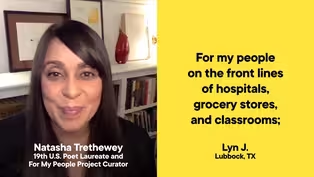
Clip: Ep4 | 6m 58s | A crowd-sourced poem titled, Remix: For My People. (6m 58s)
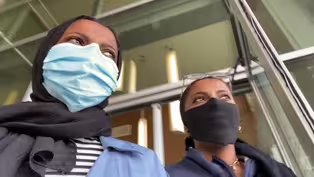
Sisters Explain How Their Identity Influences Their Activism
Video has Closed Captions
Clip: Ep4 | 2m 26s | Twin sisters explain how the different facets of their identity affect their activism. (2m 26s)
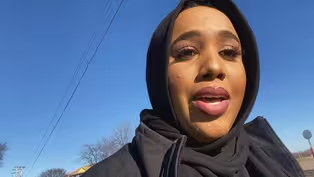
A Student Advocates To Keep Police Out Of Schools
Video has Closed Captions
Clip: Ep4 | 4m 17s | A student makes the case for the removal of school resource officers. (4m 17s)
Providing Support for PBS.org
Learn Moreabout PBS online sponsorship











Support for PBS provided by:
Funding for PBS American Portrait provided by Anne Ray Foundation, Target, and the Corporation for Public Broadcasting.