
Back to the Sky
Special | 12m 43sVideo has Closed Captions
A licensed falconer transforms her home and yard into a a sanctuary for injured and displaced birds.
Driven by her passion for raptors, a licensed falconer transforms her home and yard into a a sanctuary for injured and displaced birds of prey. She discovers that offering them a second chance at survial is simultaneously reshaping her own life.
Problems playing video? | Closed Captioning Feedback
Problems playing video? | Closed Captioning Feedback
Back to the Sky is a local public television program presented by WETA
Back to the Sky
Special | 12m 43sVideo has Closed Captions
Driven by her passion for raptors, a licensed falconer transforms her home and yard into a a sanctuary for injured and displaced birds of prey. She discovers that offering them a second chance at survial is simultaneously reshaping her own life.
Problems playing video? | Closed Captioning Feedback
How to Watch Back to the Sky
Back to the Sky is available to stream on pbs.org and the free PBS App, available on iPhone, Apple TV, Android TV, Android smartphones, Amazon Fire TV, Amazon Fire Tablet, Roku, Samsung Smart TV, and Vizio.
When we get birds that are injured that we feel like we can help.
There's a whole process.
And anywhere along the way in the process, you can lose, but you can also win.
So it's nice to see them progress.
And we can kind of see the whole healing process as we're going through it.
It's really nice to see the birds go from being so debilitated that they can't stand and they're just, in terrible pain and gradually improve and show their real character and their, fight to survive and live.
My name is Suzanne Shoemaker, and I'm the founder and director and president of our Moon Raptor Center.
It's okay.
It's okay.
It's okay.
We do a rescue, rehabilitation, and, release of injured birds of prey.
I've been doing rescue and rehabilitation for 22 years, starting in 2002.
Back then, I was, it was just taking in a few birds, and now we're taking in about 500 a year.
We usually name the birds after the people that find them.
The barred owl.
Cole was found in a chimney.
One of our volunteers, actually, one of her neighbors, had, discovered it there.
They had lost a tree the year before.
And then after this tree fell down, they discovered that the owls had tried to move into the chimney to nest.
So this one needed rescue.
And it was in there for only about, a day or maybe two days at the most.
But that was long enough for it to get covered in soot and get some damage to its eyes.
So it has corneal ulcers in both eyes.
And which we are treating.
And we're giving him time to remove the soot.
And then we expect we'll be able to release him back where he came from.
And hopefully in time for nesting season.
Snyder is a juvenile red tailed hawk.
He came in in August after being hit by a car, and it shattered his radius and ulna in his wing.
We wrapped his wing and started care for him with pain medications and what have you to see if we could try and heal his wing.
Legler was a call from Glen Burnie.
He's a little Cooper's hawk that was, found in there on their fenced in yard.
And, couldn't get it.
Couldn't fly, couldn't get over the fence.
Sent one of our rescuers, Nancy McDonald, to fetch him.
He arrived at night, and he was.
We could see immediately that he had a fractured wing.
We, had to wrap that quickly to prevent any further damage to that wing, because it was already an open fracture and it was bone exposed.
So that's a dangerous thing because you can't repair them if the bone gets, gets too exposed and gets an infection or dries up.
We just took X-rays today, and we saw that he was shot.
So now we know that that he was the victim of a gunshot.
We were able to get it to a surgeon, but unfortunately, when the bird was on the table and they went in to insert a pin to stabilize the wing for healing, they noticed that the bone was already dying and it was compromised, and it was not going to be successful.
Rehabilitation effort.
So the doctor made the decision at that time to euthanize the bird for the best interest of the bird.
It's a worthwhile thing to do, rescue and rehabilitation, but it is also a very painful at times because it's, you can see all of the all of the suffering and death.
It's out there and you can't save them all.
There's always going to be birds that die and or they have to be euthanized because they're in such bad shape that they can't be rehabilitated.
So it's very difficult, at times, but it's it's a passion I have for the birds that keeps me going.
McKenzie is a broad-winged hawk that came to us back about five years ago, presumably hit by a vehicle because she was found right on the side of the highway, route 70, going out towards Hagerstown.
She was in bad shape.
She was just a juvenile at that time.
And she was about had just recently fledged because we could tell her some of her feathers were still growing in.
We got her in and she had a, she had a very serious eye injury that it was so badly damaged that the eye had to be removed.
And in that case, you cannot ever release a bird because they they need to be able to see, all around them and be able to have binocular vision to hunt.
She was going to be either had to be using Ised or had to be placed.
And we decided to to place her here.
She's a she's now a falconry bird.
She's on a felony permit.
She's very tame because we she got because we got her as a juvenile.
She's very easy to work with.
And she'll make a good ambassador bird.
So that's, McKenzie.
She's now an adult, and she's beautiful.
And she's very calm and comfortable with people.
Suzanne has been a mentor to me.
She has a true love and desire to help birds and help return them to the wild.
It's been a real gift to be able to learn from her and to understand what it takes to take a bird from intake.
When they're injured all the way to release, and all every step of the way.
We live in Boyds, and I've always worked out of my home because we never could afford to have any place else to do work.
And so my basement has become a the rehabilitation center, and that's where we have, where we, where we treat birds.
Over the years, we've built several outbuilding structures that we can use to house them in, in the process of their rehabilitation and give them a little more exercise as they recover from their injuries.
When I first started learning about wild animals and the way they live, I always was on the side of the victim, the animals that were killed by predators.
But, as I grew older, I know, and I learned that that was the way they lived.
The way they had to live.
They couldn't live any other way.
So I could justify my passion for birds of prey.
Birds of prey are just impressive creatures.
They're huge compared to their victims.
They have, just a magnificent look about them.
They have strength.
They have, you know, sharp talons.
They have a lot of weaponry there that you have to deal with and, very keen.
They know what's, around them all the time.
They perceive things that we we can never dream about perceiving because they just have incredible, hearing and vision that we just don't share with them.
Birds of prey are just, so well adapted to what they do in all animals.
But I guess being the top predators, they are the most impressive.
She had sores on both eyes.
Corneal ulcers.
She had, very sooty feathers.
And so she needed to get cleaned up and, heal a little bit.
But now she's ready to go, we think.
But we want to test fly her and make sure she's flying well enough to be released.
So we're just out here testing, his flight to make sure that he's good to go.
I am applying a, federal band.
On to her.
This is a one of a kind band with numbers on it that, only she will be wearing.
And so if she is, if she's found either dead or alive and at any other time in her life, this can be reported to the bird banding laboratory.
And they will tell you the history of the bird from from at least as much as they know of it.
And, and, they'll tell me what the what the situation is in which she was found and where she was found.
So it'll be interesting.
It's interesting for our our purposes to know what happens to these birds when they go back in the wild.
And so this is one way we might be able to get some information.
Snyder was a candidate for euthanasia, but we wanted to try and we wanted to see if we couldn't possibly help rehabilitate him.
And we were hoping that the fractures would heal correctly.
And the only way we would know if he would be able to, be released is by flying him and test flying him several times, and trying to build up strength in that wing to make sure it was strong enough to catch prey in the wild.
His wing is healed and he's gone through some reconditioning, exercises, training.
And then, now he's he's all fit and ready to go.
But we had to do some finishing touches today to get his his, talons sharpened in his beak, sharpened up and everything, ready so that when he gets back in the world, he'll be a successful hunter.
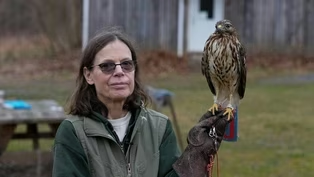
A licensed falconer transforms her home and yard into a a sanctuary for injured and displaced birds. (1m 1s)
Providing Support for PBS.org
Learn Moreabout PBS online sponsorship








Support for PBS provided by:
Back to the Sky is a local public television program presented by WETA